 HYGO News
 Bessent: Chinese Delegation Said Biden 'Ignored Their Obligations'; 'China Shock Gutted U.S. Manufacturing -- Strategic Decoupling Coming'
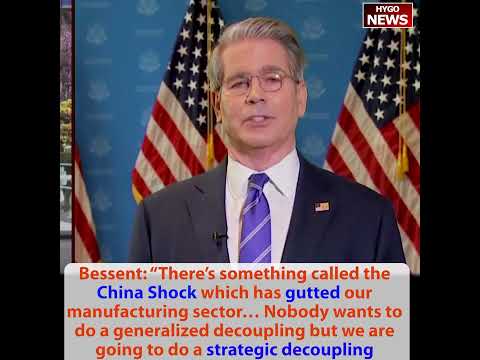
Bessent: Chinese Delegation Said Biden “Ignored Their Obligations”; “China Shock Gutted U.S. Manufacturing — Strategic Decoupling Coming”
Treasury Secretary Bessent revealed the most damaging admission of the Geneva meetings in May 2025: the Chinese delegation itself acknowledged that Biden had failed to enforce Trump’s first-term trade deal. “We had an excellent trade agreement with China in January 2020 — and the Biden administration chose not to enforce it. The Chinese delegation basically told us that once President Biden came into office, they just ignored their obligations.” He described the systemic problem: “There’s something called the China Shock which has gutted our manufacturing sector. No one wants a generalized decoupling, but we are going to do a strategic decoupling — because we realized during COVID that efficient supply chains were not secure supply chains.” Bessent also noted the structural advantage: “We are the deficit country, and historically, the deficit country has a better negotiating position."
"They Just Ignored Their Obligations”
Bessent delivered an admission that came directly from the Chinese negotiators themselves.
“In January 2020, President Trump produced a template,” Bessent said. “We had an excellent trade agreement with China, and the Biden administration chose not to enforce it.”
He revealed the Chinese testimony: “The Chinese delegation basically told us that once President Biden came into office, they just ignored their obligations.”
The admission was devastating. The “Phase One” trade deal — signed in January 2020 during Trump’s first term — had included specific Chinese commitments to purchase American goods, reform intellectual property protections, open financial services markets, and address currency manipulation. By most analyses, China had underperformed on the purchase commitments and made minimal progress on the structural reforms.
Biden’s response had been to ignore the agreement entirely. Rather than either enforcing the existing deal or renegotiating it, the Biden administration had allowed it to become functionally dormant. The trade deficit with China had exploded to record levels during the Biden years, manufacturing jobs continued to flow overseas, and the intellectual property protections remained unenforced.
The Chinese delegation confirming this dynamic — essentially saying, “Your predecessor didn’t care, so we didn’t have to comply” — was the most candid assessment of U.S.-China trade relations that had ever reached public attention. It was a indictment not just of Biden’s trade policy but of his basic engagement with one of America’s most consequential bilateral relationships.
”The China Shock”
Bessent outlined the structural economic analysis behind the administration’s approach.
“There’s something called the China Shock, which has gutted our manufacturing sector,” Bessent said.
He explained the fundamental difference: “China has a different form of government from us. They have a different economic model where they subsidize labor, they subsidize capital goods, and they have exported that to us and the rest of the world.”
He described the American response: “We have put up tariffs to push back on that.”
He framed the negotiation: “It will be a matter of what is the equilibrium level on tariffs, and also getting China to open their markets for American companies.”
The “China Shock” was a specific academic concept popularized by economists David Autor, David Dorn, and Gordon Hanson. Their research had documented how the surge of Chinese imports after China joined the WTO in 2001 had devastated specific American manufacturing regions — causing job losses, community decline, and increased mortality rates in communities that lost their economic base. The “shock” was not a metaphor; it was a measurable economic and social catastrophe.
Bessent’s framing acknowledged that the problem was not simply trade policy but the underlying asymmetry between economic systems. China’s state-directed capitalism could generate manufacturing capacity that market-based economies could not match without equivalent subsidization. Tariffs were one response; industrial policy was another; but both were ultimately tools for managing a structural mismatch that had caused real economic damage.
Non-Tariff Barriers
Bessent identified the real obstacle to balanced U.S.-China trade.
“The negotiations are a combination of tariffs, non-tariff trade barriers, currency manipulation, and subsidies of labor and capital,” Bessent said.
He identified the key: “China actually has a low tariff regime, but it is the non-tariff trade barriers that can be the most difficult to overcome.”
He outlined the approach: “We will be focusing on the non-tariff trade barriers and the subsidies. And the idea that China can become more open to American business, and the things that are sold into the U.S. can not have the same level of subsidy.”
The non-tariff barrier problem was the core challenge in U.S.-China trade. China’s official tariffs were modest — typically in single digits — but the barriers to actually selling into the Chinese market were enormous. Regulatory approvals could take years. Required technology transfers stripped American firms of their intellectual property. State-owned enterprises received preferential treatment in procurement. Licensing requirements effectively excluded foreign competitors from entire sectors.
Addressing these non-tariff barriers required negotiation at a level of specificity that tariff-reduction agreements did not. Each industry sector had its own regulatory framework, each product category had its own certification requirements, and each market segment had its own informal practices that favored domestic over foreign suppliers. Unwinding this architecture required patience, expertise, and continued leverage.
”Strategic Decoupling”
Bessent articulated the policy that would continue regardless of tariff-level negotiations.
“No one wants to do a generalized decoupling,” Bessent said. “But we are going to do a strategic decoupling.”
He explained the rationale: “We realized during COVID that efficient supply chains were not secure supply chains.”
He listed the sectors: “With steel, with semiconductors, with medicines, with a couple of other strategic categories, we are going to have to become self-reliant again.”
The COVID lesson was the formative experience for the strategic decoupling argument. When pandemic-related disruptions hit global supply chains in 2020, the United States discovered that it couldn’t produce essential medical supplies domestically. Ventilators, masks, pharmaceutical ingredients, and testing equipment all depended on Chinese manufacturing. A crisis that should have been manageable became a catastrophe partly because America had outsourced production of essential goods to a strategic competitor.
The “strategic decoupling” concept preserved most of the U.S.-China trade relationship while carving out specific sectors where dependency was unacceptable. America could still buy Chinese consumer electronics, textiles, and toys — but it would not depend on China for antibiotics, military semiconductors, or rare earth minerals essential to defense production.
”We Are the Deficit Country”
Bessent revealed the underlying negotiating logic.
“There was no sense of anxiety. There was a sense of moving forward. There was a sense of mutual respect. There was a sense that we had shared interest,” Bessent said about the Geneva meetings.
He then stated the leverage: “But I had seen what’s going on in the Chinese economy. We can see what’s going on with the shipments to the U.S.”
He delivered the key insight: “We are the deficit country, and historically, the deficit country has a better negotiating position.”
The “deficit country has better position” observation was counterintuitive but economically sound. The country that imports more than it exports can always reduce imports — it has alternatives, domestic production options, and the ability to weather disrupted supply. The country that exports more than it imports needs the customer; losing the customer means finding no replacement, because there is no equivalent alternative market.
China needed access to the American market far more than America needed access to Chinese goods. Every Chinese factory that produced goods primarily for the American market depended on American consumers for its survival. Every American dollar that had flowed to China over decades had financed economic development that could not be sustained if American consumption shifted elsewhere. The asymmetric dependency was why 145% tariffs had brought China to the table — the damage to the Chinese economy was far greater than any damage to the American economy.
The 90-Day Pause
Bessent described the immediate outcome.
“What we have is a 90-day pause on the reciprocal tariffs,” Bessent said. “Both sides de-escalated by 115 percent. So we are both at 10 on the reciprocal tariffs.”
He described the path forward: “Over the next 90 days, we have a mechanism to meet with the Chinese trade delegation.”
He outlined the agenda: “Again, we will be discussing tariffs, non-tariff trade barriers, currency, and their subsidies of labor and capital, and how we can open up China to American businesses and rebalance what is our most imbalanced, unbalanced trading relationship.”
He noted a specific detail: “The April 2nd level for China is 34%. So we will be working to see where their final reciprocal number ends up.”
The April 2 reference was important. The 34% figure was the baseline reciprocal rate that had been established on Liberation Day before additional escalations pushed it to 145%. If negotiations failed after the 90-day pause, the tariff rate might return to 34% rather than the pre-Liberation Day level — meaning China faced a significant downside risk if the talks produced no breakthrough.
Key Takeaways
- Bessent bombshell: “The Chinese delegation told us that once Biden came into office, they just ignored their obligations” under the Phase One deal.
- “China Shock gutted our manufacturing sector. They subsidize labor and capital, exported it to us. We have put up tariffs to push back.”
- “Strategic decoupling” in steel, semiconductors, medicines: “Efficient supply chains were not secure supply chains — we have to become self-reliant.”
- “We are the deficit country. Historically, the deficit country has a better negotiating position.”
- 90-day pause at 10% reciprocal; if talks fail, rate could return to April 2 level of 34%, not pre-Liberation Day.