 HYGO News
 U.S.-China Breakthrough: 90-Day Pause, Tariffs Drop 115% Both Sides; Fentanyl Engagement 'Upside Surprise'; Strategic Rebalancing Continues
U.S.-China Breakthrough: 90-Day Pause, Tariffs Drop 115% Both Sides; Fentanyl Engagement “Upside Surprise”; Strategic Rebalancing Continues
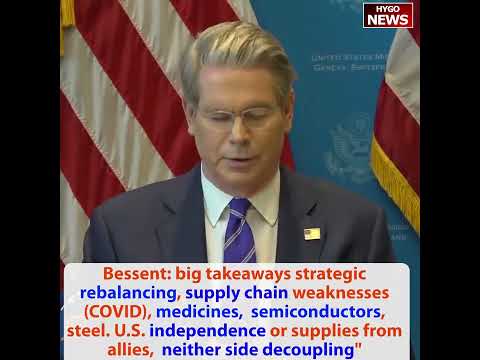
Treasury Secretary Bessent announced the terms of the U.S.-China Geneva agreement in May 2025: “We have reached an agreement on a 90-day pause and substantially moved down the tariff levels. Both sides, on the reciprocal tariffs, will move their tariffs down 115%. Our reciprocal tariff rate will go to 10%. They remove their countermeasures.” He revealed an unexpected win: “The upside surprise was the level of Chinese engagement on the fentanyl crisis. They brought the Deputy Minister for Public Safety and had a robust, highly detailed discussion.” He preserved the strategic framework: “The U.S. will continue strategic rebalancing in medicines, semiconductors, steel — five or six strategic industries. Moving toward U.S. independence or reliable supplies from allies. But neither side wants a decoupling. The 145% tariff was the equivalent of an embargo.”
The Deal Terms
Bessent laid out the specific agreement.
“We have reached an agreement on a 90-day pause,” Bessent announced.
He specified the tariff movement: “Both sides on the reciprocal tariffs will move their tariffs down 115%.”
He described the meeting dynamics: “We had very robust discussions. Both sides showed great respect. It was a chance for me to meet the Chinese delegation. The vice premier I had previously had only a video call with.”
He described the personal connection: “Ambassador Jamison was familiar with two of the other leaders on the delegation from his previous time. So there was very good personal interaction.”
He stated the substantive conclusion: “Both countries represented their national interests very well. We concluded that we have shared interests. We both have an interest in balanced trade.”
He provided the specific outcome: “Our reciprocal tariff rate will go down to 10% on the United States side — so it goes down 115%. We enter into a 90-day pause period for negotiations, which both the Chinese and the United States are very committed to. And the Chinese on their side also go down 115% to 10%, and they remove the countermeasures that they have in place.”
The math was significant. The tariff rate had moved from 145% to 10% — a reduction of 135 percentage points for the Trump-era reciprocal tariffs, with both sides making equivalent reductions. The 90-day pause created space for substantive negotiations on the underlying trade imbalance while relieving the economic pressure that had begun to hurt both economies.
The “removes countermeasures” on the Chinese side was equally important. China had imposed retaliatory tariffs and other restrictions in response to the U.S. tariffs. These countermeasures were also being rolled back, restoring normal-ish trade flows during the 90-day negotiation period.
He added the caveat: “Other measures that the United States has put in place in the past — whether it’s tariff measures from 2018 or since, tariffs under other statutory authorities, tariffs related to fentanyl — those remain unchanged for now.”
The distinction was important. The 10% baseline was specifically the Trump-era reciprocal tariff rate. Other tariffs — particularly those from Trump’s first term, Biden-era measures, and fentanyl-related duties — remained in effect. The full U.S.-China tariff architecture was still more restrictive than before Trump’s second term, just significantly less restrictive than the 145% peak.
”Upside Surprise”: Fentanyl
Bessent revealed what he considered the unexpected win of the Geneva meeting.
“I would say one of the big takeaways — the upside surprise for me from this weekend — was the level of Chinese engagement on the fentanyl crisis in the United States,” Bessent said.
He described the unusual delegation: “They brought the Deputy Minister for Public Safety. It was not traditionally part of the trade team or the negotiating team.”
He described the substance: “He had a very robust and highly detailed discussion.”
Ambassador Greer added: “Both the Chinese and the United States agreed to work constructively together on fentanyl, and there’s a positive path forward there as well.”
The fentanyl engagement was a breakthrough in what had been one of the most intractable aspects of U.S.-China relations. China had historically denied responsibility for the fentanyl precursor chemicals flowing into Mexico and ultimately into the United States. The opioid crisis — which had killed hundreds of thousands of Americans — had been driven largely by fentanyl manufactured from Chinese chemicals by Mexican cartels.
For China to bring a Deputy Minister for Public Safety to trade negotiations — an official who had no reason to be there unless fentanyl was on the agenda — signaled that Beijing was prepared to engage seriously on the crisis. The “robust and highly detailed discussion” meant concrete proposals had been exchanged, not just general statements of concern.
”Process, Plan, and Mechanism”
Bessent framed the negotiations as structurally established.
“Throughout the trade process, we have had a plan. We have a process in place,” Bessent said. “Now with the Chinese, after this weekend, we have a mechanism for continued talks. So process, plan, and mechanism.”
The “mechanism for continued talks” was the institutional architecture that would allow the 90-day pause to produce substantive agreement. Trade negotiations at this scale required sustained engagement at multiple levels — working groups on specific sectors, regular meetings at the ministerial level, and ongoing communication channels that allowed rapid response to new issues.
”Strategic Rebalancing”
Bessent made clear that the tariff reduction did not mean abandoning the broader strategic goal.
“One of the big takeaways from this weekend — the United States will continue a strategic rebalancing in many areas that were exposed as supply chain weaknesses during COVID,” Bessent said.
He identified the sectors: “Whether it’s medicines, whether it’s semiconductors, steel — the other — we’ve identified five or six strategic industries and supply chain vulnerabilities.”
He stated the goal: “We will continue moving toward U.S. independence or reliable supplies from allies on those.”
He addressed the fundamental question: “But the consensus from both delegations this weekend is neither side wants a decoupling.”
He described why the tariffs were reduced: “What had occurred with these very high tariffs, as Ambassador Greer said, was the equivalent of an embargo. And neither side wants that.”
He stated the objective: “We do want trade. We want more balanced trade. And I think that both sides are committed to achieving that.”
He outlined American demands: “We would like to see China open to more U.S. goods. We expect that as the negotiations proceed, that there will also be a possibility of purchase agreements to pull what is our largest bilateral trade deficit into balance.”
The strategic rebalancing framework preserved the core of the Trump economic agenda while allowing for tactical flexibility on tariff rates. Medicines, semiconductors, and steel were too important to national security to depend on Chinese supply, regardless of how the trade relationship evolved. The United States would continue bringing manufacturing home or shifting it to allied nations — but it would do so through sustained industrial policy rather than through punitive tariffs that threatened complete decoupling.
The Trade Deficit Context
Bessent identified the underlying problem driving the entire negotiation.
“That has gotten out of balance,” Bessent said of the trade deficit. “Much of this has happened through neglect over the past four years as the previous administration did not engage on this issue.”
He noted: “That was put forward to us by the Chinese, in fact, and we can see it.”
When asked about the “phase one” trade agreement from Trump’s first term, Bessent declined to dwell on the past: “We are only looking forward, and we look forward to very good discussions now that we have the mechanism created in Geneva this weekend for talks.”
The “phase one” agreement from 2020 had included Chinese commitments to purchase specific quantities of American goods — commitments that China had significantly underperformed. Bessent’s refusal to rehash that history was strategically wise. Litigating past Chinese failures would have undermined the current negotiating relationship. Better to build on the fresh foundation established in Geneva than to demand accountability for agreements the previous administration had allowed to lapse.
Key Takeaways
- Geneva breakthrough: 90-day pause, both sides drop tariffs 115%. U.S. reciprocal tariff goes from 145% to 10%. China removes countermeasures.
- “Upside surprise”: China brought Deputy Minister for Public Safety to discuss fentanyl — historic engagement on the opioid crisis.
- Strategic rebalancing continues: “Medicines, semiconductors, steel — 5-6 strategic industries moving to U.S. independence or allied supply.”
- “Neither side wants decoupling. The 145% tariff was an embargo. We want balanced trade.”
- Other tariffs (2018, fentanyl-related, statutory) remain unchanged. “Process, plan, and mechanism” established for continued talks.