 HYGO News
 Before Midterm the tentative agreement is a 'big win'. Should it be implemented?
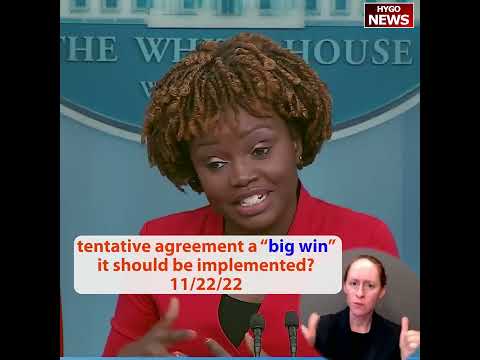
Reporter: Biden Called Tentative Railroad Agreement a “Big Win” Before Midterms — Does He Still Endorse It After Rank-and-File Workers Rejected It?
On 11/22/2022, a reporter pointed out that Biden had called the tentative railroad agreement “a big win” when it was negotiated in September — not just because it averted a strike, but because of the substance of the deal. Now, with four unions having rejected the agreement, the reporter asked whether Biden was “pulling back on his endorsement” or whether he still thought “this tentative agreement should be implemented.” KJP’s response shifted the framing from substance to economics: “It averted a horrible downturn in our economy. It was a big deal. What it could have done to our economy would have been devastating.” She asked “the parties involved to come together in good faith and resolve this” — without addressing whether Biden still believed the substance of the rejected agreement was worth imposing on the rejecting workers.
The September “Big Win”
The reporter’s framing referenced Biden’s earlier celebration of the tentative agreement. “The President a couple months ago called the tentative agreement a big win. It wasn’t just the fact that a strike at the time was averted. He was talking about the substance of the agreement,” the reporter said.
The distinction was important. When Biden called the deal a “big win” in September, he had framed it as both a procedural achievement (averting a strike) and a substantive one (workers getting a good deal). The White House had used the agreement as evidence of Biden’s pro-labor credentials — he had personally intervened in the negotiations, secured concessions from the railroads, and delivered benefits to workers.
But the workers themselves disagreed with Biden’s characterization. When the rank-and-file members of four unions voted on whether to ratify the agreement, they rejected it. The substance of the deal was not, in their view, a “big win” — it was inadequate because it denied them basic protections like paid sick leave.
The reporter was asking whether Biden’s earlier endorsement of the substance still held. If Biden had thought in September that the agreement was substantively good for workers, and the workers themselves had since decided it wasn’t, which view would Biden now endorse?
”Is the President Pulling Back?”
The reporter’s specific question was whether Biden was reconsidering his endorsement. “So now that the rank and file, the workers in four of the unions have rejected that agreement, is the president pulling back on his endorsement, or does he still think this tentative agreement should be implemented?” the reporter asked.
This was a binary question with major implications:
If Biden was pulling back: He would be acknowledging that his September characterization was wrong, that the agreement wasn’t actually a “big win” for workers, and that new negotiations were needed to produce a better deal.
If Biden still endorsed the agreement: He would be dismissing the workers’ democratic rejection and implicitly calling for the agreement to be imposed on them — which would require legislative action.
The question asked Biden to take a position. He could either admit the agreement was flawed or insist it should be imposed despite worker rejection. There was no middle ground.
The Shift From Substance to Economics
KJP’s response carefully shifted the framing. “Well, here’s what we’re saying is that it averted a horrible downturn in our economy by that tentative agreement. It was a big deal. What it could have done to our economy would have been devastating,” KJP said.
This response changed the basis of Biden’s praise for the deal. In September, Biden had praised the agreement for its substance — the wages, the benefits, the terms. In November, KJP was praising it for its economic impact — the strike it averted.
The shift was strategically significant. Praising the agreement for economic reasons gave KJP a way to defend the deal without having to defend its substance. Workers might have rejected the substance, but the economy still needed the agreement. This allowed the White House to maintain support for the deal while acknowledging (implicitly) that the workers had good reasons to reject it.
But the shift also abandoned the original pro-labor framing. The September celebration had been about workers winning. The November defense was about the economy needing the deal. Workers were no longer the beneficiaries in the new framing — they were the obstacles to economic stability.
”Devastating to Our Economy”
KJP emphasized the economic stakes. “What it could have done to our economy would have been devastating,” she said.
The devastation framing was a political argument, not a labor argument. It prioritized macroeconomic concerns (supply chain stability, inflation, GDP) over worker concerns (paid sick leave, scheduling, health). The argument was: yes, workers have legitimate grievances, but their grievances matter less than preventing economic damage.
This framing set up the eventual outcome. If the administration’s primary concern was avoiding economic damage, the logical conclusion was to impose the agreement on the rejecting workers — which is what Biden eventually asked Congress to do. The November framing was already laying the groundwork for the December imposition.
”Come Together in Good Faith”
KJP concluded with the standard call for negotiation. “And so right now we’re asking the parties involved to come together in good faith and resolve this. The president is directly involved, as I have said,” KJP said.
The “come together in good faith” framing was polite but substantively empty. The parties had already come together. They had negotiated a tentative agreement. Workers had voted on it. Four unions had rejected it. Asking them to “come together in good faith” implied there was more negotiating to be done — but neither the railroads nor the administration was offering additional concessions on the sick leave issue that drove the rejection.
What “come together in good faith” actually meant, in context, was: workers need to accept the deal as it is. There was no indication that the railroads would offer better terms. There was no indication that the administration would advocate for better terms. The only path to “resolution” that fit the administration’s framing was workers abandoning their demand for paid sick leave.
“The president is directly involved” was meant to project leadership, but it raised its own questions. If Biden was directly involved, what was he doing? Was he pressuring the railroads for better terms? Was he pressuring the unions to accept? Was he working on alternative approaches? KJP didn’t specify. The vague “directly involved” claim created an impression of engagement without committing to any specific actions.
The Missing Substance Answer
The most significant aspect of KJP’s response was what she didn’t say. She didn’t say Biden still endorsed the substance of the agreement. She didn’t say the agreement was a good deal for workers. She didn’t say the rejecting workers were wrong to reject it. She didn’t say the deal addressed workers’ core concerns.
These omissions were telling. Biden’s September “big win” characterization had included substance. KJP’s November defense studiously avoided substance. The implicit acknowledgment was that the substance wasn’t defensible — the deal had failed to address workers’ legitimate concerns about sick leave and scheduling.
Key Takeaways
- A reporter asked whether Biden was “pulling back” on his September endorsement of the tentative railroad agreement after workers in four unions rejected it.
- KJP shifted the framing from substance (worker benefits) to economics (strike prevention) — abandoning the original “big win” characterization.
- She emphasized that the agreement “averted a horrible downturn in our economy” — prioritizing macroeconomic concerns over worker grievances.
- KJP didn’t say Biden still endorsed the substance of the agreement, implicitly acknowledging the deal didn’t adequately address worker concerns.
- The framing shift set up the eventual legislative imposition, when Biden asked Congress to force the agreement on rejecting workers.
Transcript Highlights
The following is transcribed from the video audio (unverified — AI-generated from audio).
- The President a couple months ago called the tentative agreement a big win.
- It wasn’t just the fact that a strike at the time was averted. He was talking about the substance of the agreement.
- Is the president pulling back on his endorsement, or does he still think this tentative agreement should be implemented?
- It averted a horrible downturn in our economy by that tentative agreement. It was a big deal.
- What it could have done to our economy would have been devastating.
- We’re asking the parties involved to come together in good faith and resolve this.
Full transcript: 134 words transcribed via Whisper AI.