 HYGO News
 Ashish Jha Says Biden Was 'Very Clear That COVID Is Not Over' Despite Saying 'The Pandemic Is Over'
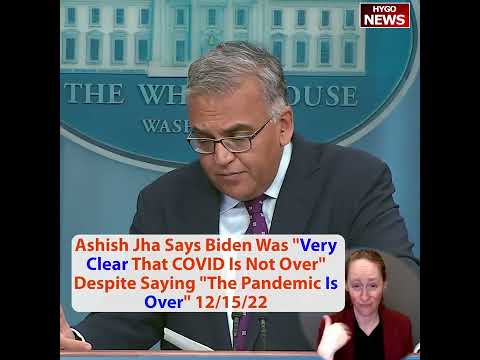
Dr. Ashish Jha Threads Biden “Pandemic Is Over” Contradiction: “The President Was Also Very Clear That COVID Is Not Over”
On 12/15/2022, a reporter asked White House COVID-19 Response Coordinator Dr. Ashish Jha about how Biden’s September 2022 statement that “the pandemic is over” had complicated messaging about continued COVID vigilance. “Back in September, the president publicly said that the pandemic is over. How has that complicated the messaging to keep Americans vigilant facing COVID?” the reporter asked. Jha’s response tried to thread the contradiction: “So I think the president was also very clear that COVID is not over. Can COVID continue to pose a challenge for us? That is true. The COVID is not over.” Jha acknowledged that “too many Americans needlessly dying of COVID” but defended Biden’s broader messaging. The exchange captured the administration’s difficulty explaining why Biden had declared the pandemic over while public health officials continued to urge vigilance.
The September 2022 Statement
Biden had made the “pandemic is over” statement in a September 18, 2022 60 Minutes interview. Specifically, Biden said:
“The pandemic is over” — In response to a specific question.
“We still have a problem with COVID” — Immediately qualifying.
“We’re still doing a lot of work” — Additional context.
But the headline — Was “Biden says pandemic is over.”
The specific phrasing — “the pandemic is over” — had been particularly striking because:
Definitive language — Not “ending” or “diminishing.”
Past tense — “Is over” suggests completion.
Broad scope — “The pandemic” not “acute phase.”
Public context — Millions watching 60 Minutes.
Policy implications — Various programs tied to pandemic status.
The statement had generated substantial controversy. Public health officials worried it would reduce vigilance. Administration insiders were reportedly surprised by the specific phrasing. Various programs that operated under “pandemic” legal frameworks faced questions.
The Persistent Challenge
By December 2022, COVID was genuinely still causing significant impact:
Ongoing infections — Thousands of daily cases.
Continued deaths — Hundreds daily.
Hospital strain — Particularly with “tripledemic” pressures.
Variant evolution — XBB and other subvariants emerging.
Long COVID concerns — Continued.
Vaccination gaps — Not everyone up to date.
These realities meant public health officials needed to continue urging vigilance. But Biden’s September statement had undermined the messaging. People could reasonably ask: if the pandemic was over, why should they continue various protective behaviors?
The Reporter’s Question
The reporter’s question asked about messaging complications. “Back in September, the president publicly said that the pandemic is over. How has that complicated the messaging to keep Americans vigilant facing COVID?” the reporter asked.
The question had specific features:
Factual reference — To Biden’s September statement.
Consequentialist framing — About messaging complications.
Invited analysis — Not just defense.
Sought acknowledgment — Of the practical problem.
This was a substantive question. Biden’s statement had created a messaging challenge. The reporter was asking the administration’s COVID coordinator how that challenge was being addressed.
Jha’s Diplomatic Threading
Jha tried to thread the contradiction. “So I think the president was also very clear that COVID is not over. Can COVID continue to pose a challenge for us? That is true. The COVID is not over,” Jha said.
The response was interesting for what it attempted:
“Also very clear” — Acknowledged that Biden had said COVID was continuing.
“Is not over” — Direct statement of current reality.
“Can continue to pose a challenge” — Acknowledging ongoing risk.
“That is true” — Confirming the challenge.
Jha was essentially walking back the “pandemic is over” statement while not directly contradicting the president. He distinguished between:
“The pandemic” being over — What Biden had said.
“COVID” continuing — What Jha was emphasizing.
This verbal threading tried to preserve Biden’s statement while supporting continued vigilance messaging. The “pandemic” might be “over” in some definitional sense while “COVID” continued to pose threats.
The Definitional Gymnastics
The distinction between “pandemic” and “COVID” required definitional interpretation:
“Pandemic” — Can mean the acute phase of mass infection, or the entire period of disease spread.
“COVID” — The disease itself, regardless of phase.
Official definitions — The WHO declared COVID a pandemic but also uses various terms for phases.
Public understanding — Generally conflates these terms.
Legal frameworks — Use specific definitions for specific purposes.
Jha’s threading relied on a distinction most listeners wouldn’t naturally make. For most Americans, “pandemic over” and “COVID over” were similar concepts. Saying the pandemic was over but COVID wasn’t required sophisticated definitional parsing that public health messaging wasn’t well-suited to communicate.
The “Needlessly Dying” Acknowledgment
Jha acknowledged ongoing deaths. “And obviously we continue to see people getting infected, getting sick. Unfortunately, too many Americans needlessly dying of COVID,” Jha said.
The “needlessly dying” framing was important:
Acknowledged current deaths — COVID was still killing Americans.
“Needlessly” — Suggested preventability.
Public health implication — More action could reduce deaths.
Contradicted “over” framing — Pandemic-over messaging didn’t fit continuing deaths.
The “needlessly” framing implied that vaccines, treatments, and other measures could prevent deaths. If the pandemic were truly over, deaths wouldn’t be needless — they’d just be normal endemic disease. The “needlessly” characterization treated COVID as still actively problematic, not as just another disease.
Biden’s “Has Been Very Clear”
Jha defended Biden’s overall messaging. “So I think the president has been very clear on this, even since that day about the importance of people getting vaccinated, people getting treated,” Jha said.
The “has been very clear” framing was somewhat aspirational. While Biden had continued to emphasize vaccination and treatment, the “pandemic is over” statement had muddied the overall message. Clarity is hard to maintain after high-profile contradictions.
The “since that day” reference was interesting. It implicitly acknowledged that the September statement had been a specific moment that required clarification afterward. Biden had been “very clear” after September, trying to restore the vigilance message.
The Communication Challenge
The administration faced a fundamental communication challenge:
Biden’s “pandemic is over” — Sent a specific message.
Continued public health needs — Required different messaging.
Media coverage — Would focus on striking statements.
Public behavior — Was influenced by administration messaging.
Political incentives — To declare progress on pandemic.
Public health incentives — To maintain vigilance.
These tensions couldn’t be resolved through verbal threading. The administration either had to:
Walk back the “over” statement — Admitting it was premature.
Commit to the “over” framing — Reducing vigilance messaging.
Live with contradiction — As had been happening.
The administration chose the third option. Jha’s response reflected this — maintaining both that COVID wasn’t over and that Biden had been “very clear” from the beginning.
The Political Calculation
Biden’s September statement had been politically calculated:
Pre-midterm messaging — Wanted to claim progress.
Post-pandemic pivot — For 2024 positioning.
Economic framing — Ending COVID-era spending.
Public fatigue — Americans wanted COVID era over.
Administration success claim — Pandemic response working.
These political incentives had overridden public health caution. The “pandemic is over” statement delivered political messaging at the cost of public health message coherence.
The COVID Deaths Context
December 2022 COVID mortality was substantial:
About 400 daily deaths — Still significant.
Several hundred thousand annual deaths possible — At current rates.
Elderly disproportionately affected — Most deaths in older populations.
Unvaccinated disproportionately affected — Vaccination providing significant protection.
Long COVID creating ongoing health issues — Beyond acute deaths.
The “too many Americans needlessly dying” Jha mentioned wasn’t rhetorical excess — it reflected real ongoing mortality. COVID remained among the leading causes of death in the United States through late 2022, even if it had dropped from the peak pandemic years.
The Messaging Challenge Continuing
The tension Jha was managing didn’t resolve in late 2022. The administration continued to:
Talk about COVID ending — In political contexts.
Urge continued vigilance — In public health contexts.
Reduce emergency programs — Consistent with “end” framing.
Maintain testing and vaccination programs — Consistent with “not over” framing.
This dual messaging persisted through 2023 and beyond. The administration eventually ended the formal COVID public health emergency in May 2023, but continued to encourage vaccinations and acknowledge ongoing COVID risks.
The communication challenge reflected a fundamental reality: the pandemic was transitioning from acute emergency to endemic disease, but neither framing fully captured the current situation. Declaring it “over” was premature; continuing to call it an active pandemic overstated the case. The administration was trying to navigate this transition without good options.
The Dr. Jha Role
Ashish Jha had become the administration’s COVID coordinator in April 2022. His role:
Public communications — On COVID matters.
Inter-agency coordination — Across federal COVID responses.
Policy advice — To Biden and senior staff.
Scientific leadership — Within administration.
Public face — At briefings.
Jha had been chosen partly for his communication skills. A pediatric physician and former dean of Brown University School of Public Health, he could explain complex medical issues clearly. His role required balancing:
Scientific accuracy — Based on medical evidence.
Political constraints — Administration messaging.
Public understanding — Accessible communications.
Effective action — Leading public behavior change.
The “pandemic is over” threading exemplified these tensions. Jha had to acknowledge public health reality (COVID not over) while defending administration messaging (Biden’s statement wasn’t wrong).
Key Takeaways
- A reporter asked Dr. Ashish Jha how Biden’s September 2022 “pandemic is over” statement had complicated messaging about continued COVID vigilance.
- Jha threaded the contradiction: “The president was also very clear that COVID is not over.”
- He distinguished between “pandemic” being over (what Biden said) and “COVID” continuing (what public health needed to communicate).
- Jha acknowledged “too many Americans needlessly dying of COVID” — a direct acknowledgment of ongoing mortality.
- He defended Biden’s overall messaging as “very clear” on vaccination and treatment importance.
- The exchange exemplified the administration’s challenge managing dual messaging: political “pandemic ending” framing alongside public health “remain vigilant” messaging.
Transcript Highlights
The following is transcribed from the video audio (unverified — AI-generated from audio).
- Back in September, the president publicly said that the pandemic is over.
- How has that complicated the messaging to keep Americans vigilant facing COVID?
- I think the president was also very clear that COVID is not over.
- Can COVID continue to pose a challenge for us? That is true. The COVID is not over.
- We continue to see people getting infected, getting sick. Unfortunately, too many Americans needlessly dying of COVID.
- The president has been very clear on this, even since that day about the importance of people getting vaccinated, people getting treated.
Full transcript: 112 words transcribed via Whisper AI.