 HYGO News
 Are you afraid to give me an answer? At loss why none of 3 of you would give me an answer. Kennedy.
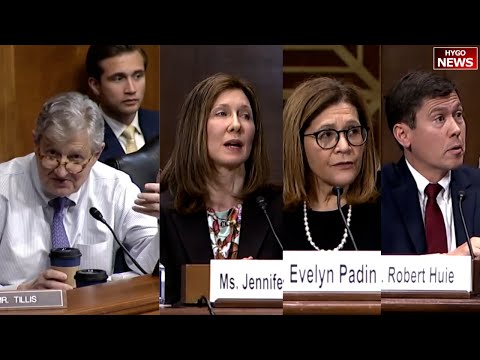
Senator Kennedy Asks Three Biden Nominees the Same Question — None Will Answer: “Are You Afraid to Give Me an Answer?”
On 3/5/2022, Senator John Kennedy posed the same straightforward question to three separate Biden judicial nominees during a Senate Judiciary Committee hearing: do you agree or disagree with prosecutors who refuse to prosecute entire categories of crimes in the name of social justice? All three refused to give a direct answer. Kennedy told them he was “at a loss why none of the three of you would give me an answer” and concluded: “I think I got my answer.”
The Same Question, Three Times
Kennedy’s question was consistent across all three nominees. “We have a number of prosecutors who have chosen, in the name of social justice, not to prosecute an entire class of cases, despite the fact that their legislature has passed these criminal statutes. Do you think that’s proper?” Kennedy asked.
Each nominee deployed a different evasion strategy, but all reached the same destination: no answer.
Nominee One: “Article 2 Directs…”
The first nominee attempted a constitutional detour. “To phrase my opinion in constitutional terms, on the federal side, Article 2 directs that the president shall take care that the laws are faithfully executed,” the nominee said. “It’s long been recognized that there’s a principle of prosecutorial discretion.”
Kennedy cut in. “Let me stop because I’m going to run out of time, as I think you’re aware. Do you agree with what these prosecutors are doing or do you disagree?”
“Senator, I agree with the principle of prosecutorial discretion exercised in the interests of the United States,” the nominee said.
“That’s not what I’m asking and we both know that, counselor,” Kennedy responded. “Do you agree with what these prosecutors are doing, or do you disagree?”
“Senator, I would have to get a little more detail in order to opine on that,” the nominee said.
“Are you afraid to give me an answer?” Kennedy asked.
“Certainly not, and I’m happy to give you an answer,” the nominee said.
“Okay, could you give me an answer?” Kennedy pressed.
Nominee Two: “It’s Complicated”
The second nominee took a similar tack. Kennedy asked directly: “Do you agree with these prosecutors or disagree?”
“Senator, I can tell you that if a criminal matter appears before me, I would apply—” the nominee began.
“I know you would, but I’m asking you your opinion on that prosecutorial decision,” Kennedy said.
“That’s an area that really falls within the executive part of government to be able to address,” the nominee replied.
“Are you afraid to give me an answer?” Kennedy asked.
“No, but I think it’s a complicated answer,” the nominee said.
“No, it’s not,” Kennedy responded. “Do you agree or disagree?”
Nominee Three: “I Have Not Refined an Opinion”
The third nominee claimed she had never thought about the issue. “It’s not anything that I have studied,” she said.
“Have you — are you aware of the issue?” Kennedy asked.
“I am aware of the issue,” the nominee confirmed.
“And do you agree with the prosecutors or disagree?” Kennedy asked.
“I know there are positions on both sides. I have not refined an opinion on this,” the nominee said.
“Are you afraid to give me your answer?” Kennedy pressed.
“No, Senator, I would give you an answer if I had it, and I’m trying — I’m doing my best to answer your question,” the nominee said.
“You could have fooled me, counselor,” Kennedy replied.
”I Think I Got My Answer”
Kennedy closed by addressing all three nominees simultaneously. “We both know what we’re talking about here. I’m just at a loss why none of the three of you will give me an answer,” he said. “It’s very simple. You agree with the prosecutors or disagree?”
Silence.
“Are you going to give me an answer?” Kennedy asked one final time. “I think I got my answer.”
The Pattern
Kennedy’s questioning highlighted a recurring pattern in Biden judicial nominations: nominees who had spent their careers in criminal law — and in some cases had publicly praised progressive prosecutors — would not defend those positions under oath before the Senate. The refusal to answer a yes-or-no question about whether prosecutors should enforce the law revealed either a position the nominees knew was unpopular or a confirmation strategy of saying nothing that could be held against them.
Kennedy’s frustration reflected broader concerns that the Senate’s “advice and consent” role was being undermined by nominees who treated every substantive question as unanswerable.
Key Takeaways
- Kennedy asked three separate Biden judicial nominees whether they agreed with prosecutors who refuse to prosecute entire categories of crimes in the name of social justice; none would answer.
- One nominee said she would need “more detail”; another called it “complicated”; a third said she had “not refined an opinion” despite being “aware of the issue.”
- Kennedy asked each nominee directly: “Are you afraid to give me an answer?” All said no — then continued to evade.
- Kennedy concluded: “I’m at a loss why none of the three of you will give me an answer. I think I got my answer.”
- The pattern reflected a broader strategy among Biden nominees of refusing to state positions on politically charged questions before the Judiciary Committee.
Transcript Highlights
The following is transcribed from the video audio (unverified — AI-generated from audio).
- Do you agree with these prosecutors or disagree? That’s not what I’m asking and we both know that, counselor.
- Are you afraid to give me an answer? Certainly not. Okay, could you give me an answer?
- No, but I think it’s a complicated answer. No, it’s not. Do you agree or disagree?
- I have not refined an opinion on this. Are you afraid to give me your answer? No, Senator.
- You could have fooled me, counselor. I’m at a loss why none of the three of you will give me an answer.
- I think I got my answer.
Full transcript: 906 words transcribed via Whisper AI.