 HYGO News
 Archbishop Elpidophoros Presents Trump with Holy Cross: 'You Remind Me of Constantine the Great'; Trump: 'Birthplace of Democracy'
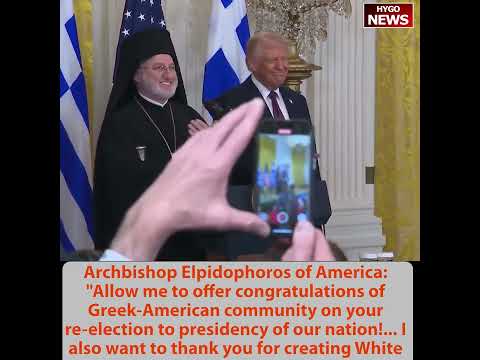
Archbishop Elpidophoros Presents Trump with Holy Cross: “You Remind Me of Constantine the Great”; Trump: “Birthplace of Democracy”
Archbishop Elpidophoros of America presented President Trump with a Holy Cross at the White House Greek Independence Day celebration in March 2025, comparing him to the Roman Emperor Constantine the Great. “Through your leadership, you embody the values of our Christian faith and love for the Gospel,” the Archbishop said. “You remind me of the great Roman Emperor, Constantine the Great. This cross is the very symbol that led this great Roman Emperor to victory.” Trump responded with a meditation on the U.S.-Greece bond, calling Americans “bound by history and culture to the birthplace of democracy and the cradle of Western civilization."
"You Remind Me of Constantine the Great”
Archbishop Elpidophoros opened his remarks with a comparison that carried extraordinary theological and historical weight.
“Through your leadership, you embody the values of our Christian faith and love for the Gospel,” the Archbishop said. “You remind me of the great Roman Emperor, Constantine the Great.”
He provided the personal connection: “This Emperor, dear Mr. President, is the one who founded and built the magnificent city of Constantinople. My birthplace, known today as Istanbul.”
The comparison to Constantine was not casual praise. Constantine I, who ruled the Roman Empire from 306 to 337 AD, was one of the most consequential figures in Western and Christian history. He was the first Roman emperor to convert to Christianity, issued the Edict of Milan legalizing Christian worship, convened the Council of Nicaea that defined fundamental Christian doctrine, and founded Constantinople as the new capital of the Roman Empire. For the Greek Orthodox Church, Constantine was not merely an important historical figure — he was a saint, revered as “Equal to the Apostles.”
For the Archbishop to compare a sitting American president to Constantine was to invoke the highest comparison available in the Orthodox Christian tradition: a powerful leader who used his authority to protect and advance the Christian faith.
The Holy Cross: “In This Sign, Be Victorious”
Elpidophoros then presented the physical gift that embodied the comparison.
“It is my great honor to present you with this Holy Cross,” the Archbishop said. “This cross is the very symbol that led this great Roman Emperor, Constantine, to victory.”
He recounted the foundational story of Constantinian Christianity: “As Christ revealed to him in a vision, He said” — and the Archbishop spoke the Greek phrase — “which told the Emperor: go with this and be victorious, Mr. President.”
The phrase “In hoc signo vinces” — “In this sign, you will conquer” — was the Latin rendering of the vision Constantine reportedly received before the Battle of the Milvian Bridge in 312 AD. According to tradition, Constantine saw a cross of light in the sky with the inscription, ordered his soldiers to mark their shields with the Christian symbol, and won the battle that made him sole ruler of the Western Roman Empire. The victory, attributed to divine intervention, led to Constantine’s embrace of Christianity and its eventual establishment as the dominant faith of the Roman Empire.
The Archbishop applied the symbolism directly to Trump: “This cross is an everlasting symbol of peace and an invincible trophy, a sign of divine strength and guidance. To this cross, I pray you bring peace to the world and make America invincible.”
The prayer — “bring peace to the world and make America invincible” — combined the spiritual with the geopolitical. The Archbishop was not merely presenting a religious artifact; he was invoking divine blessing on the president’s mission, explicitly linking Trump’s presidency to the Constantinian tradition of a powerful leader guided by faith.
Congratulations and the White House Faith Office
Elpidophoros shifted to the formal diplomatic congratulations.
“Allow me to offer the congratulations of the Greek-American community on your reelection to the presidency of our nation,” the Archbishop said. “We all look forward to a bright future for all Americans.”
He then acknowledged a specific policy initiative: “I also want to thank you for creating the White House Faith Office, which promises to be an extraordinary collaboration between your administration and all faith leaders.”
The White House Faith Office was one of the Trump administration’s early institutional creations, establishing a formal mechanism for collaboration between the executive branch and religious communities of all denominations. For the Greek Orthodox Archbishop, the office represented recognition that faith leaders had a legitimate role in governance — not as policymakers but as partners in addressing the moral and spiritual dimensions of national life.
The creation of the Faith Office was consistent with the administration’s broader approach to religious liberty. Where the Biden administration had been perceived as hostile to traditional religious institutions — particularly on issues of gender ideology and abortion — the Trump administration was explicitly welcoming religious leaders into the governing process.
Trump: “The Cradle of Western Civilization”
Trump’s response elevated the celebration from a community event to a statement about civilizational heritage.
“The bond between the United States and modern Greek nation goes back more than two centuries,” Trump said. “On March 25, 1821, Greek Patriots began their noble fight to reclaim their destiny from the grip of a foreign empire — a very powerful foreign empire.”
He quoted the American response at the time: “And James Monroe said at the time that the whole civilized world had a deep interest in a victory for the Greek people.”
Trump then articulated the connection: “President Monroe understood that Americans were bound by history and culture to the birthplace of democracy and the cradle of Western civilization — from the pages of our Constitution to the architecture of this capital city, this wonderful city of ours that we’re fixing up, starting to shape up very nicely, isn’t it?”
The aside about “fixing up” Washington referenced the administration’s renovation initiatives, including the Kennedy Center restoration and broader efforts to maintain the capital’s public spaces. The interjection was characteristically Trump — a momentary break from the formal remarks to note a practical accomplishment.
Trump continued: “To the very words of the English language, the legacy of the Greeks is all around us — that encircles us.”
The observation about language was historically accurate and often overlooked. Thousands of English words derived from Greek, and the conceptual vocabulary of democracy, philosophy, science, and governance was largely Greek in origin. When Americans discussed democracy, politics, economy, or philosophy, they were using Greek words to describe Greek inventions.
”Three Million Strong”
Trump concluded by celebrating the Greek-American community itself.
“But perhaps the greatest gift we have inherited from that amazing culture is our incredible Greek-American community that is now more than three million strong,” Trump said.
The three million figure represented one of America’s most successful immigrant communities. Greek Americans had achieved disproportionate success in business, education, government, and the arts, while maintaining strong connections to their cultural heritage through the Greek Orthodox Church, community organizations, and cultural institutions.
Trump’s personal relationship with the Greek-American community was long-standing. As a New York real estate developer, he had worked with Greek-American businessmen, attended Greek Orthodox events, and developed connections that predated his political career. The celebration was not a politician performing cultural outreach; it was a New Yorker among friends.
The event as a whole — the Archbishop’s comparison to Constantine, the presentation of the Holy Cross, Trump’s meditation on civilizational heritage — represented a degree of religious and cultural engagement from the White House that would have been unimaginable in many previous administrations. The president was not merely acknowledging a community; he was participating in a tradition that linked American democracy to its Greek origins and American faith to its Constantinian inheritance.
Key Takeaways
- Archbishop Elpidophoros compared Trump to Constantine the Great and presented him with a Holy Cross: “This cross led Constantine to victory — go with this and be victorious, Mr. President.”
- He thanked Trump for creating the White House Faith Office as “an extraordinary collaboration between your administration and all faith leaders.”
- Trump traced the U.S.-Greece bond to 1821, quoting James Monroe: “The whole civilized world had a deep interest in a victory for the Greek people.”
- Trump called Greeks the founders of “the birthplace of democracy and the cradle of Western civilization,” noting their legacy in “the pages of our Constitution to the architecture of this capital city.”
- He celebrated the Greek-American community as “three million strong” and “perhaps the greatest gift we have inherited from that amazing culture.”