 HYGO News
 Any follow-up, any new policies? Governor Abbott to follow up on the governor’s border requests?
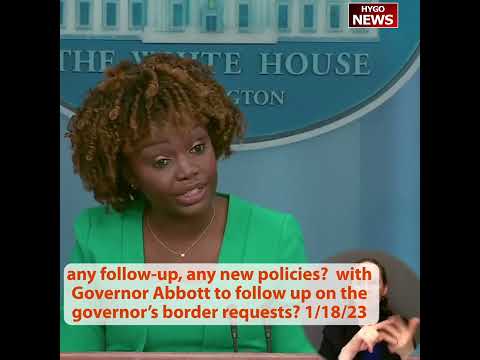
White House on Biden’s Border Visit Follow-Up: “No Conversation to Read Out” With Abbott — Claims Early Policy Impact
In January 2023, a reporter asked the White House about follow-up to President Biden’s recent border visit, including whether Biden had spoken with Texas Governor Greg Abbott about Abbott’s policy requests. The spokesperson said: “I don’t have a conversation or a call to read out.” Instead, they pivoted to claimed positive impact from Biden’s new border policies: “We are seeing some impact, the numbers of migrants arriving from those countries are low, and we look forward to sharing more once we have more data to go off of.” The spokesperson also noted that “the first individuals authorized to live and work legally in the United States” under expanded programs had begun arriving “within five days after the launch of the program.” The response mixed deflection about Abbott engagement with positive messaging about early policy outcomes.
The Biden Border Visit
Biden’s border visit had been a major January 2023 event:
El Paso visit — January 8, 2023.
Limited duration — Short stop.
Controlled exposure — Official meetings.
First presidential visit — To the border.
Pressure response — After sustained criticism.
The visit had been forced by mounting political pressure. After nearly two years of avoidance, Biden finally went. The trip was carefully managed to minimize risk — no direct migrant encounters, limited time at the border itself, meetings with officials rather than community engagement.
The Abbott Letter
Governor Abbott had given Biden a letter during the visit:
Five-point list — Of demands.
Policy requests — For federal action.
Immigration enforcement — Focus.
Public document — Shared publicly.
Political statement — As much as policy request.
Abbott’s letter had demanded various federal actions including:
Enforcing immigration law — More strictly.
Reinstating Remain in Mexico — Trump-era policy.
Continuing Title 42 — Public health expulsion.
Designating cartels as terrorists — Tougher designation.
Ceasing catch-and-release — Detention policy.
The letter was political theater as much as policy proposal. Abbott knew Biden wouldn’t adopt his agenda, but having the letter public pressured the administration to respond.
The Reporter’s Question
The reporter asked about multi-layered follow-up:
“Any follow-up” — Broad inquiry.
“Any new policies” — Policy development.
“Spoken with Governor Abbott” — Direct engagement.
“Follow up on the Governor’s request” — Abbott letter response.
Comprehensive scope — Multiple angles.
The question covered several potential areas of administration activity: internal policy development, direct communication with Abbott, and formal response to Abbott’s requests. Each was a legitimate line of inquiry post-visit.
”No Conversation or Call to Read Out”
KJP’s initial response was deflection. “I don’t have a conversation or a call to read out,” KJP said.
The phrasing:
“Don’t have” — Rather than “there hasn’t been.”
“Read out” — Technical diplomacy term.
No confirmation or denial — Of whether calls occurred.
Information withholding — Or information absence.
Standard deflection — Formula.
“No call to read out” was ambiguous. It could mean Biden had spoken to Abbott but the White House wasn’t sharing details, or it could mean no call had occurred. The phrasing preserved optionality while not providing information.
The Missing Abbott Engagement
The likely reality was limited engagement:
Biden-Abbott relationship — Poor.
Political distance — Maximal.
Abbott border theater — Not receptive.
Federal-state conflict — Ongoing.
Structural tension — Not easily resolved.
Direct Biden-Abbott conversation after the visit was unlikely. The political dynamics didn’t favor engagement. Abbott had positioned himself as hard-line opposition to Biden border policy, and Biden had no political reason to engage directly. The likely situation was minimal contact.
”I’ve Been Asked About If We’ve Seen an Impact”
KJP pivoted to policy impact claims. “I want to say I’ve been asked about if we’ve seen an impact from what the President laid out a couple weeks ago of what he’s, the actions that he was taking at the border,” KJP said.
The pivot:
Unsolicited information — Volunteered.
“Asked about” — Prior questions noted.
Impact framing — Positive.
Policy vindication — Implied.
Biden action emphasis — On his initiatives.
Rather than engaging with the Abbott question, KJP moved to preferred messaging about Biden’s new border actions. This was strategic redirection from a topic (Abbott relationship) to a favorable topic (policy success claims).
The New Border Actions
Biden had announced new border actions in early January 2023:
Expanded parole program — For Venezuelans, Cubans, Nicaraguans, Haitians.
Up to 30,000 per month — Legal entry pathway.
Requires sponsor — In U.S.
Two-year period — Initial authorization.
Conditional on Title 42 — Paired deterrent.
Streamlined asylum processing — At border.
Expanded return policy — Of those crossing illegally.
The policy package was significant expansion of parole programs paired with enhanced removal for those not using legal pathways. It was the administration’s attempt to balance enforcement and legal pathways.
”We Are Seeing Some Impact”
KJP claimed early results. “We are seeing some impact, the numbers of migrants arriving from those countries are low, and we look forward to sharing more once we have more data to go off of,” KJP said.
The impact claim:
Early assessment — Limited data.
Country-specific — The four program countries.
Arrival numbers low — For targeted nationalities.
More data coming — Promised.
Initial positive signal — Claimed.
The administration had reason for initial optimism. Early data suggested significant reduction in illegal crossings by Venezuelans, Cubans, Nicaraguans, and Haitians following the policy launch. The combination of legal pathway plus enhanced removal seemed to be working.
The Data Reality
The early data was actually encouraging for administration:
Significant drop — In targeted country crossings.
Behavior change — Migrants responding to incentives.
Legal pathway use — Growing.
Smuggling economics — Affected.
Policy theory vindicated — Preliminarily.
This was legitimate policy success to report. The administration had designed a policy and it appeared to be working as intended. Reporting the results was appropriate.
”First Individuals Authorized”
KJP noted specific policy execution. “The first individuals authorized to live and work legally in the United States. Other of the expanded programs started arriving just last Tuesday, within five days after the launch of the program,” KJP said.
The implementation details:
Specific timing — Within five days.
Authorization granted — To initial applicants.
Arrival in U.S. — Actual entry.
Legal status — Confirmed.
Program functionality — Demonstrated.
Rapid initial processing was a success indicator. The program wasn’t just announced but was actually functioning — authorizations were being granted, flights booked, arrivals happening. This addressed potential concern about implementation delays.
”Hundreds More Have Been Vetted”
KJP expanded on the implementation scale. “Hundreds more have been vetted and approved for travel and can book a flight to the United States to arrive on time,” KJP said.
The scale indication:
Hundreds pending — Beyond initial arrivals.
Vetting process — Working.
Flight booking — Ability.
Timeline compliance — Meeting commitments.
Pipeline growing — Ongoing operation.
The “hundreds” scale was modest given the 30,000/month target but appropriate for early implementation. Systems were working up to capacity over time. The early data showed the infrastructure was functional.
”We Need Congress to Take Out”
KJP’s statement ended mid-sentence. “But I want to be very clear, again, we need Congress to take out,” KJP said before the transcript cut off.
The incomplete statement was likely meant to be something like “we need Congress to take action” or “take up comprehensive reform.” The administration’s consistent position was:
Executive actions have limits — Short of legislation.
Congressional reform needed — For lasting solution.
Democratic solutions — Requiring cooperation.
Blame deflection — To Congressional inaction.
Standard closing — For immigration responses.
Whenever addressing border issues, administration officials consistently emphasized Congressional responsibility. This positioned executive actions as necessary but incomplete while putting pressure on Congress for comprehensive reform.
The Congressional Reform Challenge
The call for Congressional action was politically difficult:
Divided government — After January 2023.
Comprehensive reform history — Repeated failures.
Partisan divisions — Deep on immigration.
GOP priorities — Enforcement focus.
Democratic priorities — Broader reform.
Congressional action on comprehensive immigration reform had failed repeatedly. The political coalitions necessary for passage didn’t exist. Administration calls for Congressional action were real but unlikely to produce results. The calls were at least partly political messaging.
The Abbott Deflection Significance
Avoiding the Abbott question was strategic:
No positive story — To tell.
Ongoing conflict — Not ended.
Five demands unmet — Politically.
No cooperation — Happening.
Silence better — Than acknowledgment.
Admitting that Biden hadn’t engaged with Abbott or considered his requests would have been acknowledging continued federal-state conflict. The deflection maintained strategic ambiguity rather than confirming non-engagement.
The Policy Outcome Narrative
Whether the new policies would succeed was consequential:
If effective — Vindicate Biden approach.
If ineffective — Support GOP criticism.
Monitoring period — Needed.
Multiple variables — Affecting outcomes.
Political stakes — Significant.
The administration was investing in messaging around early positive data. But early results could be misleading. Sustainable impact over months would be the real test. The administration was framing early signals favorably while acknowledging “more data” was needed.
The Media Strategy
KJP’s pivot strategy had media implications:
Control the narrative — About border.
Emphasize positives — From new policies.
Avoid negatives — About Abbott relationship.
Generate coverage — Of favored topics.
Limit coverage — Of unfavored topics.
By volunteering positive information and deflecting on negative topics, KJP was practicing basic press secretary craft. Whether reporters would accept the redirection was another question.
The Federal-State Dynamic
The Biden-Abbott dynamic was part of larger federal-state conflict:
State enforcement actions — Without federal coordination.
Bus migrant program — Abbott sending to blue cities.
Border walls — State-built.
Legal challenges — Ongoing.
Political theater — Extensive.
Abbott had been using state power to push immigration issues aggressively. Bus programs sending migrants to New York, Chicago, Washington D.C. had generated political impact. State border walls and other actions tested federal authority. The conflict was ongoing and multifaceted.
The Title 42 Context
The administration’s new policies were in the context of Title 42:
Trump-era authority — Public health expulsion.
Biden administration used — Despite opposition.
Ended May 2023 — Eventually.
Legal battles — Over its continuation.
Policy substitution — Needed.
The January 2023 policies were designed in anticipation of Title 42’s end. The combination of legal pathways plus enhanced removal was meant to provide an alternative approach once the public health authority expired. The early success of these policies was important for post-Title 42 strategy.
Key Takeaways
- A reporter asked about follow-up to Biden’s El Paso border visit, including whether he’d spoken with Governor Abbott about Abbott’s policy requests.
- KJP declined to address the Abbott engagement: “I don’t have a conversation or a call to read out.”
- She pivoted to positive messaging about new border policies: “We are seeing some impact, the numbers of migrants arriving from those countries are low.”
- KJP noted that first individuals authorized under expanded programs arrived “within five days after the launch of the program.”
- “Hundreds more have been vetted and approved for travel” — indicating policy infrastructure was functioning.
- The standard closer emphasized Congressional responsibility: “We need Congress to take [action]” — pressure for comprehensive reform.
Transcript Highlights
The following is transcribed from the video audio (unverified — AI-generated from audio).
- On the President’s visit to the border last week, is there any follow-up, any new policies, has he spoken with Governor Abbott to follow up on the Governor’s request?
- I don’t have a conversation or a call to read out.
- We are seeing some impact, the numbers of migrants arriving from those countries are low, and we look forward to sharing more once we have more data to go off of.
- The first individuals authorized to live and work legally in the United States. Other of the expanded programs started arriving just last Tuesday, within five days after the launch of the program.
- Hundreds more have been vetted and approved for travel and can book a flight to the United States to arrive on time.
- But I want to be very clear, again, we need Congress to take out [action].
Full transcript: 183 words transcribed via Whisper AI.