 HYGO News
 Leavitt: Amazon's Tariff Display Is 'a Hostile and Political Act' -- 'They Partnered with Chinese Propaganda'; Bessent: Real Incomes Rising
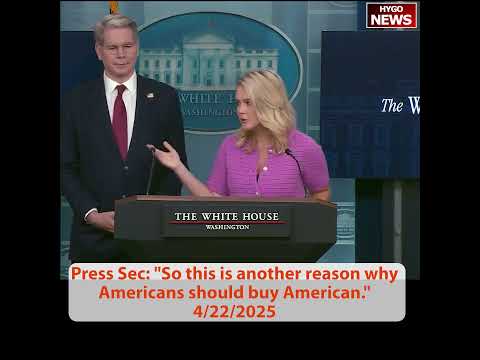
Leavitt: Amazon’s Tariff Display Is “a Hostile and Political Act” — “They Partnered with Chinese Propaganda”; Bessent: Real Incomes Rising
Press Secretary Karoline Leavitt, fresh off a phone call with President Trump, delivered the administration’s response to Amazon’s plan to display tariff costs next to product prices in April 2025. “This is a hostile and political act by Amazon,” Leavitt said. “Why did Amazon do this when the Biden administration hiked inflation to the highest level in 40 years? It’s not a surprise because, as Reuters recently wrote, Amazon has partnered with a Chinese propaganda arm. So this is another reason why Americans should buy American.” Treasury Secretary Bessent added economic context: “Bringing down Biden inflation has been a priority. Interest rates, mortgage rates are down. Gasoline and energy prices are down. By the third and fourth quarters, deregulation is really going to kick in."
"Hostile and Political Act”
A reporter set up the question with maximum framing.
“Amazon will soon display a little number next to the price of each product that shows how much the Trump tariffs are adding to the cost,” the reporter said. “So isn’t that a perfect crystal clear demonstration that it’s the American consumer and not China who is going to have to pay for these policies?”
Leavitt’s response was immediate and forceful: “I will take this since I just got off the phone with the president about Amazon’s announcement.”
She delivered the verdict: “This is a hostile and political act by Amazon.”
She posed the counter-question: “Why did Amazon do this when the Biden administration hiked inflation to the highest level in 40 years?”
She connected to a broader pattern: “And I would also add that it’s not a surprise, because as Reuters recently wrote, Amazon has partnered with a Chinese propaganda arm.”
She stated the lesson: “So this is another reason why Americans should buy American. It’s another reason why we are onshoring critical supply chains here at home to shore up our own manufacturing.”
The “hostile and political act” characterization was deliberate. Leavitt was not merely disagreeing with Amazon’s business decision; she was framing it as a political attack on the administration disguised as consumer information. The distinction mattered because it recast Amazon from a neutral marketplace to a political actor aligned against the president’s trade policy.
The Double Standard
Leavitt’s question — “why didn’t Amazon do this during Biden inflation?” — was the most effective line of her response. During 2021-2023, prices across virtually every category had surged. Grocery prices increased by over 25%. Energy prices spiked. Housing costs soared. Amazon’s prices rose along with everything else.
At no point during this period did Amazon display a “Biden inflation surcharge” next to product prices. The company did not itemize how much of each product’s cost was attributable to the Biden administration’s spending policies, energy restrictions, or supply chain mismanagement. Consumers simply paid higher prices without any corporate effort to identify the political cause.
The selective application of price transparency — showing tariff costs under Trump but not inflation costs under Biden — revealed that Amazon’s decision was political rather than informational. If the goal were genuinely to help consumers understand price drivers, the practice would have been implemented regardless of which president’s policies were responsible.
The Chinese Connection
Leavitt’s reference to Amazon partnering with “a Chinese propaganda arm” added a geopolitical dimension to the dispute. The Reuters report she cited had documented Amazon’s relationship with Chinese state-affiliated entities, raising questions about whether the company’s business interests in China were influencing its political positioning in the United States.
Amazon operated a massive marketplace for Chinese-manufactured goods. Tariffs on Chinese imports directly affected the cost of products that constituted a significant portion of Amazon’s inventory. The company had a direct financial interest in opposing tariffs — not because tariffs hurt American consumers, but because tariffs reduced the price advantage of Chinese goods that Amazon profited from selling.
By displaying tariff costs next to prices, Amazon was effectively running an anti-tariff advertising campaign embedded in its marketplace. Every shopper who saw the tariff line item received a message: the Trump administration was making your products more expensive. The fact that this “information” was absent during Biden-era inflation — when prices were rising far more dramatically — confirmed that the purpose was political opposition, not consumer education.
Bessent: The Economic Reality
Treasury Secretary Bessent provided the administration’s economic counter-narrative.
“Bringing down the terrible Biden inflation has been a priority for the first hundred days of the Trump administration,” Bessent said. “And President Trump has done a great job of leading that since January 20th.”
He listed the results: “Interest rates, mortgage rates are down. Gasoline and energy prices are down. We’re expecting further decreases.”
He identified the hidden benefit: “The big tax on consumers that goes unnoticed is regulation. And we are deregulating and bringing that down.”
He assessed the overall impact: “From a household income point of view, we would expect real purchasing power increases. We’ve seen them over the first hundred days, and we would expect that to accelerate.”
He outlined the four-pillar strategy: “We are doing peace deals, trade deals, tax deals, and deregulating.”
He set the timeline: “The deregulation is a longer lead time, but I think by the third and fourth quarters, that’s really going to kick in.”
Bessent’s response was the most substantive counter to the tariff-equals-higher-prices narrative. While Amazon was highlighting the visible cost of tariffs on individual products, Bessent was pointing to the invisible savings that consumers were already experiencing: lower energy costs, lower mortgage rates, lower regulatory burden, and rising real incomes.
The deregulation argument was particularly important. Regulations imposed costs on businesses that were ultimately passed to consumers, just like tariffs. But unlike tariffs, regulatory costs were invisible — embedded in product prices without any line item identifying them. The Trump administration’s deregulation agenda was reducing these hidden costs even as tariffs imposed visible ones.
”Buy American”
Leavitt’s recommendation that Americans “buy American” in response to the Amazon controversy was both a political message and a practical solution to the tariff concern. Products manufactured in the United States carried no tariff at all. If consumers shifted their purchasing toward domestically produced goods, the tariff line item Amazon wanted to display would read zero.
This was, of course, exactly the point of the tariff policy. Tariffs on imported goods were designed to make domestic products more competitive by closing the price gap between cheap foreign goods and American-made alternatives. Amazon’s tariff display, intended as an argument against the policy, could equally serve as an advertisement for domestic alternatives: buy American, pay no tariff.
The “onshoring critical supply chains” language connected the Amazon controversy to the broader national security argument for tariffs. The same supply chains that made Amazon’s cheap Chinese products possible were the supply chains that left America dependent on foreign countries for antibiotics, electronics, and industrial components. Reducing that dependence — even at the cost of marginally higher prices on some imported goods — was a national security imperative that transcended consumer convenience.
Key Takeaways
- Leavitt called Amazon’s tariff display “a hostile and political act,” noting Trump called her about it personally.
- She exposed the double standard: “Why didn’t Amazon show this when Biden hiked inflation to the highest in 40 years?”
- She cited Amazon’s Chinese connection: “Amazon has partnered with a Chinese propaganda arm. This is why Americans should buy American.”
- Bessent countered: “Interest rates, mortgage rates, gasoline are all down. Real purchasing power is increasing. Deregulation will kick in by Q3-Q4.”
- Bessent framed the four-pillar strategy: “Peace deals, trade deals, tax deals, and deregulating.”