 HYGO News
 Trump Reads MAHA Report: '40% of Kids Have Chronic Condition, Childhood Cancer Up 50%, Obesity from 5% to 20%, Autism from 1 in 10,000 to 1 in 31 -- There's Something Wrong'; Hegseth Ups Jump Pay First Time in 25 Years
Trump Reads MAHA Report: “40% of Kids Have Chronic Condition, Childhood Cancer Up 50%, Obesity from 5% to 20%, Autism from 1 in 10,000 to 1 in 31 — There’s Something Wrong”; Hegseth Ups Jump Pay First Time in 25 Years
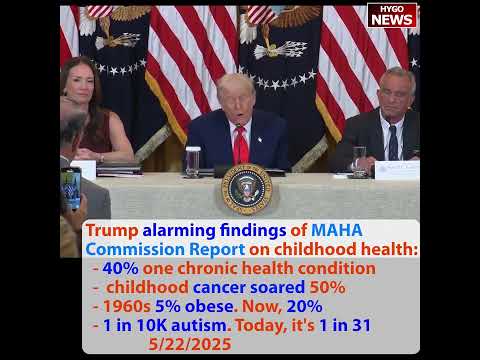
President Trump delivered the MAHA (Make America Healthy Again) Commission’s first report on childhood health in May 2025, and the findings were devastating. “More than 40% of American children now have at least one chronic health condition. Since the 1970s, rates of childhood cancer have soared by nearly 50%. In the 1960s, less than 5% of children were obese — now over 20% are obese. Just a few decades ago, 1 in 10,000 children had autism. Today it’s 1 in 31.” He cited root causes: “Ultra-processed foods, over-medicalization and over-prescription, and widespread exposure to potentially toxic chemicals.” On autism specifically: “It has to be something on the outside. It has to be artificially induced. It has to be.” On institutional capture: “We’ve not allowed our public health system to be captured by the very industries it’s supposed to oversee.” Separately, Secretary of Defense Pete Hegseth announced: “For the first time in 25 years, we are increasing jump pay… plus $150/month for jump masters who had never been compensated before.”
The MAHA Commission Report
Trump introduced the report with appropriate gravity.
“Four months ago, I created the Presidential Commission to make America healthy again,” Trump said. “And today the Commission officially delivers its first report on childhood health.”
He set the stage: “Here are just some of the alarming findings, and they really are alarming. It’s unbelievable, terrible.”
The MAHA Commission had been established by executive order in late January 2025. The Commission was chaired by HHS Secretary Robert F. Kennedy Jr. and included representatives from multiple federal agencies. Its mandate was to investigate the causes of declining American health and propose comprehensive reforms.
The first report focused on childhood health because children had experienced the most dramatic health deterioration over recent decades. If trends affecting children were understood, the root causes of American health decline could potentially be identified and addressed.
The Statistics
Trump read the first finding: “More than 40 percent of American children now have at least one chronic health condition.”
The 40% figure was extraordinary. Chronic health conditions in children had historically been rare. Categories included:
- Asthma and other respiratory conditions (the largest category)
- Obesity and metabolic conditions
- Autism spectrum and neurodevelopmental conditions
- Allergies and immune conditions
- Mental health conditions and mood disorders
- Learning disabilities and ADHD
- Autoimmune conditions
- Skin conditions like eczema and psoriasis
In the 1970s, the comparable figure might have been 10-15%. The rise to 40%+ represented a fundamental change in American childhood. Being chronically ill had become the norm rather than the exception for American children.
Childhood Cancer: 50% Increase
Trump continued: “Since the 1970, rates of childhood cancer have soared in many cases by nearly 50 percent. Five out of 50 percent.”
The 50% increase in childhood cancer rates was particularly disturbing because:
- Children have had relatively fewer environmental exposures
- Their genetic predispositions are established from birth
- Their cancers often differ from adult cancers (leukemia, brain tumors, lymphomas being more common)
- Environmental and nutritional factors should show up more clearly in pediatric populations
If childhood cancer had increased 50% over 50 years, something in the environment, diet, or medical practice was causing increased cancer in children. The cause was not known but the increase was real. Major candidates included:
- Ultra-processed food consumption
- Pesticide and herbicide residues in food supply
- Plastic and phthalate exposures (endocrine disruptors)
- Pharmaceutical exposures in utero
- Reduced breastfeeding rates
- Vaccine schedules (controversial theory)
- Gut microbiome disruption
- Electromagnetic field exposures
Obesity: 5% to 20%
Trump read the obesity statistics: “Well, in the 1960s, less than 5 percent of the children were obese. Now over 20 percent are obese.”
The four-fold increase in childhood obesity was the most extensively documented of the MAHA findings. Since the 1970s, American children had gotten dramatically heavier. The causes were well-understood even if the solutions were difficult:
Dietary changes: Shift from whole foods to processed foods, increase in sugar consumption, proliferation of cheap calories in American food supply.
Physical activity decline: Reduction in outdoor play, decrease in physical education, rise of screen time, urban design discouraging walking and cycling.
Economic factors: Industrial food production had made cheap, calorie-dense food widely available while fresh food often remained expensive.
Social factors: Single-parent households, reduced family meal time, school lunch policies, food marketing to children.
Metabolic factors: Gut microbiome changes, endocrine disruptor exposures, prenatal influences.
The 5% to 20% increase represented not just individual tragedy but civilizational crisis. Obese children became obese adults, with dramatically higher rates of diabetes, cardiovascular disease, cancer, and early mortality.
Autism: 1 in 10,000 to 1 in 31
Trump’s most emphatic finding concerned autism: “Think of this one. This is to me the one that gets me every time, and it seems to be getting worse. Just a few decades ago, one in 10,000 children had autism. Today it’s one in 31. Last time I heard the number is one in 34, right? Now it’s one in 31.”
He offered his intuitive analysis: “There’s something wrong, and we will not stop until we defeat the chronic disease epidemic.”
He continued later: “When you hear 10,000, it was one in 10,000, and now it’s one in 31 for autism. I think that’s just a terrible thing. It has to be something on the outside. It has to be artificially induced. It has to be.”
The autism statistics were the most dramatic. A ~320-fold increase in autism prevalence in a few decades was biologically implausible as a genetic shift. Genes do not change that fast across populations. If autism had actually increased this much, environmental factors must have been driving it.
Possible explanations included: Genuine increase due to environmental factors: Pollutants, food additives, pharmaceutical exposures, or other environmental changes causing increased autism.
Diagnostic expansion: Criteria for autism diagnosis had broadened over time, with conditions previously classified as other conditions now being called autism.
Increased awareness: Better recognition of autism had led to diagnosis of cases that previously would have gone unidentified.
Combination of factors: All three factors contributing to the observed increase.
Most researchers believe all three factors are real. The question is the relative weights. If diagnostic expansion accounts for half or more of the increase, the “real” increase might be less alarming. If diagnostic expansion accounts for a small fraction, the remaining increase represents a genuine health crisis.
Trump’s “it has to be artificially induced” framing pointed toward environmental causation. This was scientifically reasonable even if politically controversial. If autism had genuinely increased dramatically, something in the environment must have been responsible, because genetics cannot change fast enough to produce such rapid change.
Root Causes
Trump identified the factors the Commission was examining.
“For the first time ever, this report examines some of the root causes that many believe are making our children sicker, and our population sicker,” Trump said.
He listed them: “Ultra-processed foods over medicalization and over-prescription and widespread exposure to potentially toxic chemicals.”
Ultra-processed foods: American diet had shifted dramatically toward industrially processed foods with artificial additives, preservatives, stabilizers, colorings, and flavorings. Many of these ingredients had been approved based on limited safety testing, particularly regarding long-term cumulative effects.
Over-medicalization: American children received more medical interventions than children in peer nations: more vaccines, more antibiotics, more stimulant medications, more psychiatric prescriptions, more procedures. Some of these interventions were clearly beneficial; others had unknown long-term consequences.
Over-prescription: Specific concerns about pharmaceutical over-prescription included:
- Antibiotics in early childhood (disrupting gut microbiome)
- Stimulants for ADHD (affecting developing brains)
- Antidepressants for children (limited evidence of benefit)
- Psychiatric medications generally (often not FDA-approved for children)
Toxic chemicals: Endocrine disruptors, plasticizers, pesticides, herbicides, heavy metals, and various industrial chemicals were widely present in the American environment. Some had been studied and found problematic; others remained largely unstudied.
”Captured” Public Health System
Trump addressed institutional corruption concerns.
“Unlike other administrations, we will not be silenced or intimidated by the corporate lobbyists or special interests,” Trump said. “And I want this group to do what they have to do. We have to spell it out. In some cases, it won’t be nice or it won’t be pretty, but we have to do it.”
He made the specific accusation: “And we’re not allowed our public health system to be captured by the very industries it’s supposed to oversee.”
The “regulatory capture” concern referred to the pattern where federal health agencies had become effectively aligned with the industries they were supposed to regulate. Specific examples included:
- FDA relationships with pharmaceutical manufacturers
- CDC relationships with vaccine manufacturers
- USDA relationships with agricultural processors
- EPA relationships with chemical manufacturers
When regulatory agencies became captured, they tended to approve industry products with insufficient safety testing, dismiss industry concerns when they arose, and coordinate with industry on messaging to the public. The result was a public health system that served industry interests rather than public health.
The Trump administration’s framing was that traditional oversight had been captured, and aggressive reform was needed to break industry control of regulatory agencies. RFK Jr.’s HHS leadership was central to this reform agenda, with Kennedy’s career-long focus on industry capture providing ideological foundation for the reforms.
Hegseth: First Jump Pay Increase in 25 Years
Secretary of Defense Pete Hegseth’s announcement shifted to military personnel.
“It’s historic investment in barracks and housing, in healthcare, and yes, in pay,” Hegseth said. “There’s a big increase coming from E1 to E4.”
He made the specific announcement: “Also, I’ve got a bit of an announcement today that might be of interest to this community. For the first time in 25 years, here at the Secretary of Defense, through the Secretary of the Army, we are increasing jump pay.”
He described the additional compensation: “Not only are we increasing jump pay, but for the first time, jump masters who have never been compensated additionally for that additional duty are going to receive an additional one hundred and fifty dollars a month in incentive pay.”
He closed with appreciation: “So here’s to our paratroopers, our jump masters, who do the difficult things in difficult places that most Americans can never imagine.”
Jump pay had been one of the longest-unchanged military compensation categories. Paratroopers — soldiers certified to make parachute jumps as part of their combat mission — had received a flat monthly bonus that had not changed significantly in decades despite inflation. The real value of jump pay had eroded substantially as prices had risen while the bonus had remained constant.
Hegseth’s announcement addressed two specific issues:
Base jump pay increase: The flat monthly bonus would rise, restoring some of the real value lost to inflation.
Jump master compensation: “Jump masters” are specially trained paratroopers who organize and supervise jumps, ensuring safety of other jumpers. Despite the additional responsibility and training required, jump masters had not received additional compensation beyond base jump pay. The new $150/month incentive pay addressed this long-standing gap.
The “E1 to E4” pay increase Hegseth mentioned referred to junior enlisted personnel — privates, specialists, and similar ranks who often had the lowest pay in the military. These were the soldiers most financially stressed, often qualifying for food stamps and other government assistance despite serving on active duty. A “big increase” for these ranks would significantly improve their quality of life.
Key Takeaways
- MAHA childhood health report: “40% chronic condition, cancer up 50%, obesity 5% to 20%, autism 1 in 10,000 to 1 in 31.”
- Trump on autism: “It has to be something on the outside. It has to be artificially induced. It has to be.”
- Root causes: “Ultra-processed foods, over-medicalization, over-prescription, widespread exposure to toxic chemicals.”
- Regulatory capture: “We’ve not allowed our public health system to be captured by the very industries it’s supposed to oversee.”
- Hegseth: “First jump pay increase in 25 years. Jump masters get additional $150/month. E1-E4 big pay increase coming.”