 HYGO News
 Air Force Chief Unveils F-47: 'Crown Jewel' of Next-Gen Air Dominance -- 'Peace Through Strength Into the Future'
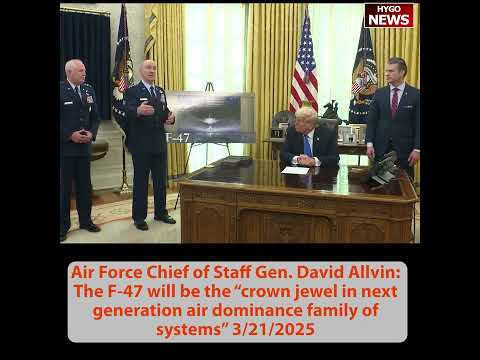
Air Force Chief Unveils F-47: “Crown Jewel” of Next-Gen Air Dominance — “Peace Through Strength Into the Future”
Air Force Chief of Staff General David Allvin stood alongside President Trump and Defense Secretary Pete Hegseth in March 2025 to unveil the F-47, America’s next-generation fighter aircraft. “Air dominance is not a birthright, but it’s become synonymous with American air power,” Allvin declared. “And with this F-47 as the crown jewel in the Next Generation Air Dominance family of systems, we’re going to be able to keep that promise well into the future.” He described the platform as providing “more lethality, more capability” and enabling “human-machine teaming” with collaborative combat aircraft. Allvin concluded: “It’s more deterrence, more capability. It’s what peace through strength looks like into the future, Mr. President."
"Air Dominance Is Not a Birthright”
General Allvin opened his remarks by thanking the administration’s leadership before delivering a statement about the nature of American air power that would have resonated with every combat pilot in the Air Force.
“Mr. President, Mr. Secretary, thank you so much for your unwavering commitment to our military,” Allvin said. “I would say this is a big day. This is a big day for our United States Air Force as well.”
He then articulated the philosophy that had driven the program: “You know, air dominance is not a birthright, but it’s become synonymous with American air power. But air dominance needs to be earned every single day.”
The distinction was crucial. The United States had maintained air superiority in every conflict since the Korean War, and that dominance had become so expected that many Americans — and some policymakers — assumed it was automatic. Allvin was warning against that complacency. Air dominance required continuous investment in technology, training, and platforms. The moment America stopped earning it was the moment an adversary could challenge it.
Allvin connected the F-47 to the longest tradition in American military aviation: “Since the earliest days of air warfare, brave American airmen have jumped into their machines, taken to the air, and they’ve cleared the skies. And whether that be clearing the skies so we can rain down destruction on our enemies from above, or we can clear the path for the ground forces below, that’s been our commitment to the fight, and that’s really been our promise to America.”
The F-47: “Crown Jewel”
Allvin then formally designated the F-47’s role in the military’s future.
“And with this F-47 as the crown jewel in the Next Generation Air Dominance family of systems, we’re going to be able to keep that promise well into the future,” he said.
The “family of systems” phrasing was significant. The F-47 was not a standalone fighter replacing the F-22 on a one-for-one basis. It was the central platform in an integrated system that included collaborative combat aircraft — unmanned drones designed to fly alongside the piloted fighter, extending its reach, absorbing risk, and multiplying its combat effectiveness.
“This, along with our collaborative combat aircraft — the president talked about with drones — this is allowing us to look into the future and unlock the magic that is human-machine teaming,” Allvin explained. “And as we do that, we’re going to write the next generation of modern aerial warfare with this. This enables us to do this.”
The “human-machine teaming” concept represented the most fundamental change in air combat since the jet engine. Rather than a single pilot in a single aircraft, the F-47 would command a fleet of autonomous wingmen — drones that could scout ahead, engage threats, carry additional weapons, and perform missions too dangerous for human pilots. The manned fighter became a command node rather than a lone combatant.
”Second to None”
Allvin credited the program’s success to American industry and engineering talent.
“I also want to thank everyone from industry and with the government, our engineers, who have worked tirelessly on this program to bring where we are right now today,” he said.
The assessment was unequivocal: “This shows that American talent, American skill, and American determination are second to none, because this platform is second to none.”
He outlined the capabilities: “So we believe that this provides more lethality, it provides more capability, more modernized capability in a way that is built to adapt.”
The “built to adapt” phrase addressed one of the most persistent criticisms of modern weapons development: that systems designed over decades often entered service already partially obsolete. Allvin was arguing that the F-47 had been engineered with adaptation as a core design principle — the ability to incorporate new technologies, weapons, and capabilities without requiring a complete redesign.
Government Control: “Speed of Relevance”
Allvin highlighted a structural innovation in how the program was managed that was as significant as the technology itself.
“The manner in which we put this program together puts more control in the hands of the government, so we can update and adapt at the speed of relevance, at the speed of technology, not at the speed of acquisition,” he said.
The “speed of relevance” versus “speed of acquisition” distinction captured a frustration that had defined military procurement for decades. Traditional acquisition programs moved so slowly that by the time a system was fielded, the technology it was built on was outdated and the threat it was designed to counter had evolved. By retaining more government control over the program, the Air Force could update the F-47’s capabilities on a timeline dictated by technological progress and operational need rather than by the procurement bureaucracy.
This was, in many ways, the most consequential aspect of the F-47 program. A fighter that could be rapidly updated with new software, sensors, and weapons systems would maintain its edge for decades. A fighter locked into a fixed configuration at delivery would begin degrading the moment it left the factory.
”More Options for the President”
Allvin connected the F-47’s capabilities directly to presidential authority and national strategy.
“This is more Air Force. This is more options for the president,” he said. “We say as our mission in the United States Air Force is to fly, fight, and win — air power anytime, anywhere. If you want to go anywhere, you have to have a platform that gets you anywhere.”
He described the range of options the F-47 would provide: “This provides the president options from the very one end, which is a quick response — and then we can get right back into fighting stance without having to deploy troops that are going to take maybe months and cost more lives. We can be back in fighting stance and maybe restore that deterrence.”
The other end of the spectrum: “All the way to decisive victory as part of a joint force that is the most lethal and capable military ever in history. That’s what we provide now, and this allows us to provide it into the future.”
The “quick response” capability was particularly significant. The ability to project power rapidly without requiring the months-long deployment of ground troops meant the president could respond to crises, deter aggression, and demonstrate resolve without the political and logistical costs of a major force mobilization. The F-47 was, in this sense, a political tool as much as a military one.
”Peace Through Strength”
Allvin concluded by connecting the F-47 to the administration’s governing philosophy.
“It’s more deterrence, more capability. It’s what peace through strength looks like into the future, Mr. President,” he said. “So we’re very proud of that. And all we can say is on behalf of the United States Air Force, let’s deliver.”
Trump responded by acknowledging the collaborative nature of the program: “We’ve worked together long and hard on this, and this was a big secret. In fact, we don’t show too much of the plane for that reason.”
The secrecy surrounding the F-47’s design details reflected the reality that the aircraft’s most important capabilities were its most classified. In an era of great-power competition with China and Russia, revealing the full specifications of America’s most advanced fighter would be a strategic gift to adversaries. What was shown was enough to communicate capability and intent; what was hidden was where the real advantage lay.
Key Takeaways
- General Allvin unveiled the F-47 as “the crown jewel in the Next Generation Air Dominance family of systems,” calling it “second to none.”
- He warned that “air dominance is not a birthright” and must be “earned every single day” through investment in new platforms.
- The F-47 will enable “human-machine teaming” with collaborative combat aircraft (drones), rewriting modern aerial warfare.
- The program was structured to give the government control to “update and adapt at the speed of relevance, not the speed of acquisition.”
- Allvin called the F-47 “more options for the president” — from quick-response deterrence to decisive joint-force victory — and declared it “what peace through strength looks like into the future.”