 HYGO News
 Agriculture Sec Rollins Welcomes DOGE to Review SNAP: 'Hand Up, Not a Handout'; Hegseth Meets Poland
Agriculture Sec Rollins Welcomes DOGE to Review SNAP: “Hand Up, Not a Handout”; Hegseth Meets Poland
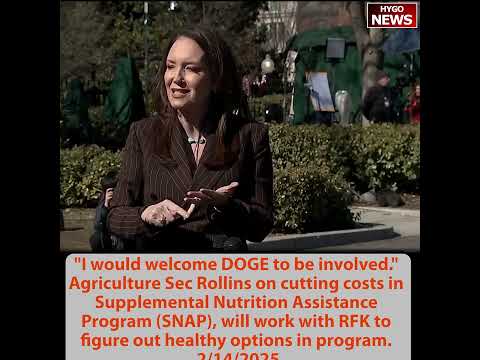
Agriculture Secretary Brooke Rollins told reporters outside the White House on February 15, 2025, that she would “welcome DOGE to be involved” in reviewing the Supplemental Nutrition Assistance Program (SNAP), which she said had grown “almost 30% more than before” under the Biden administration. Rollins pledged to work with HHS Secretary Robert F. Kennedy Jr. to evaluate whether taxpayer-funded food benefits were being used for nutritious food or “really bad food and sugary drinks,” while assuring the public that the administration would never “take food out of a hungry child’s mouth.” Separately, Defense Secretary Pete Hegseth arrived in Warsaw, Poland, for his first meeting with Polish Defense Minister Kamysz.
”I Would Welcome DOGE to Be Involved”
A reporter asked Rollins to expand on her confirmation hearing comments about making SNAP more efficient and whether Elon Musk’s Department of Government Efficiency would play a role.
Rollins’s answer was immediate: “I would welcome DOGE to be involved.”
She then laid out the philosophical framework for the review. “I think anytime that the government and massive government programs like the SNAP program, which is our food stamp program — anytime you can get sort of a business perspective on: are we hitting our goals? What are the metrics? What is the metric for success?” Rollins said.
The invitation to DOGE was significant because it signaled that the Agriculture Department would cooperate with Musk’s team rather than resist its inquiries. Several federal agencies had been accused of stonewalling DOGE’s access to data and systems. Rollins was taking the opposite approach, treating the efficiency review as an opportunity rather than a threat.
The “business perspective” framing was deliberate. SNAP is one of the largest federal spending programs, with annual costs exceeding $100 billion during the Biden administration. Applying business metrics — defined goals, measurable outcomes, return on investment — to a program of that scale had the potential to identify significant waste and misallocation.
”A Hand Up, Not a Handout”
Rollins articulated the fundamental question she intended to ask about SNAP: whether the program was achieving its original purpose.
“Oftentimes these government programs are started with the idea that you’re going to help people. It’s not a handout, it’s a hand up,” Rollins said. “And then years later, the programs are even bigger and you’ve got more people on them. And are we really giving people a hand up, or is it instead a handout?”
The hand-up-versus-handout distinction was a classic formulation of conservative welfare reform philosophy, but Rollins delivered it without ideological edge. She was asking a practical question: if a program designed to help people become self-sufficient was instead growing larger every year, was it working?
The numbers supported the inquiry. SNAP enrollment and spending had surged during the Biden administration, driven by pandemic-era expansions that were extended and in some cases made permanent. Rollins cited the specific figure: “Under Biden, I think that SNAP grew almost 30% more than before.”
A 30 percent expansion of one of the federal government’s largest spending programs warranted scrutiny regardless of one’s political orientation. Whether the growth reflected genuine need or bureaucratic expansion was precisely the question Rollins intended to answer.
”Will We Ever Take Food Out of a Hungry Child’s Mouth?”
Rollins anticipated the most potent criticism of any SNAP review by addressing it head-on. “Will we ever take food out of a hungry child’s mouth? Of course not. This is the United States of America,” she said.
The preemptive assurance was necessary because any discussion of reforming food assistance programs inevitably generated accusations that Republicans wanted to starve the poor. By stating the red line clearly and publicly — no child would go hungry — Rollins established the parameters of the review before critics could define it for her.
The assurance also created political cover for the more aggressive questions she intended to ask about how SNAP dollars were being spent.
Working with RFK Jr. on Healthy Food
Rollins’s most substantive policy announcement was her plan to work with HHS Secretary Robert F. Kennedy Jr. on the nutritional quality of food purchased with SNAP benefits.
“I look forward to working with Bobby Kennedy as we figure out: do we have the healthiest choices?” Rollins said. “So when a taxpayer is putting money into SNAP, are they okay with us using their tax dollars to feed really bad food and sugary drinks to children who perhaps need something more nutritious?”
The question cut to the heart of a longstanding policy debate. SNAP benefits can be used to purchase virtually any food item, including candy, chips, soda, and other products with minimal nutritional value. Nutrition advocates across the political spectrum had long argued for restrictions that would direct SNAP spending toward healthier options, but previous reform efforts had been blocked by a coalition of food industry lobbyists and anti-paternalism advocates.
Kennedy’s appointment as HHS secretary had brought the food quality issue to the forefront of the administration’s domestic agenda. His “Make America Healthy Again” campaign had focused on the connection between processed food, chronic disease, and the rising costs of healthcare. Partnering with Rollins on SNAP reform allowed the two recently confirmed secretaries to combine their mandates: Rollins overseeing the program that fed tens of millions of Americans, and Kennedy overseeing the healthcare system that treated the chronic diseases associated with poor nutrition.
Rollins and Kennedy had both been confirmed by the Senate on February 13, 2025, and would both serve on Trump’s new 13-member Make America Healthy Again commission. The commission represented an institutional framework for the kind of cross-agency collaboration that the SNAP-nutrition reform would require.
The DOGE-SNAP-MAHA Nexus
The combination of DOGE’s efficiency review, Rollins’s SNAP reform, and Kennedy’s MAHA agenda created a policy nexus with significant potential to reshape how the federal government approached food assistance.
DOGE would bring the analytical rigor to identify where SNAP dollars were being spent inefficiently or fraudulently. Rollins would provide the programmatic authority to redirect spending and change eligibility criteria. Kennedy would supply the nutritional science and public health framework to justify redirecting benefits toward healthier food options.
Together, the three initiatives could transform SNAP from a program that simply distributed purchasing power to one that actively promoted health outcomes — a shift that would have implications for both the Agriculture Department’s budget and the healthcare system’s long-term costs.
Rollins signaled the scope of her ambitions: “These are all massive questions we’re going to be asking and working on in the coming months and years. And I look forward to solving some of these major, major issues for this country.”
Defense Secretary Hegseth in Warsaw
In a separate development, Defense Secretary Pete Hegseth arrived in Warsaw, Poland, for his first meeting with Polish Defense Minister Wladyslaw Kosiniak-Kamysz. The visit came as the Trump administration was simultaneously pursuing peace negotiations with Russia over Ukraine while reaffirming its commitment to NATO allies on Russia’s border.
Poland had become one of the most important NATO allies in the post-2022 European security landscape. The country had dramatically increased its defense spending, hosted significant U.S. military deployments, and served as the primary logistics hub for Western military assistance to Ukraine. Hegseth’s visit to Warsaw signaled that the Trump administration intended to maintain strong defense ties with Poland even as it pursued diplomatic engagement with Moscow.
The timing of Hegseth’s Poland visit — coinciding with Vance’s Munich Security Conference appearance and Trump’s phone calls with both Putin and Zelensky — illustrated the multi-track approach the administration was taking to European security: peace talks with Russia, defense reassurance with allies, and a direct challenge to European leaders on free speech and defense spending, all happening simultaneously.
Key Takeaways
- Agriculture Secretary Rollins said she would “welcome DOGE to be involved” in reviewing SNAP, which grew “almost 30% more than before” under the Biden administration.
- Rollins pledged to work with HHS Secretary RFK Jr. to evaluate whether SNAP dollars were funding “really bad food and sugary drinks” rather than nutritious options for children.
- She assured the public that the administration would never “take food out of a hungry child’s mouth” while applying “business perspective” metrics to determine if the program was delivering “a hand up” rather than “a handout.”
- Both Rollins and Kennedy were confirmed on February 13 and would serve on Trump’s 13-member Make America Healthy Again commission.
- Defense Secretary Pete Hegseth arrived in Warsaw for his first meeting with Poland’s defense minister, reaffirming NATO alliance commitments alongside the administration’s simultaneous peace push with Russia.