 HYGO News
 AG Bondi: No longer rogue judges striking down Trump; Trump: SCOTUS monumental victory nationwide
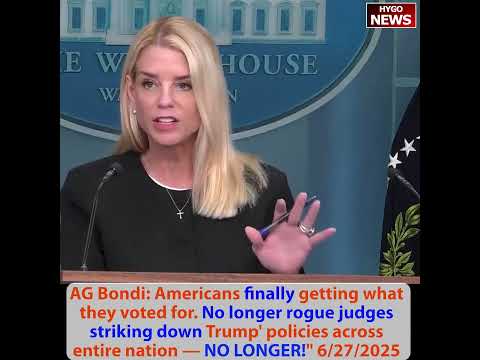
AG Bondi: No longer rogue judges striking down Trump; Trump: SCOTUS monumental victory nationwide
The Supreme Court’s 6-3 decision holding that district courts lack the authority to issue nationwide universal injunctions fundamentally reshapes the legal landscape for every future presidential administration. Justice Amy Coney Barrett wrote the majority opinion. Attorney General Pam Bondi called it the moment “Americans are finally getting what they voted for” — because single federal district judges will no longer be able to block presidential policies from taking effect across the entire country. President Trump, addressing the nation shortly after the decision was announced, called it a “monumental victory for the Constitution, the separation of powers, and the rule of law.” The ruling’s practical effect: a single rogue district judge in a blue jurisdiction can no longer use a single case to stop a national policy.
”Americans Are Finally Getting What They Voted For”
Bondi’s opening captured the political moment. “Americans are finally getting what they voted for. No longer will we have rogue judges striking down President Trump’s policies across the entire nation. No longer.”
The double “no longer” emphasizes the structural change. For years, presidents of both parties have faced a pattern in which single federal district judges issued injunctions with nationwide effect. A single judge in Hawaii could block a national immigration policy. A single judge in Texas could block a national vaccine mandate. A single judge in New York could block a national tax regulation.
The pattern was, by any measure, extraordinary. A single judge, appointed by a single president, serving in a single district, could stop the policies of a nationally elected administration from taking effect anywhere in the country.
The 6-3 Decision
Bondi then described the ruling. “Today in the 6-3 opinion, Justice Barrett correctly holds that the district court lacks authority to enter nationwide or universal injunctions.”
The 6-3 split is the Court’s ideological division. The six conservative-appointed justices joined the majority. The three progressive-appointed justices dissented. That split reflects the underlying legal question — whether district courts have traditionally had the equitable authority to issue universal injunctions — and the philosophical dispute about how such authority should be understood.
Justice Barrett’s opinion is authoritative because Barrett is a sophisticated judicial thinker whose career has included substantial engagement with the separation-of-powers question. Her writing this specific opinion suggests the Court chose its most analytically rigorous justice for the task.
”Relief To Everyone In The World”
Bondi characterized the prior practice. “These lawless injunctions gave relief to everyone in the world instead of the parties before the court.”
The observation captures what was distinctive about nationwide injunctions. Traditional injunctive relief is scoped to the specific parties in the lawsuit. If Smith sues to enjoin a regulation, and Smith wins, the regulation is enjoined as to Smith. Other affected parties who were not part of the lawsuit would need their own lawsuits to obtain their own relief.
Nationwide injunctions inverted that principle. A single plaintiff could obtain relief that applied to everyone affected by the regulation — literally “everyone in the world” in some cases, including individuals who were not American, had never heard of the case, and had no connection to the original plaintiff.
”The Imperial Judiciary”
Bondi deployed the Court’s own phrasing. “As the Supreme Court held today, they turned district courts into the Imperial Judiciary.”
“Imperial Judiciary” is the phrase that captures the problem. District courts, in the prior practice, had imperial reach — their decisions affected the entire country, not just their districts. That reach was not consistent with the constitutional structure that allocated federal judicial authority across different courts at different levels.
The phrase evokes the broader concern about judicial overreach that has animated conservative constitutional thought for decades. Judges, in this framework, should rule on the cases before them. They should not make policy for the nation. Nationwide injunctions crossed that line.
The Geography Of Injunctions
Bondi then provided the specific data point. “Active liberal justices, judges have used these injunctions to block virtually all of President Trump’s policies. To put this in perspective, there are 94 federal judicial districts. Five of those districts throughout this country held 35 of the nationwide injunctions.”
The concentration is striking. Out of 94 federal judicial districts across the United States, just five districts — roughly 5% of the total — issued 35 of the 40 nationwide injunctions against Trump administration policies. That means five specific jurisdictions accounted for almost 90% of the injunctions.
”94 Districts And 35 Out Of The 40”
Bondi drove the point home. “Think about that. 94 districts and 35 out of the 40 opinions with nationwide injunctions came from five liberal districts in this country.”
The political reality is that plaintiffs who want to block Trump administration policies file their lawsuits in specific districts where they expect favorable rulings. That practice — known as forum shopping — is not technically improper, but it produces the pattern Bondi describes. Progressive plaintiffs file in progressive districts. Progressive judges issue progressive rulings. Those rulings, as nationwide injunctions, affect the entire country.
The Supreme Court’s ruling breaks that pattern. Progressive plaintiffs can still file in progressive districts. Progressive judges can still rule in their favor. But their rulings can no longer apply to non-parties nationwide. Other affected parties would need their own cases, potentially in other districts where the legal analysis might differ.
”Monumental Victory”
Trump’s press statement was expansive. “This morning the Supreme Court has delivered a monumental victory for the Constitution, the separation of powers, and the rule of law. It’s striking down the excessive use of nationwide injunctions to interfere with the normal functioning of the executive branch.”
“Monumental victory” is Trump’s preferred framing. The characterization places the ruling in the category of transformational constitutional decisions. Whether the ruling rises to that level depends on how future presidents and future courts apply the principle.
“The normal functioning of the executive branch” is the administration’s framing of what the ruling protects. Executive branch policies, duly issued under constitutional authority, should be able to take effect unless and until they are formally invalidated by legitimate judicial process. Nationwide injunctions interrupted that normal functioning by allowing single district judges to pause policies across the country.
”The Presidency Itself”
Trump continued. “The Supreme Court has stopped the presidency itself. That’s what they’ve done.”
The transcription appears to be distorted — Trump likely said “The Supreme Court has stopped the attacks on the presidency itself” or similar. The substantive point is that the ruling protects the presidency from systematic interference by lower courts.
”People Elated All Over The Country”
Trump offered a political characterization. “It’s been an amazing period of time this last hour. There are people elated all over the country. I’ve seen such happiness and spirit. Sometimes you don’t see that, but this case is very important.”
The “elated all over the country” framing captures the emotional register. For supporters of the administration who have been frustrated by nationwide injunctions blocking specific policies, the ruling is a validation. Policies they voted for can now actually take effect. The frustration of watching elected policy blocked by unelected judges has, at least for now, been addressed.
”I Was Elected On A Historic Mandate”
Trump then framed the democratic significance. “I was elected on a historic mandate, but in recent months we’ve seen a handful of radical left judges effectively try to overrule the rightful powers of the president to stop the American people from getting the policies that they voted for in record numbers.”
The “historic mandate” claim is the 2024 election result. Trump won both the Electoral College and the popular vote. He flipped multiple states. His victory was, by any measure, decisive. The mandate claim rests on that electoral outcome.
“A handful of radical left judges” is the characterization of the specific judges who had been issuing the injunctions. Trump is arguing that their actions have been politically motivated rather than legally grounded.
”A Grave Threat To Democracy”
Trump elevated the stakes. “It was a grave threat to democracy, frankly, and instead of merely ruling on the immediate cases before them, these judges have attempted to dictate the law for the entire nation.”
“A grave threat to democracy” is strong language. Trump is arguing that the pattern of nationwide injunctions was fundamentally incompatible with democratic self-governance. If voters elect an administration and the administration’s policies can be blocked by single unelected judges, the democratic will is thwarted by the judicial machinery.
”If Any One Of The Nearly 700 Federal Judges”
Trump provided the specific statistic. “In practice, this meant that if any one of the nearly 700 federal judges disagreed with the policy of a duly elected president of the United States, he or she could block that policy from going into effect or at least delay it for many years tied up in the court system.”
The 700 figure captures the scale of potential judicial interference. With nearly 700 federal judges, any one of whom could issue a nationwide injunction, presidential policy implementation faced 700 potential single points of failure. Any one judge could stop any one policy.
“Delay it for many years tied up in the court system” is the operational reality. Even if appeals eventually reversed the district court’s injunction, the reversal could take years. During those years, the administration’s policy was stuck. By the time it could take effect, the administration might have changed and the policy might have been abandoned.
”A Colossal Abuse Of Power”
Trump’s historical framing. “This was a colossal abuse of power which never occurred in American history prior to recent decades. We’ve been hit with more nationwide injunctions than were issued in the entire 20th century. Together, think of it more than the entire 20th century.”
The historical comparison is striking. The 20th century included major administrations from Theodore Roosevelt through Bill Clinton. Each of those administrations issued extensive executive orders and regulations. Yet the nationwide injunctions against those policies, across the entire century, totaled less than the nationwide injunctions against Trump administration policies in the recent period.
That ratio captures the abnormality of the recent pattern. Nationwide injunctions as a routine judicial tool are a recent innovation — one that the Supreme Court has now formally rejected.
Gratitude To The Justices
Trump closed by acknowledging the specific justices. “I’m grateful to the Supreme Court for stepping in and solving this very, very big and complex problem, and they’ve made it very simple. I want to thank Justice Barrett, who wrote the opinion brilliantly, as well as Chief Justice Roberts, and Justice Isolito, Gorsuch, Kavanaugh, and Thomas. Great people.”
The list covers the six conservative-appointed justices who joined the majority. Barrett wrote the opinion. Roberts, Alito, Gorsuch, Kavanaugh, and Thomas joined. Trump’s public acknowledgment of each by name is the president’s way of recognizing their individual roles in the outcome.
The Practical Implications
The ruling’s practical implications extend across policy areas. Immigration policy, environmental regulation, healthcare, tax policy, national security — every area where presidential action might be subject to legal challenge is affected. Under the prior regime, a single district judge could block any policy. Under the new regime, only the specific parties to the litigation are affected by injunctive relief.
For future Democratic administrations, the ruling cuts both ways. Democratic presidents will also benefit from the constraint on single-judge nationwide injunctions against their policies. Conservative plaintiffs who oppose Democratic policies will face the same constraint. The ruling applies evenly across party lines.
That cross-partisan application is part of what makes the ruling analytically defensible. It is not a political ruling. It is a structural ruling about the scope of federal judicial authority. That structural principle applies equally regardless of which party controls the executive branch.
The Broader Judicial Context
The ruling fits within a broader pattern of Supreme Court decisions that have constrained lower court overreach. The Court has, in various cases, limited standing doctrines, addressed the major questions doctrine in agency deference, and now constrained nationwide injunctions. Each decision incrementally adjusts the balance between judicial and executive authority.
The cumulative effect is a judicial posture that is less interventionist in executive branch operations than the pattern that had developed in recent decades. Presidents, in this new environment, will have more freedom to execute their policies without fear of single-judge interference. Courts, in this new environment, will need to remain focused on the specific cases before them rather than functioning as national policy referees.
The Dissent
The 6-3 split means three justices dissented. The dissenters — Justices Sotomayor, Kagan, and Jackson — presumably argued that nationwide injunctions have legitimate equitable uses and that constraining them weakens the judicial branch’s ability to provide meaningful relief against systemic illegality.
The dissent’s reasoning will be part of future legal discourse. Scholars and lower-court judges will engage with both the majority and dissenting views. Over time, the application of the majority’s principle will be refined through subsequent cases.
For the immediate political moment, however, the majority rules. Nationwide injunctions are no longer available as a judicial tool against presidential policies.
Key Takeaways
- AG Bondi: “Americans are finally getting what they voted for. No longer will we have rogue judges striking down President Trump’s policies across the entire nation. No longer.”
- The 6-3 ruling: Justice Barrett writing for the majority, holding that district courts lack authority to issue nationwide or universal injunctions.
- The geographic concentration: 94 federal judicial districts, but “35 out of the 40 opinions with nationwide injunctions came from five liberal districts.”
- Trump’s framing: “The Supreme Court has delivered a monumental victory for the Constitution, the separation of powers, and the rule of law.”
- The historical comparison: “We’ve been hit with more nationwide injunctions than were issued in the entire 20th century.”