 HYGO News
 "ACLU Paid For Justice Sotomayor's Trip" — Kennedy Questions Fogel On SCOTUS Ethics
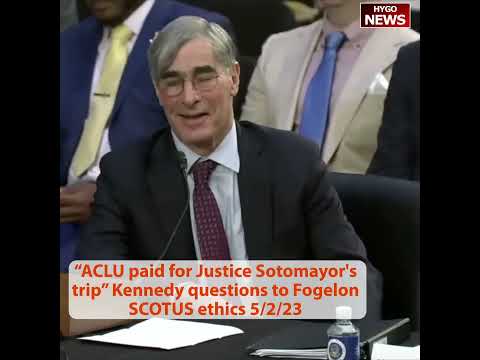
“ACLU Paid For Justice Sotomayor’s Trip” — Kennedy Questions Fogel On SCOTUS Ethics
Senator John Kennedy (R-LA) used a Senate Judiciary Committee hearing on Supreme Court ethics to put a hypothetical to former federal judge Jeremy Fogel: would payment from the American Civil Liberties Union for Justice Sonia Sotomayor’s trip to San Juan, Puerto Rico, be considered a bribe? Fogel said no. Kennedy agreed — then identified what he framed as the “understated premise” of the ethics debate: critics implicitly treat all gifts and travel from outside groups as suspect, even though the same logic would not be applied to ideologically friendly groups like the ACLU. The exchange dramatized the partisan asymmetry Republicans see in 2023’s Supreme Court ethics push.
The ACLU Sotomayor Example
- The trip: The American Civil Liberties Union covered some travel costs for Justice Sotomayor in San Juan, Puerto Rico.
- Standard practice: Universities, law schools, and advocacy groups often cover travel for justices’ speaking events.
- ACLU presence: The ACLU is a frequent litigant before the Supreme Court on civil liberties cases.
- Kennedy framing: Kennedy used the example to test whether the same scrutiny applies across ideological lines.
- Editorial choice: Kennedy chose Sotomayor — a justice from the Court’s liberal wing — for the hypothetical.
The San Juan Trip Hypothetical
- Cost question: Kennedy walked Fogel through what a first-class trip to San Juan might cost.
- Estimate offered: Fogel estimated “probably a couple thousand dollars” for first-class travel.
- Litigation status: Kennedy confirmed with Fogel that the ACLU has cases at the Court “all the time.”
- Bribery question: Kennedy then asked if the ACLU was trying to bribe Sotomayor.
- Shared answer: Both Fogel and Kennedy agreed the answer was no.
The Understated Premise
- Implicit assumption: Kennedy argued ethics critics implicitly treat all third-party support as suspect.
- Selective application: He suggested that scrutiny is selectively applied to politically conservative donors and friends.
- Logical extension: If support from frequent litigants is bribery, the rule must apply across the political spectrum.
- ACLU comparison: The ACLU appears before the Court more frequently than many of the donors recently scrutinized.
- Ethics framework: Kennedy used the comparison to argue ethics rules must be applied without ideological bias.
The Witness Response
- Honest answer: Fogel — a former federal judge — answered Kennedy’s questions directly.
- No bribery finding: Fogel said he did not believe the ACLU was trying to bribe Justice Sotomayor.
- Cost estimate: Fogel offered a real-world cost estimate without hedging.
- Frequent litigant acknowledgment: Fogel confirmed that the ACLU regularly appears before the Supreme Court.
- Hearing record: The exchange placed the ACLU comparison into the formal Senate record.
The Asymmetry Argument
- Symmetric standard: Kennedy’s questioning argued for an ethics standard that applies symmetrically to left and right.
- ProPublica context: ProPublica reporting in 2023 had focused on undisclosed gifts to Justice Clarence Thomas.
- Counter-illustration: Kennedy’s ACLU example was designed to illustrate that disclosed travel is common across the bench.
- Disclosure focus: The argument shifted the question from “did money change hands?” to “was the relationship disclosed?”
- Editorial framing: Republican senators have repeatedly used examples involving liberal justices to argue against asymmetric scrutiny.
The Disclosure Question
- Reporting requirements: Justices file annual financial disclosures covering reimbursed travel and gifts.
- ACLU disclosure: Travel reimbursed by the ACLU appears in standard disclosure forms.
- Reporting gaps: ProPublica reporting argued that some travel and gifts had not been properly disclosed.
- Definition fights: Much of the ethics debate turns on whether specific items qualify as “gifts” or “personal hospitality.”
- Statutory ambiguity: Existing rules contain ambiguity that has produced inconsistent practice across justices.
The Frequent Litigants
- ACLU caseload: The ACLU appears as party or amicus in dozens of Supreme Court cases each term.
- Conservative analogues: Conservative legal groups like the Alliance Defending Freedom also regularly litigate at the Court.
- Bar associations: State and federal bar associations also frequently support travel and events.
- Universities: Law schools host Supreme Court justices for talks, often with travel reimbursement.
- Reporting practice: All of these reimbursements appear, in varying degrees, in formal disclosure filings.
The Bribery Definition
- Legal definition: Bribery typically requires a quid pro quo connected to a specific official act.
- Disclosure distinction: Disclosed travel and reimbursements are not generally treated as bribery.
- Conflict standards: Recusal rules govern situations in which a judge has a financial or personal interest.
- Public perception: The public perception challenge is broader than the legal definition.
- Rhetorical use: Kennedy’s question forced witnesses to draw a clear line between disclosed travel and corruption.
The Republican Strategy
- Counter-narrative: Republicans have used hearings to construct a counter-narrative on Court ethics.
- Hypothetical method: Senators including Kennedy have used hypotheticals to expose perceived double standards.
- Public-facing posture: The strategy is designed to land in clips rather than detailed legislative debates.
- Long arc: Republican senators argue the ethics push is a political project rather than a structural reform.
- Senate calendar: With Democratic control of the Senate, Republicans cannot block hearings outright.
The Democratic Response
- Reform framing: Democratic senators frame the hearings as a step toward binding ethics rules.
- Specific concerns: Democratic concerns center on undisclosed gifts and travel involving Justice Thomas.
- Legislative bills: Several pending bills propose disclosure standards modeled on lower federal courts.
- Constitutional question: Constitutional debate centers on whether Congress can regulate the Court’s internal conduct.
- Election-year horizon: 2024 campaigns will likely use Court ethics as a turnout issue.
The Sotomayor Record
- Speaking events: Justice Sotomayor regularly speaks at universities, bar associations, and advocacy groups.
- Disclosure compliance: Her annual disclosures cover reimbursed travel and personal hospitality.
- Author income: Sotomayor’s book deals and royalties are also publicly disclosed.
- Public posture: Sotomayor is one of the most publicly active members of the current Court.
- No suggestion of impropriety: Kennedy’s question explicitly framed the ACLU example as not improper.
The Ethics Hearing Stakes
- Court legitimacy: The hearings overlap with public concerns about Court legitimacy and approval.
- Bipartisan tension: Both parties treat ethics as a tool for advancing broader narratives about the Court.
- Reform prospects: Prospects for binding legislation remain uncertain in a divided government.
- Administrative response: The Court’s internal response — including any ethics framework changes — is closely watched.
- Public messaging: Both parties use hearings as platforms for public messaging more than legislative drafting.
The Witness Selection
- Fogel’s background: Jeremy Fogel is a former federal judge and ethics scholar.
- Bipartisan credibility: Fogel’s record gives him credibility with both parties at hearings.
- Substantive testimony: Witnesses like Fogel provide substantive insight into existing disclosure practice.
- Republican use: Republicans used Fogel’s testimony to draw the symmetry argument into the record.
- Democratic use: Democrats used the same witness panel to highlight gaps in current rules.
The Disclosure System
- Annual filings: Justices file annual disclosures with the federal judiciary’s disclosure office.
- Reimbursement reporting: Reimbursed travel is reported with destination, source, and approximate value.
- Personal hospitality: A long-standing exemption for “personal hospitality” has been narrowed in recent guidance.
- Reform proposals: Proposed rules would tighten reporting on private travel, lodging, and meals.
- Enforcement question: Existing enforcement is largely self-regulatory, with no external enforcement mechanism.
The Public Perception Layer
- Approval ratings: Public approval of the Supreme Court is at multi-decade lows in 2023 polling.
- Partisan divide: The partisan gap in Court approval is among the widest on record.
- Disclosure narratives: Disclosure stories have driven much of the recent decline in public approval.
- Ethics fatigue: Both parties report concerns about ethics-driven erosion of institutional trust.
- Repair pathways: It remains unclear how the Court can rebuild public trust without binding rules.
The Constitutional Argument
- Article III scope: Congress has broad authority over court structure under Article III.
- Internal conduct: Whether that authority extends to internal ethics rules is contested.
- Self-regulation: The Court has historically set its own ethics framework via internal practice.
- Statement of ethics: In late 2023, the Court would issue a written code in response to pressure.
- Enforcement gap: Even after the code, no external enforcement mechanism exists.
The Long Arc
- Multi-year story: The 2023 ethics fight is part of a multi-year story about Court legitimacy.
- 2024 implications: Court rulings and ethics debates will run into 2024 election cycles.
- Confirmation echoes: Republican memories of recent confirmation battles inform their posture.
- Down-ballot effects: Senate races may turn in part on competing Court reform visions.
- Institutional outcome: The Court’s response will shape the next decade of Court politics.
Key Takeaways
- Kennedy used the ACLU’s reimbursement of Sotomayor travel as a hypothetical bribery test.
- Former federal judge Jeremy Fogel agreed the ACLU was not trying to bribe Sotomayor.
- Kennedy framed the exchange as exposing the “understated premise” of ethics critics.
- The ACLU appears as litigant before the Court “all the time,” per Kennedy and Fogel.
- The exchange highlighted Republican concerns about asymmetric ethics scrutiny.
- The exchange entered the Senate hearing record as a counter-narrative on Court ethics.
Transcript Highlights
The following quotations are drawn from an AI-generated Whisper transcript of the hearing and should be considered unverified pending official transcript release.
- “The American Civil Liberties Union paid for a Justice Sotomayor’s trip to San Juan, Puerto Rico” — Sen. Kennedy
- “Have you ever been to San Juan, Mr. Fogel? Is it expensive?” — Sen. Kennedy
- “It depends whether you fly first class or economy” — Jeremy Fogel
- “Probably a couple thousand dollars” — Jeremy Fogel
- “Do they have cases in front of the Supreme Court? All the time” — Sen. Kennedy / Fogel
- “Do you think the ACLU was trying to bribe Justice Sotomayor? No, sir, I don’t. I don’t either” — Kennedy / Fogel exchange
Full transcript: 116 words transcribed via Whisper AI.