 HYGO News
 A: MAGA Republicans hold debt ceiling Q: Biden’s specific plan? Medicare in 3 years & Social Securi
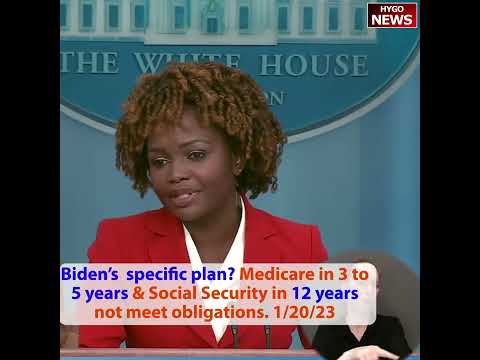
Reporter Presses on Biden’s Plan for Medicare (3-5 Years) and Social Security (12 Years) — KJP Pivots to “MAGA Republicans”
In January 2023, a reporter pressed White House Press Secretary Karine Jean-Pierre on when President Biden would lay out a specific plan for the looming Medicare and Social Security funding shortfalls. “What they say is that Medicare in three to five years will not be able to meet all its obligations. Social Security 12 years will not be able to meet all its obligations. The president’s been president for two years. He hopes to be president for six more years. When is he going to lay out a specific plan? We hear at the State of the Union, will it come in 2023?” the reporter asked. KJP’s response pivoted to attacking Republicans: “You know these MAGA Republicans in the house who are saying they’re gonna hold the debt ceiling unless those things are cut, that is a problem. We should not be doing this with conditions, should be done without conditions and we should not be negotiating around it.” The deflection showed the administration’s strategy of making entitlement reform about GOP threats rather than its own plans.
The Medicare and Social Security Shortfalls
The trust funds faced real challenges:
Medicare Hospital Insurance — 2028 projected insolvency.
Social Security OASI — 2034 projected depletion.
Obligations issue — Benefit cuts without action.
Demographic pressures — Growing retirees.
Political challenges — Reform difficulties.
Both programs faced well-documented funding challenges. Medicare’s Hospital Insurance trust fund was projected to be unable to pay full benefits starting around 2028 — within Biden’s second term if he won one. Social Security’s main trust fund was projected to hit similar point in 2034.
The Reporter’s Specific Framing
The reporter’s framing was carefully constructed:
“What they say” — Third-party attribution.
“Three to five years” — Specific Medicare timeline.
“12 years” — Specific Social Security timeline.
Biden’s time horizon — Two past plus six potential future.
Specific plan — Administration responsibility.
State of the Union — Specific occasion.
The framing pressed on specific administration obligation. If Biden hoped to serve until 2029, the Medicare shortfall would occur during his term. This wasn’t abstract policy — it was a problem he would face. The State of the Union reference provided specific occasion for plan announcement.
The Biden Presidential Timeline
The “two years down, six more” framing was notable:
2021-2025 — First term.
2025-2029 — Potential second term.
Medicare 2028 — Within potential term.
Action needed — In his service.
Plan expected — From his administration.
The reporter was making clear that Medicare solvency would fall on Biden’s watch if he served eight years. This wasn’t a problem he could defer to successors — it would require his administration’s attention.
”These Are Programs the American People Pay Into”
KJP started with the standard framing. “These are programs that the American people pay into,” KJP said.
The framing:
Entitlement foundation — Workers contribute.
Earned benefits — Political framing.
Government obligation — To honor contributions.
Democratic norm — Of preserving programs.
Political messaging — Defensive.
This framing was political boilerplate for defending Medicare and Social Security. It positioned these as earned rather than welfare, making cuts politically toxic. The framing was effective messaging but didn’t address the reporter’s question about plans.
”MAGA Republicans in the House”
KJP pivoted to attack GOP. “You have these MAGA Republicans in the house who are saying they’re gonna hold the debt ceiling unless those things are cut, that is a problem,” KJP said.
The pivot:
From Biden plans — To GOP threats.
Attack framing — Of Republicans.
MAGA identifier — Standard label.
Debt ceiling linkage — Entitlement cuts as ransom.
Problem characterization — Of GOP position.
The pivot was strategic. Rather than answer when Biden would propose changes, KJP made the topic about Republican threats. This shifted ground from Biden responsibility (what’s his plan?) to GOP critique (they’re threatening cuts).
The Accuracy of “Cuts” Framing
Whether Republicans were actually demanding “those things cut” was debatable:
GOP demands — Varied by faction.
Spending cuts broadly — Common demand.
Specific entitlement cuts — Less agreed upon.
RSC proposals — Republican Study Committee had proposals.
Leadership position — Often ambiguous.
Some Republican Study Committee proposals did include significant Medicare and Social Security changes. But House leadership had been hedging on specifics. The administration was using the harshest GOP proposals to characterize the party’s overall position, which was tactical messaging more than accurate description.
”Should Be Done Without Conditions”
KJP reiterated the no-negotiations debt ceiling position. “We should not be doing this with conditions, should be done without conditions and we should not be negotiating around it,” KJP said.
The no-conditions framing:
Clean debt ceiling — No concessions.
No negotiations — Position maintenance.
Entitlement protection — Through non-engagement.
Pattern establishment — Against leverage.
Constitutional framing — Duty to act.
This was the administration’s core debt ceiling position, applied here to entitlement discussions. By framing any entitlement discussion as “conditions” or “negotiations,” the administration was trying to keep entitlements off the debt ceiling table entirely.
The Real Question Avoided
The reporter had asked about Biden’s plans, not about Republican positions. By pivoting to GOP attacks, KJP avoided the actual question:
When would Biden act? — Unanswered.
What was Biden’s plan? — Not revealed.
State of the Union announcement? — Uncommitted.
Specific proposals? — Unnamed.
Timeline for action? — Unclear.
All the substantive questions about administration plans went unanswered. The pivot to GOP critique was effective for message management but left the reporter’s questions about Biden plans unaddressed.
The Political Calculation
The administration’s approach reflected calculation:
Any plan would be attacked — If specific.
Entitlement reform is risky — Politically.
GOP as foil — Useful framing.
Vague rather than specific — Safer.
Inaction better than bad specific — Assessment.
Biden would face attack if he proposed specific changes. Any cuts would alienate seniors. Any tax increases would alienate some constituencies. Inaction paired with attack on GOP was politically safer than proposing controversial specifics.
The State of the Union Question
The reporter’s State of the Union reference was pointed:
Major annual address — To Congress.
Policy agenda moment — Traditional venue.
Specific announcement expected — For major proposals.
Administration priorities — On display.
Presidential leadership — On issues.
If Biden was going to propose major entitlement reform, the State of the Union would be natural venue. The reporter’s question about 2023 SOTU put specific timing pressure on the administration. KJP’s non-committal response suggested no major announcement was planned.
The 2023 State of the Union Actual Content
When Biden delivered the 2023 State of the Union on February 7, 2023:
Entitlement defense — Against GOP “cuts.”
No specific reform — Proposed.
GOP attacks — Prominent.
Confrontation moment — With Congress.
Message focus — On defense not reform.
Biden’s 2023 State of the Union featured dramatic confrontation with Republicans over alleged cut plans. Biden didn’t propose his own reform. The speech doubled down on the approach previewed in KJP’s January comments.
The Accountability Gap
This exchange represented accountability gap:
Problem acknowledged — Programs face shortfalls.
Timeline pressing — Within his time.
Biden responsibility — As president.
Plans not provided — By administration.
Deflection to GOP — Rather than proposal.
The gap between problem recognition and administration solution was significant. The administration acknowledged the programs had funding issues but declined to propose solutions, instead attacking Republicans for theoretical solutions they might propose.
The 2022 Election Lessons
Democrats had used Social Security and Medicare defense effectively in 2022 midterms:
GOP unfavorable positions — On some cuts.
Attack ad material — Extensive.
Democratic messaging — Strong.
Base motivation — Successful.
Swing voter impact — Positive.
The political success of attacking GOP on entitlements in 2022 reinforced the administration’s 2023 approach. If attacks worked politically, why propose positive plans that would invite attacks in turn?
The Reform Difficulty
Entitlement reform was genuinely difficult:
Tax increases — Required for solvency.
Benefit changes — Politically toxic.
Bipartisan required — For sustainability.
Previous failures — Bush, Obama, Ryan.
Senior voting power — Deterring cuts.
Any reform package would need tax increases or benefit changes — both politically costly. Successful reform required bipartisan consensus that didn’t exist. Previous presidents had failed to achieve major reform. The difficulty was structural, not just messaging.
The Congressional Budget Office Reality
CBO analysis had been clear:
Long-term imbalance — Substantial.
Growing gap — Over time.
Debt implications — Significant.
Interest costs — Rising.
Policy choices — Limited in attractiveness.
The CBO had repeatedly documented the entitlement shortfalls. The administration knew these projections. Not proposing responses was choice, not ignorance. The choice reflected political calculation about priorities rather than substantive disagreement about problem existence.
The Interest Groups
Various interest groups affected the politics:
AARP — Senior protection focused.
AFL-CIO — Worker interests.
Chamber of Commerce — Fiscal concerns.
Think tanks — Various perspectives.
Advocacy groups — Specific constituencies.
The political coalition for maintaining current programs was stronger than for reform. Changing programs would energize opposition; maintaining them would please beneficiaries. Electoral incentives ran against reform.
The Long-Term Implications
Eventually, something would have to give:
Benefit cuts automatic — If trust funds deplete.
Tax increases needed — For solvency.
Political crisis — At trigger points.
Reform forced — Eventually.
Delay costs — Growing over time.
The longer reform was delayed, the harder it would be. Each year of inaction made eventual changes more dramatic. Biden not proposing reform during his term meant a future president would face more painful choices. This was cost of political caution.
Key Takeaways
- A reporter pressed KJP on Biden’s specific plan for Medicare (3-5 year shortfall) and Social Security (12-year shortfall).
- The reporter noted Biden’s timeline: “The president’s been present for two years. He hopes to be present for six more years. When is he going to lay out a specific plan?”
- KJP pivoted to attacking Republicans: “These MAGA Republicans in the house who are saying they’re gonna hold the debt ceiling unless those things are cut, that is a problem.”
- She reiterated the no-negotiations debt ceiling position: “Should be done without conditions and we should not be negotiating around it.”
- The substantive question about Biden’s plans went unanswered; the administration preferred attacking GOP to proposing specific reform.
- The approach foreshadowed the 2023 State of the Union, which featured entitlement defense against GOP “cuts” rather than any positive administration reform plan.
Transcript Highlights
The following is transcribed from the video audio (unverified — AI-generated from audio).
- My question though is, you know, what they say is that Medicare in three to five years Will not be able to meet all its obligations.
- Social Security 12 years will not be able to meet all its obligations.
- The president’s been present for two years. He hopes to be present for six more years. When is he going to lay out a specific plan?
- We hear at the State of the Union will it come in 2023?
- These are programs that the American people pay into when you have a You know these MAGA Republicans in the house who are saying they’re gonna hold the debt ceiling Unless those things are cut that is that is a problem.
- We should not be doing this with conditions should be done without conditions and we should not be negotiating around it.
Full transcript: 150 words transcribed via Whisper AI.