 HYGO News
 A: doesn’t change still not going to negotiate if McCarthy “no intention” of cutting Social Sec
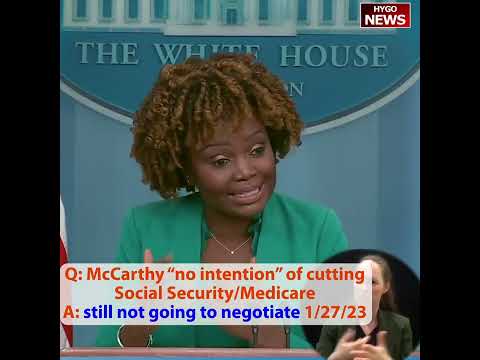
KJP: Even if GOP Presents Plan, “Doesn’t Change the Fact That We Are Not Going to Negotiate” on Debt Ceiling
In late January 2023, a reporter asked White House Press Secretary Karine Jean-Pierre about potential Republican plan presentation that might enable debt ceiling negotiations. “If the Republicans in the House do present a plan for conditions for what they would raise the debt limit under, will you start negotiations with them on that plan?” the reporter asked. KJP rejected negotiation regardless: “What would be the point of them presenting you with a list of demands?” She repeated attack on GOP “rhetoric”: “They want to cut, cut, cut, but they are just saying this rhetoric that’s incredibly dangerous, that is very dangerous to our full, the full credit and of our country.” She firmly concluded: “It doesn’t change the fact that we are not going to negotiate here.”
The Reporter’s Hypothetical
The hypothetical:
GOP plan — Possible presentation.
Conditions — For debt ceiling raise.
Negotiations — Starting point.
Process — Traditional.
Conditional question — Asked.
The reporter was asking reasonable hypothetical. If Republicans presented formal plan with specifications, would administration negotiate? This was standard policy question.
”What Would Be the Point”
KJP’s rejection. “What would be the point of them presenting you with a list of demands?” KJP said.
The rejection:
Demands characterized — List framing.
Presentation dismissed — Preemptively.
Negotiation refused — In advance.
Firm position — Maintained.
Process dismissed — By administration.
The response was revealing. KJP was saying Republican policy plan wouldn’t matter — no negotiations would occur regardless of specifics. This was absolute position.
”Cut, Cut, Cut”
The framing. “They want to cut, cut, cut,” KJP said.
The framing:
Repetition — Rhetorical.
Cutting emphasis — Attack angle.
Simple message — Clear.
Republican motivation — Characterized.
Political attack — Sharp.
The “cut, cut, cut” repetition was effective political rhetoric. It characterized Republicans as monotonously focused on cuts without substantive policy purpose.
”Rhetoric That’s Incredibly Dangerous”
The danger claim. “But they are just saying this rhetoric that’s incredibly dangerous, that is very dangerous to our full, the full credit and of our country,” KJP said.
The claim:
“Rhetoric” — Dismissive.
“Incredibly dangerous” — Escalation.
Credit of country — At stake.
Full faith and credit — References.
Stakes — High framed.
Characterizing GOP rhetoric as “dangerous to full credit” was escalated language. This elevated stakes while dismissing GOP position as mere rhetoric rather than policy.
The Verbal Stumble
Verbal stumble:
“Our full, the full credit” — Correction.
Standard phrase — “Full faith and credit.”
Recovery — Made.
Characteristic — KJP delivery.
Pressure response — Perhaps.
The brief stumble showed KJP working through standard terminology. “Full faith and credit” was standard phrase about U.S. government obligations. Recovery was quick.
”Should Be Done Without Condition”
The core position. “We continue to say we are not, this should be done when it comes to the debt limit, it’s the debt ceiling, it should be done without condition,” KJP said.
The position:
“Without condition” — Standard phrase.
Continuing commitment — Emphasized.
Debt ceiling distinct — From spending.
Administrative message — Discipline.
Consistency — Valued.
The “without condition” framing had been administration’s core position throughout. Continuing to repeat it maintained message discipline.
”That Doesn’t Change Anything”
The impact denial. “That doesn’t change anything. I’m just laying out how they’re proceeding here,” KJP said.
The denial:
Hypothetical — Doesn’t matter.
GOP behavior — Unchanged.
Administration position — Unchanged.
Specific plan — Irrelevant.
Fixed position — Admitted.
By saying GOP plan presentation “doesn’t change anything,” KJP was making explicit that Administration position was absolute regardless of GOP actions.
”It’s Such a Reckless Way”
The characterization. “It’s such a reckless way and so we’re just calling that out,” KJP said.
The characterization:
“Reckless” — Strong.
GOP approach — Characterized.
Moral framing — Added.
Calling out — Function.
Political attack — Continued.
“Reckless” characterization added moral dimension to attack. GOP wasn’t just wrong — they were reckless. This elevated political critique.
”It Doesn’t Change the Fact That We Are Not Going to Negotiate”
The firm conclusion. “It doesn’t change the fact that we are not going to negotiate here,” KJP said.
The conclusion:
Firm commitment — Restated.
No negotiation — Absolute.
Regardless of GOP — Actions.
Pattern maintained — Consistently.
Political stake — Established.
The firm no-negotiation position was being maintained absolutely. Even hypothetical reasonable GOP plan wouldn’t trigger negotiations. This was strong stance.
The Political Strategy
Political strategy:
No conditions — Public stance.
Force GOP concession — Goal.
Clean raise — Demand.
Time pressure — Weapon.
Political framing — For eventual resolution.
Administration strategy was to maintain “no conditions” position as long as possible. This would pressure GOP as default approached. Eventually something would give.
The 2011 Lesson
2011 lesson:
Obama negotiated — Then.
Bad deal — Result.
Sequestration — Cascading effects.
Political damage — Lasting.
Democratic learning — From experience.
Democrats had learned from 2011 that negotiations over debt ceiling were politically costly. Biden’s team was determined not to repeat that experience. The “no negotiation” position came from that lesson.
The Political Reality
Political reality:
Default — Must be avoided.
Negotiations — Usually happen.
Public positioning — Matters.
Brinkmanship — Each side.
Eventual deal — Typically.
The political reality was that debt ceiling crises historically ended in negotiations. “No negotiation” positions typically softened as deadlines approached. The question was how long positioning could hold.
The Republican Position
Republican position:
Spending cuts — Required.
Freedom Caucus demands — Binding.
McCarthy’s problem — Coalition.
Specific demands — Evolving.
Public pressure — Building.
Republicans also had fixed positioning initially. Spending cuts were required. This matched Democratic fixed positioning. Something would have to give.
The Hypothetical Premise
The hypothetical:
GOP presenting plan — Would be concrete step.
Demands clarity — From it.
Administration response — Tested.
Reasonable behavior — Expected.
Engagement invitation — Possible.
If Republicans presented formal written plan, that would be concrete step toward engagement. Administration’s refusal to engage even with hypothetical plan showed rigidity.
The Negotiation Purpose
Negotiation purpose:
Compromise — Finding.
Mutual concessions — Possible.
Both get something — Typical.
Resolution — Eventually.
Democratic function — Important.
Negotiations weren’t surrender — they were process for finding compromise. Administration rejecting negotiations preemptively was rejecting democratic process essentially.
The Constitutional Argument
Constitutional argument:
14th Amendment — Some invoke.
Public debt — Cannot be questioned.
Biden authority — Possibly unilateral.
Court uncertainty — Real.
Legal theory — Untested.
Some scholars argued Biden had constitutional authority to pay debts regardless of ceiling. Administration hadn’t explicitly embraced this but was leaving option open.
The Premium Coin
Premium coin:
Trillion-dollar coin — Mint.
Legal theory — Controversial.
Administrative option — Available.
Technical workaround — Possible.
Not officially — Considered.
The platinum coin option was technical workaround some had proposed. Administration hadn’t officially endorsed but hadn’t ruled out. This was another escape valve from ceiling crisis.
The Market Implications
Market implications:
Uncertainty — Growing.
Treasury yields — Affected.
Stock market — Watching.
International concern — Real.
Economic damage — If default.
As debt ceiling crisis continued, markets reacted. Treasury yields rose. Stocks were volatile. International concerns grew. Economic damage from default would be substantial.
The 2024 Political Dimension
2024 dimension:
Campaign ammunition — For both sides.
Biden blamed — Or credited.
GOP blamed — Or credited.
Default impact — Political.
Resolution — Political narrative.
Whatever resolution came would affect 2024 campaigns. Both sides were positioning for blame or credit. Default would hurt everyone; resolution would be claimed as victory.
The Timeline
Timeline:
January hit — Ceiling.
Extraordinary measures — Extending.
Summer deadline — Approximate.
Negotiations window — Months.
Eventual resolution — June.
The timeline for debt ceiling resolution was months not weeks. Between January and summer, positioning would continue. Eventually negotiations would produce deal.
The Eventual Deal
Eventual deal:
June 2023 — Reached.
Biden-McCarthy — Agreement.
Both compromised — Necessarily.
Default averted — Barely.
Political outcome — Mixed.
The Fiscal Responsibility Act reached in June 2023 required both sides to compromise. The “no negotiation” position was abandoned when necessary. But political positioning throughout had shaped deal terms.
The McCarthy Position
McCarthy position:
Freedom Caucus — Pressure.
Moderate members — Concerns.
Deal-making — Required.
Coalition management — Difficult.
Eventual compromise — Made.
McCarthy had to navigate coalition dynamics while negotiating with Biden. Freedom Caucus demands versus moderate concerns versus White House positions. Compromise was difficult.
The Democratic Strategy Success
Democratic strategy:
No concessions — Publicly.
Force GOP movement — Goal.
Moderate position — Ultimately.
Campaign messaging — Preserved.
Reasonable success — Arguably.
The Democratic “no negotiation” strategy could be judged moderately successful. Final deal included some concessions but was relatively limited in scope. Political messaging was largely preserved.
The Messaging Discipline
Messaging discipline:
Consistent line — Maintained.
Individual statements — Not allowed to break.
Party unity — Preserved.
Political benefit — Real.
Strategy execution — Professional.
The messaging discipline on debt ceiling was professional level. Individual statements weren’t allowed to break party line. Consistency maintained through months of positioning.
The Press Secretary Role
Press secretary role:
Message delivery — Primary.
Substantive engagement — Secondary.
Consistency — Valued.
Flexibility — Limited.
Political dimension — Always.
KJP’s role was message delivery rather than policy engagement. Consistency with established positions was prioritized. Individual substantive engagement was limited.
The Administrative Confidence
Administrative confidence:
Position justified — Internally.
Precedent invoked — 2011.
Political calculation — Strong.
Risk accepted — Default possibility.
Strategy maintained — Throughout.
Administration was confident in strategy. 2011 precedent supported it. Political calculation was strong. Even default risk was accepted as worth preserving position. Commitment was firm.
The Republican Calculation
Republican calculation:
Pressure Biden — Goal.
Spending cuts — Demand.
Political blame — Risk.
Freedom Caucus — Require satisfaction.
Negotiation inevitable — Eventually.
Republicans had their own calculation. Pressure Biden into negotiations. Extract spending concessions. Avoid default blame. Satisfy Freedom Caucus. Multiple objectives to balance.
The Eventual Compromise
Eventual compromise:
Spending caps — Agreed.
Debt ceiling raised — 2 years.
Work requirements — Added.
Various specifics — Included.
Both sides — Claimed victory.
The final deal included elements both sides could claim. Spending caps for GOP. Debt ceiling raise for administration. Various specifics for different interests. Political success claimed by both.
The Post-Deal Assessment
Post-deal assessment:
Democrats relieved — No crisis.
Republicans claimed — Fiscal discipline.
Moderate voices — Vindicated.
Hard-liners — Disappointed.
Democracy — Worked.
After deal, both sides declared victory. Moderate voices who advocated compromise felt vindicated. Hard-liners were disappointed. Democratic system produced resolution despite brinkmanship.
Key Takeaways
- A reporter asked KJP about hypothetical GOP plan presentation enabling negotiations.
- KJP rejected negotiation regardless: “What would be the point of them presenting you with a list of demands?”
- She attacked GOP rhetoric: “They want to cut, cut, cut, but they are just saying this rhetoric that’s incredibly dangerous.”
- KJP maintained firm position: “We continue to say we are not, this should be done when it comes to the debt limit, it’s the debt ceiling, it should be done without condition.”
- She made explicit: “It doesn’t change the fact that we are not going to negotiate here.”
- The rigid “no negotiation” position would eventually give way to June 2023 compromise deal, but public positioning maintained throughout crisis.
Transcript Highlights
The following is transcribed from the video audio (unverified — AI-generated from audio).
- If the Republicans in the House do present a plan for conditions for what they would raise the debt limit under, will you start negotiations with them on that plan?
- What would be the point of them presenting you with a list of demands?
- They want to cut, cut, cut, but they are just saying this rhetoric that’s incredibly dangerous, that is very dangerous to our full, the full credit and of our country.
- We continue to say we are not, this should be done when it comes to the debt limit, it’s the debt ceiling, it should be done without condition.
- That doesn’t change anything. I’m just laying out how they’re proceeding here. It’s such a reckless way and so we’re just calling that out.
- But it doesn’t change where we stand. It doesn’t change the fact that we are not going to negotiate here.
Full transcript: 169 words transcribed via Whisper AI.