 HYGO News
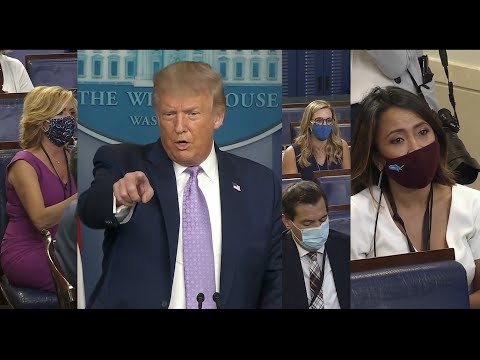
 8/5/2020 Trump Holds a News Conference
8/5/2020 Trump Holds a News Conference
On August 5, 2020, President Trump held a wide-ranging White House news conference covering the Hatch Act controversy over his potential convention speech at the White House, ongoing pandemic relief negotiations with congressional Democrats, Arizona’s approach to controlling coronavirus, and economic recovery numbers. Trump dismissed Republican Sen. John Thune’s concerns about Hatch Act violations and touted his administration’s pandemic response while pressing for a payroll tax suspension.
The Hatch Act and the Convention Speech
A reporter opened with a question about Trump’s consideration of using the White House as the venue for his Republican National Convention nomination acceptance speech, noting that Sen. John Thune had questioned whether it would be legal under the Hatch Act.
Trump’s response was immediate and dismissive. “John Thune did? The Republican John Thune?” he asked, clearly displeased that the criticism came from within his own party. “Okay, well, it is legal. There is no Hatch Act because it doesn’t pertain to the President.”
Trump was technically correct that the president and vice president are exempt from the Hatch Act, which bars federal employees from using government property for political purposes. However, other federal employees involved in organizing or facilitating the event on White House grounds would still be subject to the law’s restrictions.
Trump then made a practical case for the White House venue: “If I use the White House, we save tremendous amounts of money for the government in terms of security, traveling. If we go to another state or some other location, the amount of money is very enormous.” He added that the White House “would be by far the least expensive location” and would eliminate the need for “tremendous traveling security with airplanes and everybody flying all over the place.”
The convention speech question had arisen because the coronavirus pandemic had largely prevented the Republican Party from holding its planned in-person event, forcing the campaign to find alternative arrangements.
Pandemic Relief Negotiations
Trump provided an update on negotiations with congressional Democrats over the next round of pandemic relief. He noted that his administration had enacted $3 trillion in economic relief since the virus began spreading and characterized the relief efforts as “very, very successful.”
“We’ve been negotiating in good faith with Democrat leaders in the House to extend relief payments,” Trump said. “If Democrat leaders put partisan demands aside, we would reach an agreement very quickly.”
Trump signaled he was prepared to act unilaterally if negotiations stalled, saying his administration was “exploring executive actions to provide protections against eviction” and “additional relief to those who are unemployed as a result of the virus.”
He expressed strong support for a payroll tax suspension: “Very importantly, I’m also looking at a term-limited suspension of the payroll tax. Something that has great support from many, many sides, especially some of our top economists.”
Trump drew a clear line against one Democratic priority: “The Democrats are primarily interested in a $1 trillion bailout of the poorly run states. We have some states and cities, you know them all. They’ve been very poorly run over the years. And we can’t go along with the bailout money. We’re not going to go along with that, especially since it’s not COVID-related.”
Arizona as a Model for Pandemic Response
A significant portion of the press conference focused on Trump’s meeting earlier that day with Arizona Governor Doug Ducey. Trump held up Arizona as “a model for applying a science-based approach to the decreasing cases and hospitalizations without implementing a punishing lockdown.”
He cited specific numbers: “Arizona has reduced the number of daily new cases by over 75 percent, cut the positivity rate in half, and reduced ER visits by two-thirds all the while, keeping the economy functioning and functioning really well.”
Trump noted that when cases surged in Arizona in June, Vice President Pence and Dr. Deborah Birx had visited the state for consultations with Ducey’s team, and Pence had remained in “constant contact ever since.”
The federal government’s support to Arizona was substantial, according to Trump: “more than 400 million pieces of personal protective equipment” along with “nearly 70,000 vials of remdesivir” and “over $18 billion in economic support.”
Economic Recovery Numbers
Trump referenced recent economic data that he characterized as evidence the recovery was underway. He cited “used car sales and auto production” numbers as “shockingly incredible” indicators of an economic rebound. The data came amid a broader debate about whether the pandemic recovery was V-shaped as the administration argued or whether more sustained damage was being masked by one-time stimulus effects.
The Alaska Question
An unexpected moment in the press conference came when a reporter asked about opposition from sportsmen, including Trump’s son, to a development project that could harm fisheries in Alaska. Trump acknowledged he had “listened to both sides” and praised his son’s environmental interests: “My son has some very strong opinions and he is very much of an environmentalist.” He noted that he would “look at both sides of it” and that a briefing was expected within the next 48 hours.
Trump also referenced an environmental bill he had signed the previous day, calling it “one of the great environmental bills and beyond that ever signed since, I guess, over a hundred years.”
Additional Context from Full Remarks
The full press conference ran well over an hour and touched on numerous additional topics through reporter questions. Trump’s comments about the Hatch Act drew the most immediate attention because they put him at odds with a member of his own party’s Senate leadership. Thune had told reporters earlier that day that “anything you do on federal property would seem to be problematic,” a position that reflected concern within the Republican caucus about the optics and legality of using the White House for a partisan political event.
The relief negotiation comments were also significant because they previewed the executive actions Trump would ultimately take later that month when talks with Congress broke down, including a memorandum on eviction protections and an executive order on payroll tax deferrals.
Key Takeaways
- Trump dismissed fellow Republican Sen. John Thune’s Hatch Act concerns about a White House convention speech, correctly noting that the president is exempt from the law but sidestepping the question of whether other federal employees would violate it by helping organize a political event on government property.
- He signaled willingness to use executive action on eviction protections, unemployment relief, and a payroll tax suspension if Democratic negotiations over the next pandemic relief package failed to produce a deal.
- Trump held up Arizona as a model for pandemic response, citing a 75 percent reduction in daily cases and halved positivity rates achieved without a full lockdown, following close consultation between the state and the vice president’s coronavirus task force.