 HYGO News
 8 days before Midterm, Biden threatens higher tax on oil companies if profit high
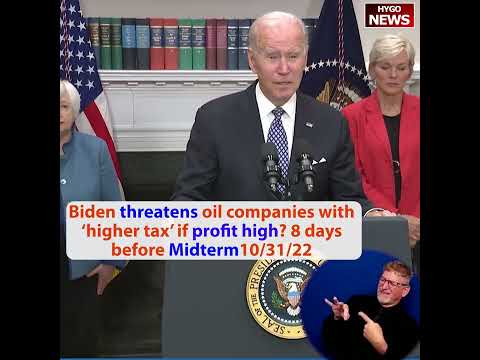
Eight Days Before Midterms, Biden Threatens Oil Companies With “Higher Tax on Excess Profits” — Industry Responds: “Increasing Taxes Discourages Production”
On 10/31/2022, just eight days before the midterm elections, President Biden delivered a White House speech threatening oil companies with a windfall profits tax if they didn’t increase production and lower gas prices. “If they don’t, they’re going to pay a higher tax on their excess profits and face other restrictions,” Biden warned. He accused the industry of “war profiteering” and said companies had “a responsibility to act in the interest of their consumers, their community, and their country.” The American Petroleum Institute fired back immediately: “Increasing taxes on American energy discourages investment in new production, which is the exact opposite of what is needed.” Biden couldn’t impose the tax unilaterally — he would need congressional approval he was unlikely to get — making the threat more pre-election messaging than actionable policy.
”They’re Going to Pay a Higher Tax”
Biden framed his threat as a last resort after giving oil companies time to act responsibly. “I think they have a responsibility to act in the interest of their consumers, their community, and their country. To invest in America by increasing production and refining capacity,” Biden said.
“If they don’t, they’re going to pay a higher tax on their excess profits and face other restrictions,” Biden continued. “My team will work with Congress to look at these options that are available to us and others.”
The threat was notable for its timing — eight days before an election in which gas prices and inflation were the dominant voter concerns. Biden had spent months blaming oil companies for high prices despite his own FTC finding no evidence of price gouging. The windfall tax threat escalated the anti-industry rhetoric to its most aggressive level yet.
But the threat was toothless. A windfall profits tax would require new legislation — meaning it would need to pass both the House and Senate. Democrats controlled both chambers by the slimmest possible margins, and even progressive Democrats like Joe Manchin — who represented coal and energy-dependent West Virginia — were unlikely to support punitive taxes on domestic energy production during an energy crisis.
”War Profiteering”
Biden escalated his rhetoric against the industry. “It’s time for these companies to stop war profiteering, meet their responsibilities in this country, and give the American people a break and still do very well,” Biden said.
The “war profiteering” charge — linking oil company profits to Russia’s invasion of Ukraine — was designed to cast the industry as villains exploiting a geopolitical crisis. The framing was politically potent but economically misleading. Oil companies were earning higher profits because global oil prices were high — driven by supply constraints that Biden’s own policies had exacerbated through pipeline cancellations, lease moratoriums, and anti-fossil-fuel regulatory signals.
Oil company profits were a function of the price of oil, which was set by global markets, not by corporate boardroom decisions. When crude oil traded at $90 per barrel instead of $50, producers earned more per barrel regardless of their pricing strategy. The “war profiteering” label implied deliberate exploitation when the actual dynamic was market-driven price increases flowing through to the companies that produced the commodity.
The Industry Response
The American Petroleum Institute responded sharply. “Increasing taxes on American energy discourages investment in new production, which is the exact opposite of what is needed,” API President Mike Sommers said. “American families and businesses are looking to lawmakers for solutions, not campaign rhetoric.”
The API’s response identified the central contradiction in Biden’s approach: threatening oil companies with punitive taxes while simultaneously demanding they invest in more production. Companies make long-term capital investment decisions — building wells, pipelines, and refineries that take years to develop — based on the regulatory and tax environment they expect to face. Threatening windfall taxes on profits from production was a signal that producing more oil would be punished, not rewarded.
The oil industry had already shown reluctance to invest aggressively in new production under the Biden administration, citing regulatory uncertainty and the president’s stated goal of transitioning away from fossil fuels. Adding windfall tax threats to the existing anti-industry climate would, as API argued, further discourage the investment Biden was demanding.
The Windfall Tax History
Windfall profits taxes on oil companies had been proposed — and rejected — multiple times in American history. The most significant precedent was the Crude Oil Windfall Profit Tax Act of 1980, signed by President Carter. The tax was designed to capture revenues from the decontrol of domestic oil prices but was widely regarded as a failure. A Congressional Research Service analysis found the 1980 tax reduced domestic production by 3-6%, increased oil imports, and generated less revenue than projected. The tax was repealed in 1988.
Biden’s 2022 threat echoed progressive proposals from Senators Bernie Sanders and Elizabeth Warren, who had introduced windfall tax legislation earlier in the year. Neither bill advanced beyond committee, and the proposals faced opposition from energy-state Democrats whose support would be essential for passage.
”I Know Where I Stand”
Biden closed with populist positioning. “The American people are going to judge who’s standing with them and who is only looking out for their own bottom line,” Biden said. “I know where I stand.”
The framing — Biden standing with consumers against greedy corporations — was classic pre-election populism. It cast the midterm choice as a battle between the people and corporate interests, with Biden as the people’s champion.
But Biden’s actual energy policy record told a different story. He had canceled the Keystone XL pipeline on day one, paused federal oil and gas leasing, proposed new methane regulations, and repeatedly pledged to end fossil fuels — all policies that constrained domestic energy supply and contributed to the price increases he was now blaming on corporate greed.
The threat to impose windfall taxes on companies producing the energy Americans needed was the policy equivalent of punishing firefighters for charging to put out a fire the government had helped start.
The Pre-Election Calculation
The timing of the windfall tax threat — eight days before the midterms — revealed its true purpose. Biden needed a villain for the inflation story, and oil companies served the role perfectly. The threat allowed him to appear tough on corporate profiteering without actually changing any policy. If Democrats held Congress, the threat could be quietly shelved. If Democrats lost Congress, the threat was moot. Either way, it served its function as pre-election messaging.
The strategy followed a pattern: announce dramatic-sounding action, generate headlines about fighting for consumers, let the news cycle absorb the message, and never follow through with actual legislation. The windfall profits tax was never introduced, never voted on, and never became law. It existed entirely as a campaign prop — eight days of rhetoric that served its political purpose and was forgotten by Thanksgiving.
Key Takeaways
- Eight days before midterms, Biden threatened oil companies with a windfall profits tax if they didn’t increase production and lower prices.
- The API responded that “increasing taxes discourages investment in new production, which is the exact opposite of what is needed.”
- Biden accused companies of “war profiteering” — though high profits reflected global oil prices, not corporate manipulation.
- The threat was toothless: a windfall tax required congressional approval Biden couldn’t secure, even with Democratic majorities.
- The 1980 windfall profits tax precedent was widely regarded as a failure that reduced domestic production and increased imports.
Transcript Highlights
The following is transcribed from the video audio (unverified — AI-generated from audio).
- They have a responsibility to act in the interest of their consumers, their community, and their country.
- To invest in America by increasing production and refining capacity. If they don’t, they’re going to pay a higher tax on their excess profits.
- My team will work with Congress to look at these options available to us.
- It’s time for these companies to stop war profiteering and give the American people a break.
- The American people are going to judge who’s standing with them and who is only looking out for their own bottom line.
- I know where I stand. I want to let you hear more from me about this when Congress gets back.
Full transcript: 159 words transcribed via Whisper AI.