 HYGO News
 785 Days After Biden Took Office, KJP Says 'We're Going To Secure The Border'
By HYGO News
Published
· Updated
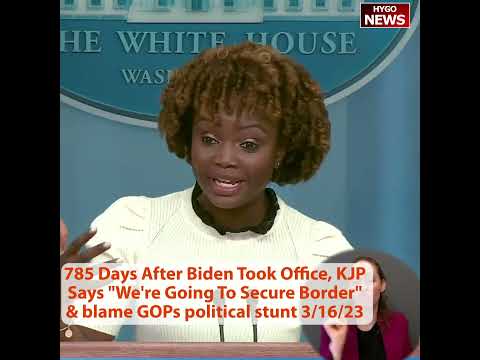
785 Days After Biden Took Office, KJP Says “We’re Going To Secure The Border”
White House Press Secretary Karine Jean-Pierre told reporters the Biden administration would “secure the border” during a March 2023 briefing — 785 days into President Biden’s term — while defending the administration’s humanitarian parole program for migrants from Cuba, Haiti, Nicaragua, and Venezuela. The exchange came as Texas led a multi-state lawsuit challenging the program and as critics pointed to record Southwest border encounters since Biden took office in January 2021.
The 785-Day Context
- Inauguration baseline: Biden took office January 20, 2021, making the briefing day roughly 785 days into his presidency.
- Border encounter trend: Customs and Border Protection had logged consecutive record fiscal years for Southwest border encounters in 2021 and 2022.
- Title 42 wind-down: The pandemic-era border expulsion authority remained in effect at the time of the briefing but was scheduled to end in May 2023.
- Critics’ framing: Republican lawmakers seized on the “going to secure” phrasing as an admission the border was not already secure after two years.
- White House framing: Jean-Pierre positioned border security as an ongoing bipartisan responsibility, not a task yet to begin.
The Humanitarian Parole Program
- Four-country scope: The program allowed up to 30,000 migrants per month from Cuba, Haiti, Nicaragua, and Venezuela to enter with a U.S. sponsor.
- Statutory basis: The program relied on the Department of Homeland Security’s parole authority under the Immigration and Nationality Act.
- Sponsor requirements: U.S.-based sponsors had to pass background checks and commit to supporting parolees financially.
- Two-year status: Approved parolees received two years of authorization to live and work in the United States.
- Early results: The administration credited the program with reducing unauthorized crossings from the four nationalities in the months after launch.
The Texas-Led Lawsuit
- Coalition: Texas led a coalition of roughly 20 Republican-led states in challenging the program in federal court.
- Legal theory: Plaintiffs argued the administration exceeded its statutory parole authority by creating a categorical program rather than case-by-case reviews.
- Standing argument: States claimed financial harm from hosting parolees who would use state services.
- Venue: The case was filed in the Southern District of Texas, where the state had previously prevailed in immigration-related litigation against the administration.
- Program stakes: A ruling blocking the program could force migrants back to unauthorized crossings or stranding at the border.
KJP’s Comprehensive Reform Framing
- Day one proposal: Jean-Pierre referenced the U.S. Citizenship Act that Biden introduced on his first day in office.
- Bill contents: The proposal would have provided a pathway to citizenship for roughly 11 million undocumented immigrants and expanded legal immigration channels.
- Republican reception: The comprehensive bill never advanced in the Senate, where it faced a 60-vote threshold and unified GOP opposition.
- KJP critique: The press secretary framed Republican refusal to engage as evidence they preferred the border as a political issue.
- Messaging bet: By tying border security to comprehensive reform, the White House attempted to shift responsibility to Congress.
The “Political Stunt” Characterization
- Attack line: Jean-Pierre characterized the Republican legal challenge as “a political stunt” rather than a serious policy disagreement.
- Rhetorical strategy: The framing attempted to dismiss legal criticism while avoiding substantive engagement on parole authority questions.
- Seriousness challenge: KJP repeatedly said Republicans “are not serious” about border solutions — a frame contested by GOP lawmakers with competing border bills.
- Program effectiveness claim: The press secretary insisted the parole program “is working” multiple times without providing specific metrics.
- Partisan defense: By positioning challengers as bad-faith actors, the White House attempted to insulate the program from legitimate legal scrutiny.
Comprehensive Immigration Reform History
- 2013 effort: The Senate passed a comprehensive bill in 2013 with bipartisan support, but it died in the Republican-controlled House.
- 2018 Trump attempts: Multiple comprehensive packages failed during the first Trump administration amid disputes over DACA and border funding.
- Biden 2021 proposal: The U.S. Citizenship Act represented the most ambitious reform attempt in a decade.
- Filibuster barrier: Senate rules requiring 60 votes made comprehensive reform nearly impossible in a narrowly divided Senate.
- Piecemeal approaches: Both parties proposed narrower bills addressing DREAMers, farm workers, or border enforcement separately.
Border Enforcement Measures in Place
- CBP One app: The administration launched a mobile app allowing migrants to schedule asylum appointments at ports of entry.
- Venezuela policy: Expanded expulsions of Venezuelans under Title 42 were paired with the parole program as a push-pull combination.
- Wall construction: The administration resumed limited border wall construction in high-traffic areas despite earlier pauses.
- Personnel: CBP staffing levels remained a political flashpoint as agents faced record apprehension workloads.
- Asylum processing: New asylum rules requiring migrants to seek protection in transit countries before reaching the U.S. were under development.
The Political Calculus
- 2024 implications: Immigration polling consistently showed Biden underwater on border handling among independents and Hispanic voters.
- GOP messaging: Republican presidential hopefuls uniformly attacked the administration on border security ahead of 2024 primaries.
- Democratic fractures: Border-state Democrats including Sen. Mark Kelly and Rep. Henry Cuellar pressed the White House for tougher enforcement.
- Activist pushback: Immigration advocates criticized any tightening as betrayal of Biden’s more humane campaign promises.
- Narrow path: The White House attempted to balance enforcement signaling with legal pathway expansion — pleasing neither flank.
Key Takeaways
- Jean-Pierre’s “going to secure the border” phrasing — 785 days into Biden’s term — drew immediate Republican criticism as an admission of failure.
- The press secretary defended the four-country humanitarian parole program as “working” without providing specific metrics.
- KJP framed the Texas-led lawsuit challenging the parole program as a “political stunt” rather than a substantive legal dispute.
- The White House pivoted to Biden’s day-one comprehensive immigration reform proposal to shift blame to congressional Republicans.
- The administration’s messaging strategy tied border security to comprehensive reform that had no realistic path through the Senate.
- Border encounters at the Southwest border had hit consecutive record fiscal years during Biden’s term at the time of the briefing.
Transcript Highlights
The following quotations are drawn from an AI-generated Whisper transcript of the briefing and should be considered unverified pending official transcript release.
- “Look, we’re going to secure the border.” — Karine Jean-Pierre
- “That parole program that we put into place is working.” — Karine Jean-Pierre
- “The President put this program together, and again, it’s working.” — Karine Jean-Pierre
- “Instead of Republicans in Congress or Republicans working with us on fixing this issue or dealing with a real issue, the border, they want to repeal a program that is actually doing what it is supposed to be doing.” — Karine Jean-Pierre
- “This is a political stunt by them.” — Karine Jean-Pierre
- “It’s going to put forth a comprehensive immigration reform bill on day one, and they have refused to work with us.” — Karine Jean-Pierre
Full transcript: 157 words transcribed via Whisper AI.