 HYGO News
'Four Pages of Blame': Kirby on the White House's Afghanistan Withdrawal Review (April 6, 2023)
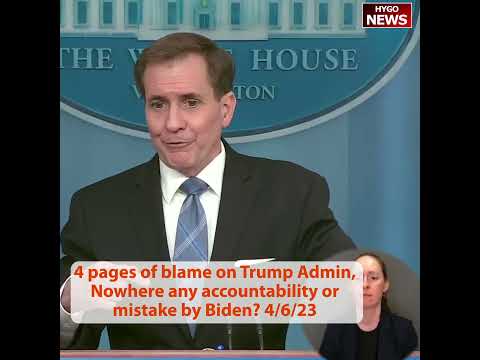
On April 6, 2023, the White House released a 12-page summary of the government’s internal reviews of the 2021 U.S. withdrawal from Afghanistan [2]. During that withdrawal, a suicide bomber at Abbey Gate, outside the Kabul airport, killed 13 U.S. service members and about 160 civilians [5]. John Kirby, the National Security Council’s coordinator for strategic communications, presented the summary at that day’s White House briefing. A reporter pointed out that the document devoted pages to the previous administration’s decisions and asked whether anyone was acknowledging mistakes. This video shows Kirby’s answer. Quotes are from the official transcript published by the American Presidency Project [1].
Key Moments
”Decisions made … by the previous administration”
Kirby opened by saying that “the President’s decision to end the war in Afghanistan was the right one,” and that “it is also undeniable that decisions made and the lack of planning done by the previous administration significantly limited options available to him. President Biden inherited a force presence in Afghanistan of some 2,500 troops. That was the lowest since 2001.” He said Biden had also inherited “a deal struck between the previous administration and the Taliban that called for the complete removal of all U.S. troops by May of 2021,” and that when Biden’s transition team asked to see plans for the withdrawal, “None were forthcoming. Transitions matter. That’s the first lesson learned here” [1].
”Four pages here of blame”
“There’s four pages here of blame on the previous administration or this White House explanation of what the last White House did regarding Afghanistan,” a reporter said. “Nowhere in here does there appear to be any expression of accountability or mistake by either the President himself or others. Is there any for what happened?” Kirby answered: “I would argue that the very fact that we voluntarily — the agencies voluntarily decided to go conduct after-action reviews — nobody told them to do that. That wasn’t legislated by Congress. They did that on their own.” Releasing the reviews to Congress, publishing a summary and “the fact that I’m up here talking to you about it, I think, shows you how seriously the President felt about learning lessons from this withdrawal,” he said [1].
”Sometimes enemies get a vote”
Another reporter noted that the document said the government now prioritizes earlier evacuations and asked whether Biden had any regrets about how the withdrawal was carried out. “The President is very proud of the manner in which the men and women of the military, the Foreign Service, the intelligence community … conducted this withdrawal,” Kirby said. “But, look, I’ve been around operations my entire life, and there’s not a single one that — that ever goes perfectly according to plan. Things happen. Sometimes enemies get a vote.” Asked whether Biden wished he had done things differently, he said: “I think everything is laid out here in this document about the main — the main takeaways, the main lessons that we learned” [1].
Background: What the Summary Says
The document’s central argument appears on its first page: “President Biden’s choices for how to execute a withdrawal from Afghanistan were severely constrained by conditions created by his predecessor.” It recounts that in February 2020 “the United States and the Taliban reached a deal, known as the Doha Agreement, under which the United States agreed to withdraw all U.S. forces from Afghanistan by May 2021” [2]. By our count, most of its references to the previous administration fall in its first four pages; the rest describes the evacuation of “over 124,000 American citizens, permanent residents, Afghan partners, and allies” and the lessons drawn from it. Among them: “We now prioritize earlier evacuations when faced with a degrading security situation,” and “In a destabilizing security environment, we now err on the side of aggressive communication about risks” [2].
Fact Check
- “Some 2,500 troops. That was the lowest since 2001.” Accurate. On January 15, 2021, five days before Biden took office, the Pentagon announced that U.S. forces in Afghanistan had reached 2,500, “the goal President Trump had set” and “the lowest number of American troops since the U.S. first invaded the country in 2001,” PBS reported [3].
- “Nowhere in here does there appear to be any expression of accountability or mistake.” Mostly accurate. The document acknowledges one error: it says the drone strike the U.S. military launched in Kabul after the Abbey Gate bombing “mistakenly killed ten civilians,” calling it a “tragic error.” It attributes no mistakes to the president, and it argues that “There were no signs that more time, more funds, or more Americans at risk in Afghanistan would have yielded a fundamentally different trajectory” [2].
- “Severely constrained by conditions created by his predecessor.” Disputed. A September 2024 report by Republicans on the House Foreign Affairs Committee found that Biden and Vice President Harris were advised that the Taliban were already violating the Doha agreement’s conditions, so the U.S. was not bound by its deadline, and quoted then-State Department spokesman Ned Price as testifying that the agreement was “immaterial” to Biden’s decision [6]. The White House rejected the report, noting that Trump set the withdrawal in motion with the 2020 deal [4].
What Happened Next
- The House report: The committee’s Republican report, NPR reported, claimed the Biden administration “prioritized ‘optics’ over safety.” The committee’s Democrats rejected its findings as relying on “cherry-picked” testimony, and the panel’s top Democrat, Rep. Gregory Meeks of New York, said: “President Trump initiated a withdrawal that was irreversible without sending significantly more American troops to Afghanistan to face renewed combat with the Taliban” [4].
- The bombing case: In March 2025, the Justice Department charged Mohammad Sharifullah, a member of ISIS-K, who it said admitted during an FBI interview “to helping prepare for the Abbey Gate attack” [5]. On September 16, 2026, he was sentenced to 20 years in prison for his part in a nearly 10-year conspiracy to provide material support to ISIS-K [7].
Sources
- The American Presidency Project: Press Briefing by Press Secretary Karine Jean-Pierre and National Security Council Coordinator for Strategic Communications John Kirby (April 6, 2023)
- White House (archived): U.S. Withdrawal from Afghanistan (April 2023)
- PBS NewsHour: Meeting Trump’s goal in Afghanistan, U.S. forces are reduced to lowest level since 2001 (January 15, 2021)
- NPR: GOP report on Afghanistan withdrawal faults Biden and could add fuel to presidential debate (September 9, 2024)
- U.S. Department of Justice: United States arrests ISIS-K attack planner for role in killing of U.S. military service members at Abbey Gate (March 5, 2025)
- Fox News: House GOP releases scathing report on Biden’s withdrawal from Afghanistan (September 8, 2024)
- U.S. Department of Justice: ISIS-K terrorist sentenced to 20 years in prison for role in Abbey Gate and other terror attacks (September 16, 2026)