 HYGO News
 Leavitt: 'April 2, 2025, Will Go Down as One of the Most Important Days in Modern American History'
Leavitt: “April 2, 2025, Will Go Down as One of the Most Important Days in Modern American History”
Press Secretary Karoline Leavitt delivered the final pre-Liberation Day briefing on April 1, 2025, declaring that “April 2, 2025, will go down as one of the most important days in modern American history.” She outlined the administration’s economic formula: “America will offer companies the lowest taxes, energy costs, and regulations if they make their products right here in the United States.” She cataloged investment commitments from Apple ($500B), Nvidia (hundreds of billions), TSMC ($100B), and Project Stargate ($500B), then answered a Wisconsin teacher’s question about education reform by calling teaching “the most noble profession” and explaining how dismantling the Department of Education would “empower teachers to have greater decision-making in the classroom."
"One of the Most Important Days”
Leavitt opened with the historic framing that established the stakes.
“Looking ahead to tomorrow, April 2, 2025, will go down as one of the most important days in modern American history,” she said.
She described the problem: “Our country has been one of the most open economies in the world, and we have the consumer base — hands down, the best consumer base. But too many foreign countries have their markets closed to our exports. This is fundamentally unfair.”
Leavitt articulated the consequences: “The lack of reciprocity contributes to our large and persistent annual trade deficit that’s gutted our industries and hollowed out key workforces.”
The declaration: “But those days of America, beginning tomorrow, being ripped off are over. American workers and businesses will be put first under President Trump, just as he promised on the campaign trail.”
She previewed the impact: “The president’s historic action tomorrow will improve American competitiveness in every area of industry, reduce our massive trade deficits, and ultimately protect our economic and national security.”
The Formula: Lowest Taxes, Energy, Regulations
Leavitt then distilled the administration’s economic vision into a single sentence.
“President Trump’s economic vision is rooted in common sense,” she said. “America will offer companies the lowest taxes, energy costs, and regulations if they make their products right here in the United States and hire American workers for the job.”
The simplicity: “If you make your product in America, you will pay no tariffs.”
The formula combined four elements: the lowest corporate taxes (through the tax reform agenda), the lowest energy costs (through the energy dominance agenda), the lightest regulatory burden (through the deregulation agenda), and zero tariffs (for domestic production). Any company doing the math would reach the same conclusion: manufacturing in the United States was the economically rational choice.
The formula was designed to be irresistible not through any single incentive but through the combination of all four. Lower taxes alone might not offset higher labor costs. Lower energy costs alone might not justify relocating a factory. But lower taxes plus lower energy costs plus less regulation plus zero tariffs created a package that was difficult for any other country to match.
The Investment Catalog
Leavitt provided the evidence that the formula was already working.
“We have already seen a number of the largest companies in the world respond to this economic approach,” she said.
The roster: “Project Stargate, led by Japan-based SoftBank and US-based OpenAI and Oracle, announced a $500 billion private investment in United States-based artificial intelligence infrastructure.”
“Apple announced a $500 billion investment in U.S. manufacturing and training.”
“Nvidia announced it will invest hundreds of billions of dollars over the next four years in U.S.-based manufacturing.”
“And the Taiwan Semiconductor Manufacturing Company, TSMC, announced a $100 billion investment in U.S.-based chip manufacturing.”
Leavitt concluded: “These are just a few of the investment announcements that have already been made, and it is clear that President Trump’s America-first approach is already working.”
The combined value of just these four announcements exceeded $1.5 trillion. When added to the Hyundai, Honda, GM, and dozens of other investments announced in previous weeks, the total approached the $4 trillion figure Trump had cited at the cabinet meeting. The investment wave was not slowing; it was accelerating as Liberation Day approached.
A Wisconsin Teacher’s Question
The briefing took an unusual turn when Leavitt read a question from a community member rather than the press corps.
“A question from one of our community members — Katie Reaves is a school teacher in Wisconsin,” Leavitt said. “She’s taught K through 3 in public, independent, private, and private schools.”
The question: “I see the elimination of the Department of Education as an excellent first step in the improvement of our school system. Do you see any further role the federal government can take beyond this, possibly in promoting the expansion of voucher programs or reducing the influence that teachers unions hold over our schools?”
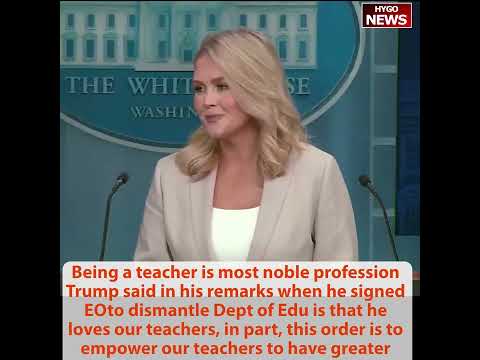
Leavitt’s response began with appreciation: “I want to thank Katie for her service to our country and our nation’s children. Being a teacher is the most noble profession that we believe one can have.”
She cited Trump’s personal statement: “The president said in his remarks when he signed the executive order to dismantle the Department of Education that he loves our teachers. And in part, this order is to empower our teachers to have greater decision-making in the classroom. Nobody knows our nation’s children and our students better than our teachers who are with them every single day.”
On the federal role, Leavitt was specific: “The president has made it clear to Linda McMahon that we need to find other places within our federal government for critical programs regarding education. Pell grants, Title IX lawsuits, civil rights lawsuits — all of that are critical functions. Special needs programs, nutrition programs. But there are other places throughout the federal bureaucracy where those things can happen.”
She delivered the indictment of the status quo: “The Department of Education has been a very bloated bureaucracy. We spent trillions of dollars on this department, and for what? Our children are worse off as far as education goes today than they were when this department originated. And that’s very concerning to the president.”
The decision to take a question from a teacher in Wisconsin rather than a reporter in Washington was itself a statement about who the administration considered its constituency. The podcast row, community questions, and direct-to-public communications were all part of a strategy that treated the press corps as one audience among many — and not always the most important one.
Key Takeaways
- Leavitt declared April 2, 2025, “one of the most important days in modern American history” as Liberation Day tariffs would end “decades of being ripped off.”
- The economic formula: “Lowest taxes, energy costs, and regulations if you make products in the United States. No tariffs if you make your product in America.”
- Investment already secured: Apple ($500B), Project Stargate ($500B), Nvidia (hundreds of billions), TSMC ($100B) — evidence the formula was “already working.”
- Leavitt called teaching “the most noble profession” and said the education EO was designed to “empower teachers to have greater decision-making in the classroom.”
- On the Dept. of Education: “We spent trillions on this department, and for what? Our children are worse off than when it originated.”