 HYGO News
 30 million workers, vast majority of them on an hourly wage, had to sign non-compete agreement
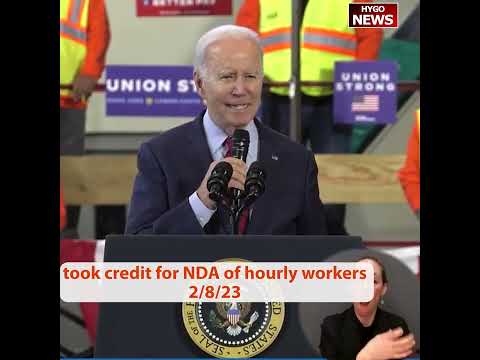
Biden: “30 Million Hourly Workers Had To Sign Non-Compete Agreements” — FTC Ban Proposed
In February 2023, President Joe Biden spoke about non-compete agreements affecting hourly workers, highlighting the FTC’s proposed ban on such agreements. “You know, 30 million workers, the vast majority of them on an hourly wage, had to sign non-compete agreements when they took their job. 30 million. These aren’t trade secrets they’re hiding. They are hourly wages,” Biden said. He illustrated with concrete example: “That’s when a construction worker on a job site can’t cross the street and take a job with another outfit to make a couple more bucks.” He supported regulatory action: “For banning these agreements for companies that will compete won’t compete. So they pay people their fair share.” He concluded with rhetorical question: “Why in God’s name you tell a worker, an hourly worker, that they have to sign an agreement? That they will not take a similar job anywhere in the area?”
The 30 Million Figure
30 million figure:
Substantial number — Of workers.
Non-compete bound — Claimed.
Hourly majority — Asserted.
Economic impact — Significant.
Policy driver — For action.
The 30 million workers figure was substantial estimate of how many Americans were bound by non-compete agreements. Hourly majority of these workers made the issue not just executive-level but widespread labor market concern.
The Hourly Worker Focus
Hourly worker focus:
Low-wage — Often.
Mobility restricted — By non-competes.
No trade secrets — Typically.
Labor market — Distorted.
Worker — Disadvantaged.
Biden’s focus on hourly workers was politically effective. Low-wage workers had mobility restricted by non-competes despite typically having no trade secrets to protect. Labor market was distorted. Workers were disadvantaged relative to employers.
”These Aren’t Trade Secrets They’re Hiding”
The substance argument:
Trade secrets — Original justification.
Not applicable — To hourly workers.
Wages protected — Instead.
Competition suppressed — Actually.
Mismatch — Legal theory vs. practice.
Biden’s “these aren’t trade secrets they’re hiding” attacked the original legal justification for non-competes. Trade secret protection made sense for executives with sensitive knowledge. Applied to hourly workers, the justification didn’t match reality.
The Construction Worker Example
Example:
Construction worker — Specific.
Cross the street — Concrete.
“Another outfit” — Different employer.
“Couple more bucks” — Better wages.
Prevented — By non-compete.
The construction worker example was concrete illustration. Worker at one site couldn’t cross street to another site offering better wages due to non-compete. This real example made abstract legal concept accessible to audience.
The Wage Impact
Wage impact:
Mobility restricted — Negotiating power.
Employer leverage — Enhanced.
Wage suppression — Effect.
Competition — Reduced.
Worker — Disadvantaged.
The wage impact of non-competes was mobility restriction that reduced worker negotiating power. Employers had enhanced leverage. Wage suppression was actual effect. Labor market competition was reduced. Workers were disadvantaged.
The FTC Proposed Ban
FTC ban:
January 2023 — Proposed.
Federal Trade Commission — Agency.
All non-competes — Covered.
Comment period — Opened.
Industry opposition — Expected.
The FTC proposed ban announced in January 2023 would cover essentially all non-compete agreements. Federal Trade Commission was the agency. Comment period opened for public input. Industry opposition was expected.
”Companies That Will Compete Won’t Compete”
Biden verbal struggle:
Grammar confused — Syntax.
Meaning — Companies avoiding competition.
Through — Non-competes.
Recovery attempted — Partial.
Under pressure — Evident.
Biden’s “companies that will compete won’t compete” had confused syntax. Intended meaning was companies using non-competes to avoid competing. Recovery was partial. Verbal struggle under pressure was evident, consistent with pattern.
”Pay People Their Fair Share”
Fair share framing:
Wages — Target.
Competition — Drives wages up.
Non-competes — Prevent this.
Removing them — Raises wages.
Theory — Sound.
The “fair share” framing connected non-compete elimination to fair wages. Theory was sound: removing mobility restrictions would increase labor market competition, driving wages up. Economic argument was substantive.
”Why in God’s Name”
Rhetorical emphasis:
“God’s name” — Emphatic.
Absurdity — Highlighted.
Worker protection — Implied.
Political messaging — Clear.
Accessibility — Increased.
“Why in God’s name” was emphatic rhetorical question highlighting apparent absurdity of applying non-competes to hourly workers. Absurdity framing was effective political messaging. Made issue accessible.
The Policy Rationale
Policy rationale:
Worker mobility — Restricted.
Wage competition — Reduced.
Free market — Distorted.
Economic dynamism — Hurt.
Reform — Needed.
The policy rationale for non-compete reform was that restricted worker mobility reduced wage competition, distorted free market operations, hurt economic dynamism. Reform was needed to restore labor market function.
The Labor Market Economics
Labor economics:
Wage determination — Competition.
Non-competes — Monopsony tool.
Employer power — Enhanced.
Worker power — Reduced.
Efficiency loss — Real.
Labor market economics showed non-competes as monopsony tool that enhanced employer power and reduced worker power. This was inefficient for labor market operations. Reform would restore competitive market function.
The FTC’s Authority Questioned
FTC authority:
Proposed ban — Broad.
Legal authority — Questioned.
Industry challenges — Expected.
Court battles — Anticipated.
Uncertain — Outcome.
The FTC’s authority to ban non-competes broadly was questioned by some legal scholars. Industry challenges were expected. Court battles were anticipated. Ultimate outcome was uncertain through litigation.
The Industry Opposition
Industry:
Chambers of commerce — Opposed.
Trade associations — Concerned.
Business models — Challenged.
Lobbying — Active.
Counter-arguments — Deployed.
Industry opposition included Chambers of Commerce, trade associations concerned, challenged business models, active lobbying, deployed counter-arguments. Business community was mobilized against the FTC proposal.
The Worker Benefits Projected
Worker benefits:
Wages — Projected up.
Mobility — Increased.
Bargaining power — Enhanced.
Career paths — Opened.
Overall — Improvement.
Projected worker benefits from non-compete ban included higher wages through competition, increased mobility, enhanced bargaining power, more opened career paths. Overall labor market improvement for workers.
The Employer Concerns
Employer concerns:
Trade secrets — Legitimate.
Training investment — Protected.
Customer relationships — Some.
Competitive intelligence — Concerns.
Legitimate uses — Some.
Employer concerns about non-compete elimination included legitimate trade secret protection, training investment returns, customer relationship continuity, competitive intelligence concerns. Some legitimate uses existed even if broadly applied agreements were problematic.
The Alternative Protections
Alternatives:
Non-disclosure agreements — Exist.
Trade secret law — Available.
Non-solicitation — Narrow.
Confidentiality — Specific.
Legitimate purposes — Protected.
Alternative protections for legitimate employer concerns existed: non-disclosure agreements for trade secrets, trade secret law for IP, non-solicitation agreements narrowly targeting customer relationships, specific confidentiality provisions. These served legitimate purposes without mobility restrictions.
The Political Appeal
Political appeal:
Worker-focused — Message.
Simple — Explanation.
Relatable — Examples.
Populist — Framing.
Base appeal — Democratic.
Political appeal of non-compete issue was worker-focused message with simple explanation, relatable examples (construction worker crossing street), populist framing, appeal to Democratic base. Effective messaging territory.
The Bipartisan Potential
Bipartisan:
Small business — Sometimes supports reform.
Free market — Conservative framing.
Worker mobility — Across spectrum.
Innovation — Enhanced.
Potential — For broader support.
Bipartisan potential existed on non-compete reform. Small business sometimes supported reform. Free market framing could appeal to conservatives. Worker mobility benefits crossed political spectrum. Innovation enhanced. Broader support potential.
The 2024 Campaign Framework
2024 framework:
Worker protection — Biden theme.
Competition restoration — Message.
Specific achievement — Claim.
Administrative action — Used.
Policy demonstration — Provided.
The 2024 campaign framework used non-compete issue as worker protection theme, competition restoration message, specific administrative achievement claim, demonstration of Biden’s policy priorities. Useful campaign material.
The Labor Department Coordination
Labor Dept:
Enforcement role — Some.
Education campaign — Possible.
Cooperation — With FTC.
Administration unity — Displayed.
Policy — Multi-agency.
Labor Department coordination with FTC on non-compete issue was multi-agency policy effort. Enforcement roles existed for some aspects. Education campaigns were possible. Cooperation demonstrated administration unity on worker protection.
The Business Community Response
Business response:
Chamber of Commerce — Opposed.
Various associations — Concerned.
Litigation prepared — For court battle.
Legislative response — Possible.
Extensive — Opposition.
Business community response was extensive with Chamber of Commerce opposed, various associations concerned, litigation prepared for court battles, legislative responses possible. Opposition was organized and well-funded.
The State-Level Variation
State variation:
California ban — Existing.
Various state limits — Present.
Federal action — Overlay.
Preemption issues — Legal.
Complex landscape — Resulting.
State-level variation on non-competes already existed. California had long banned them. Various states had limits. Federal action would overlay state laws. Preemption issues existed legally. Complex landscape resulted.
The Court Battle Projected
Court battle:
Challenge — Expected.
Chevron deference — In play.
Statutory interpretation — Contested.
Supreme Court — Ultimate.
Outcome uncertain — Genuinely.
Court battle was projected over FTC authority to ban non-competes. Chevron deference was in play. Statutory interpretation was contested. Supreme Court was ultimate venue. Outcome was genuinely uncertain.
The Broader Worker Protection Agenda
Broader agenda:
Minimum wage — Pushed.
Overtime expansion — Proposed.
Labor rights — Strengthened.
Unions — Supported.
Non-competes — Addressed.
Biden’s broader worker protection agenda included pushing minimum wage increases, proposing overtime expansion, strengthening labor rights, supporting unions, addressing non-competes. Comprehensive worker-focused policy approach.
The Policy Complexity
Complexity:
Legitimate uses — Some.
Overbroad application — Common.
Balance needed — Policy.
Precision — Important.
Administration approach — Broad.
The policy complexity was that legitimate uses of non-competes existed while overbroad application was common. Balance between these was needed. Precision in policy was important. Administration’s broad approach had pros and cons.
The Senior White House Attention
Senior attention:
Biden personal — Attention.
FTC commissioner — Coordination.
Economic team — Engaged.
Speechwriting — Reflected.
Priority — Established.
Senior White House attention to non-compete issue was evident through Biden’s personal attention, FTC commissioner coordination, economic team engagement, speechwriting reflection. Priority was established through these commitments.
The Lina Khan FTC Leadership
Lina Khan:
FTC Chair — Biden appointee.
Anti-monopoly — Focus.
Non-compete action — Driven.
Progressive — Approach.
Enforcement — Aggressive.
FTC Chair Lina Khan, a Biden appointee, drove anti-monopoly focus and non-compete action. Progressive approach to competition policy. Aggressive enforcement stance. Significant policy leader for Biden administration.
The Historical Labor Policy Context
Historical context:
New Deal — Framework.
Labor protections — Built up.
Deregulation — 1980s-90s.
Non-competes spread — Over decades.
Current push — Reversal.
Historical labor policy context included New Deal framework, built up labor protections, 1980s-90s deregulation trends, non-compete spread over decades. Current push was reversal toward stronger worker protections.
The Economic Dynamism Argument
Dynamism argument:
Worker mobility — Innovation source.
Startup formation — Enabled.
Skills transfer — Accelerated.
Economic growth — Enhanced.
Reform benefits — Broad.
Economic dynamism argument held that worker mobility was innovation source, startup formation was enabled when workers could move freely, skills transferred more quickly, economic growth was enhanced. Reform benefits were broad beyond just wages.
Key Takeaways
- Biden said: “30 million workers, the vast majority of them on an hourly wage, had to sign non-compete agreements when they took their job.”
- He framed the problem: “These aren’t trade secrets they’re hiding. They are hourly wages.”
- He gave concrete example: “A construction worker on a job site can’t cross the street and take a job with another outfit to make a couple more bucks.”
- He supported FTC action: “For banning these agreements for companies that will compete won’t compete.”
- He connected to wages: “So they pay people their fair share.”
- He concluded rhetorically: “Why in God’s name you tell a worker, an hourly worker, that they have to sign an agreement?”
Transcript Highlights
The following is transcribed from the video audio (unverified — AI-generated from audio).
- You know, 30 million workers, the vast majority of them on an hourly wage, had to sign non-compete agreements when they took their job. 30 million.
- These aren’t trade secrets they’re hiding. They are hourly wages.
- That’s when a construction worker on a job site can’t cross the street and take a job with another outfit to make a couple more bucks.
- For banning these agreements for companies that will compete won’t compete.
- So they pay people the fair share.
- Why in God’s name you tell a worker, an hourly worker, that they have to sign an agreement? That they will not take a similar job anywhere in the area?
Full transcript: 110 words transcribed via Whisper AI.