 HYGO News
 $3.5B: move migrants faster, asylum claims heard faster but GOP political ploy not assisting
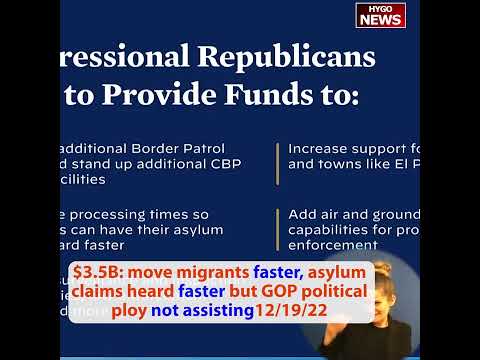
KJP Details $3.5B Plan: Scale Transportation, Add CBP Facilities, Speed Asylum Processing — 23,000 Border Patrol Called “Historic”
On 12/19/2022, White House Press Secretary Karine Jean-Pierre provided some specifics about the $3.5 billion border funding plan the administration had requested from Congress. The funding would scale air and ground transportation to move migrants to less crowded border patrols, set up additional CBP holding facilities, and speed up asylum processing. “We want to scale up air and ground transportation capabilities to move migrants to processing to less crowded border patrols. Set up an additional CBP holding facilities and speed up the processing time so individuals can have their asylum claims heard faster,” KJP said. She cited that “23,000” Border Patrol personnel were “historic” and credited Biden for the number. But she again blamed Republicans: “What we have been hearing from Republicans and seeing from Republicans in Congress is political ploys. They’re not assisting.”
The Transportation Component
KJP began with transportation capability. “You scale up, we want to scale up air and ground transportation capabilities to move migrants to processing to less crowded border patrols,” KJP said.
The transportation component addressed specific operational issues:
Migrant distribution — Moving from overcrowded to less crowded facilities.
Bottleneck relief — Reducing pressure at specific locations.
Processing capacity — Spreading across multiple facilities.
Resource utilization — Using capacity across regions.
Regional balance — Distributing impact.
The transportation capability was a real operational need. The 4,600 migrants in a 1,040-capacity facility (from a related briefing) could theoretically be distributed to less crowded facilities. But this required:
Available transportation — Buses, planes, staff.
Available capacity elsewhere — Other facilities with room.
Logistics coordination — Scheduling and management.
Migrant cooperation — In movements.
Legal processing — Required for transfers.
The CBP Holding Facilities
KJP mentioned additional facilities. “Set up an additional CBP holding facilities,” KJP said.
The holding facility expansion addressed capacity directly:
More facilities — Meaning more capacity.
Faster construction/setup — Than existing building.
Temporary structures — Possibly tents or modular.
Strategic locations — Near crossing areas.
Staffing requirements — For new facilities.
Building new facilities was a longer-term solution. Even temporary facilities required:
Siting decisions — Where to place them.
Construction — Even for temporary structures.
Staffing — Beyond current levels.
Operational setup — Systems, procedures, logistics.
Local acceptance — For facility locations.
The Asylum Processing
KJP mentioned speeding asylum processing. “Speed up the processing time so individuals can have their asylum claims heard faster,” KJP said.
Speeding asylum processing was a major systemic need:
Current backlog — Over 1 million pending cases.
Years-long waits — For asylum hearings.
Immigration court shortage — Of judges and staff.
Legal representation issues — For asylum seekers.
Appeals process — Extending total time.
Each aspect had constraints. Hiring more immigration judges took time. Expanding courts required facilities and staff. Reducing backlog required either processing more cases per judge or reducing new cases. None of these were quick fixes.
The administration’s $3.5 billion request couldn’t fully solve any of these constraints alone. Substantial funding was needed but so were policy changes, personnel additions, and operational reforms over time.
”23,000 Is Historic”
KJP cited personnel numbers. “If you were at the border, 23,000, that is historic. We’ve not seen that before. And again, that is because of the work that this president has done,” KJP said.
The 23,000 figure likely referenced Border Patrol personnel strength. The “historic” claim deserved examination:
Historical context — Border Patrol had grown over decades.
Growth over time — Under multiple administrations.
“Historic” framing — Suggesting unique achievement.
Biden credit — For the personnel level.
Actual numbers — Needed verification.
Border Patrol staffing had grown over many administrations:
Early 1990s — Around 4,000 agents. George W. Bush era — Grew to over 15,000. Obama era — Peaked around 21,000. Trump era — Various levels around 19,000-20,000. Biden era — Around 19,500-20,000 reported.
The specific 23,000 figure wasn’t clearly verifiable. If Biden had achieved 23,000 Border Patrol agents, that would exceed all prior levels. But public reporting generally showed lower numbers. The specific claim may have included additional categories beyond sworn Border Patrol agents.
The “historic” framing was consistent with administration messaging patterns but the specific number wasn’t consistent with public reporting. Like many administration statistics, the specific figure and its achievement claim deserved scrutiny.
”Because of the Work This President Has Done”
KJP credited Biden. “That is because of the work that this president has done,” KJP said.
The credit claim was partially defensible:
Biden had supported Border Patrol funding — In various budgets.
Administration had requested personnel — In various appropriations.
Recruitment efforts — Had continued.
Retention programs — Had been maintained.
But credit was also shared:
Congressional appropriations — Provided the funding.
Multi-year hiring — Spanning administrations.
Academy timelines — Required years of preparation.
Career personnel — Built over decades.
Claiming “this president” was solely responsible overlooked the multi-administration reality of Border Patrol development. The 23,000 figure, if accurate, reflected cumulative hiring decisions going back years.
”There Is a Plan for It”
KJP emphasized plan existence. “The $3.5 billion, there is a plan for it, there is a way forward,” KJP said.
The plan-existence claim was important. It countered the criticism that administration requests were vague or unfocused:
Specific purposes — Transportation, facilities, processing.
Implementation approach — “Way forward.”
Administration preparation — Having thought it through.
Ready to deploy — If Congress approved.
Accountability framework — For use of funds.
The plan specifics KJP detailed were real planning components. The administration had thought about how to use additional funding. Whether the plan was adequate for the scale of challenges was separate from whether a plan existed.
The Republican Blame Framing
KJP returned to GOP blame. “But what we have been hearing from Republicans and seeing from Republicans in Congress is political ploys. They’re not assisting. They’re not offering any assistance. Many of them are not,” KJP said.
The Republican blame framing was familiar:
“Political ploys” — Characterizing Republican engagement.
“Not assisting” — Binary engagement claim.
“Not offering any assistance” — Denying any Republican contributions.
“Many of them are not” — Slight qualification.
The framing was rhetorically forceful but factually selective. Republicans had various positions on immigration:
Some supported increased enforcement funding — For border security.
Some supported the administration’s request — With conditions.
Some offered alternative proposals — Different approaches.
Some opposed specific provisions — Not all spending.
Some were performative — Political theater.
Characterizing the entire Republican caucus as offering “not any assistance” oversimplified their diverse positions. The framing served political purposes but didn’t accurately describe the range of Republican positioning.
”If They Are Serious”
KJP offered the conditional framing. “So we are asking right now if they are serious about this, they are serious about dealing with the challenges, then they would adhere to our funding requests,” KJP said.
The “if they are serious” framing put Republicans in a bind:
Support the administration’s request — Demonstrating seriousness.
Offer alternatives — Which administration would dismiss.
Oppose the request — Being labeled “not serious.”
Propose different approaches — Being labeled “political ploys.”
This framing effectively required Republicans to either accept the administration’s approach or be characterized as not engaged. Republicans with substantive concerns or alternative ideas couldn’t express them without being categorized negatively.
The “Adhere to Our Funding Requests”
KJP’s specific request — Republicans should “adhere to our funding requests” — was politically pointed. “Adhere” suggested compliance rather than deliberation. Congress was supposed to deliberate on administration requests, not automatically “adhere” to them.
The framing reflected administration preference for Congressional action that matched administration positions. But Congress had independent authority and responsibility. “Adhere” oversimplified the appropriate role of legislative deliberation.
The Real Negotiation Dynamics
Behind the public framing, real negotiations were occurring:
Supplemental funding discussions — Between administration and Congress.
End-of-session appropriations — Package being negotiated.
Policy tradeoffs — Spending tied to policy.
Priority negotiations — Among many requests.
Political positioning — Both parties.
The administration’s $3.5 billion request was one item in complex year-end negotiations. Whether and how it would be funded depended on:
Final appropriations package — December 2022 decisions.
Inclusion of specific provisions — In omnibus.
Political deals — Between parties.
Presidential leverage — To push for approval.
Congressional priorities — Across spending.
Public messaging was one element in these negotiations but didn’t determine outcomes alone.
The Pattern of Specific Elements
KJP’s response in this briefing was more substantive than many. She provided:
Specific operational elements — Transportation, facilities, processing.
Purpose explanations — For each element.
Personnel claims — 23,000 figure.
Biden credit — For personnel achievement.
Republican criticism — Standard framing.
This level of specificity was unusual for KJP’s border briefings. More often she offered vague claims about engagement. The increased specificity may have reflected:
Approaching Title 42 deadline — Requiring concrete messaging.
El Paso crisis — Needing substantive response.
Congressional negotiation timing — Advocacy for funding.
Accumulating pressure — Forcing more detail.
Whether the specifics were adequate was another question, but the briefing did provide more operational content than typical.
Key Takeaways
- KJP provided specifics on the $3.5 billion border funding plan: scaling transportation to move migrants to less crowded facilities, setting up additional CBP holding facilities, speeding up asylum processing.
- She cited “23,000” Border Patrol personnel as “historic” and credited Biden for the level.
- KJP emphasized “there is a plan” and “a way forward” for the funding.
- She returned to blaming Republicans: “They’re not assisting. They’re not offering any assistance.”
- KJP framed Republican cooperation as demonstrating seriousness: “If they are serious… they would adhere to our funding requests.”
- The level of operational specificity was unusual for KJP’s border briefings, though whether specifics were adequate for the scale of challenges remained a separate question.
Transcript Highlights
The following is transcribed from the video audio (unverified — AI-generated from audio).
- You scale up, we want to scale up air and ground transportation capabilities to move migrants to processing to less crowded border patrols.
- Set up an additional CBP holding facilities and speed up the processing time so individuals can have their asylum claims heard faster.
- If you were at the border, 23,000, that is historic. We’ve not seen that before.
- That is because of the work that this president has done.
- The $3.5 billion, there is a plan for it, there is a way forward.
- What we have been hearing from Republicans and seeing from Republicans in Congress is political ploys. They’re not assisting.
Full transcript: 153 words transcribed via Whisper AI.