 HYGO News
 Lutnick: 200K Gold Cards = $1 Trillion to Pay Down Debt; Trump: April 2nd Tariffs 'Going to Be Amazing'
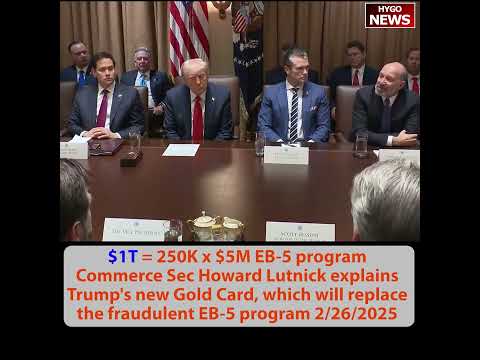
Lutnick: 200K Gold Cards = $1 Trillion to Pay Down Debt; Trump: April 2nd Tariffs “Going to Be Amazing”
Commerce Secretary Howard Lutnick provided the most detailed explanation yet of the Gold Card program in February 2025, revealing that the current EB-5 waitlist was 250,000 people and that selling just 200,000 Gold Cards at $5 million each would generate “$1 trillion to pay down our debt.” Lutnick said he and Treasury Secretary Scott Bessent would design the investment model together, with DHS Secretary Kristi Noem handling the visa component. Trump then announced that reciprocal tariffs would take effect on April 2nd — “not April 1st, I’m a little bit superstitious” — and cited 50-year record lows in illegal border crossings as well as $700 billion collected from China tariffs across his terms.
Lutnick Explains the Gold Card Mechanics
Lutnick began by describing the problems with the existing EB-5 immigrant investor program that the Gold Card would replace.
“The EB-5 program, which has been around for many years, had investment of a million dollars into projects in America,” Lutnick said. “And those projects were often suspect, they didn’t really work out, there wasn’t any oversight of it. And so for a million-dollar investment, you got a visa, and then you came into the country and ended up with a green card.”
He summarized the twin failures: “So it was poorly overseen, poorly executed, then you had our border open where millions of people came through.”
Lutnick then outlined the Gold Card’s structure. “The idea is we will have a proper business. We will modify the EB-5 agreement — Kristi and I are working on it together — for $5 million,” he said. “They’ll get a license from the Department of Commerce, then they’ll make a proper investment on the EB-5.”
He described the inter-agency collaboration. “We think Scott and I will design the EB-5 investment model, because Scott and I are the best people together to do that,” Lutnick said, referring to Treasury Secretary Bessent. “This is joint. This is exactly the Trump administration. We all work together, we work it out to be the best.”
The structure involved three cabinet departments: Commerce (licensing), Treasury (investment design), and Homeland Security (visa processing). The collaboration meant the program would benefit from Lutnick’s Wall Street expertise on investment structuring, Bessent’s Treasury experience on financial oversight, and Noem’s DHS authority on immigration enforcement.
The Math: “$1 Trillion to Pay Down Our Debt”
Lutnick then provided the revenue projection that tied the Gold Card directly to the national debt.
“Just remember — 200,000,” Lutnick said, citing the scale. “There’s a line for EB-5 of 250,000 right now.” The existing waitlist of 250,000 applicants demonstrated that demand for investment-based American residency far exceeded supply under the current program.
He did the multiplication: “200,000 of these gold green cards is $1 trillion to pay down our debt.”
The math was simple: 200,000 cards at $5 million each equaled $1 trillion. The existing waitlist of 250,000 suggested that the demand existed to hit that number.
Lutnick connected the program to the administration’s fiscal ambitions. “And that’s why the President is doing it — because we are going to balance his budget, and we are going to pay off the debt under President Trump,” he said.
The Gold Card revenue, combined with DOGE savings (projected at hundreds of billions), tariff revenue ($500 billion to $1 trillion from China alone over ten years), and economic growth from deregulation and tax cuts, formed the administration’s multi-pronged strategy for fiscal transformation. Each revenue source was large on its own; together, they represented a pathway to the balanced budget that Lutnick had pledged.
Trump: April 2nd, “Not April 1st”
Trump then provided a timeline for the reciprocal tariff implementation that markets and trading partners had been waiting for.
“It comes mostly from China, but it comes through Mexico, and it comes through Canada,” Trump said of the trade imbalance. “And I have to tell you that on April 2nd — I was going to do it on April 1st, but I’m a little bit superstitious, I made it April 2nd — the tariffs go on.”
He hedged slightly on scope: “Not all of them, but a lot of them.” The qualification suggested the April 2nd date would see a major tranche of reciprocal tariffs take effect, with additional tariffs potentially phased in over subsequent weeks or months.
Trump projected confidence: “And I think you’re going to see something that’s going to be amazing.”
He then provided historical context. “We’ve been taken advantage of as a country for a long period of time. We’ve been tariffed, but we didn’t tariff,” Trump said. “Now, I did — when I was here, I tariffed. We took in $700 billion from China. $700 billion. Not one president in the history of our country took in 10 cents from China.”
The $700 billion figure represented Trump’s claim for cumulative tariff revenue from China across both terms. The “10 cents” comparison to previous presidents was characteristic hyperbole, but the underlying point was substantive: Trump had imposed the first significant tariffs on Chinese goods in modern history and had generated substantial revenue from them.
“At the same time, China respected us. Now,” Trump added, connecting tariff policy to diplomatic leverage.
50-Year Record on Border Crossings
Trump then pivoted to immigration enforcement results that he characterized as historically significant.
“We’re also having tremendous support from Border Patrol, from ICE,” Trump said. “The ICE agents have been unbelievable. Border Patrol, their leadership at Border Patrol has been incredible, and they’re working very well.”
He cited the record: “We set records on the least number of illegal aliens coming in — migrants coming into our country — that we’ve had in more than 50 years.”
The 50-year record was the administration’s most dramatic border statistic. If accurate, it meant illegal border crossings had been reduced to levels not seen since the early 1970s — an era before mass illegal immigration from Central America had become a defining feature of U.S. border dynamics.
“And we did this all within a period of weeks, because we took over a mess,” Trump said. “The world was pouring in. And remember, they were coming in from jails and prisons and mental institutions and insane asylums. And they were gang members and drug dealers. Anybody wanted to come in, they could. And from not just South America — from all over the world.”
He praised the officials leading the effort. “Kristi and Tom Homan, the job they’ve done has been absolutely amazing,” Trump said.
Trump concluded with the framing that distinguished his immigration policy from the open-borders approach of his predecessor. “We want people to come into our country, by the way,” he said. “But they have to come in legally. I want that to be really understood. We want people in our country, but they have to come in legally.”
Key Takeaways
- Commerce Secretary Lutnick explained the Gold Card would replace the “poorly overseen, poorly executed” EB-5 program, with Commerce, Treasury, and DHS collaborating on the $5 million investment model.
- With 250,000 people on the existing EB-5 waitlist, Lutnick projected that 200,000 Gold Cards would generate $1 trillion “to pay down our debt.”
- Trump announced reciprocal tariffs would take effect April 2nd — “not April 1st, I’m a little bit superstitious” — and said “you’re going to see something that’s going to be amazing.”
- He cited $700 billion in cumulative tariff revenue from China across both terms, noting “not one president in history took in 10 cents from China.”
- Border crossings had reached their lowest level “in more than 50 years” within weeks of Trump taking office, with the president crediting ICE agents and Border Patrol leadership.