 HYGO News
 16M people (voters) approved, Republicans voted to overturn the plan (your free money)
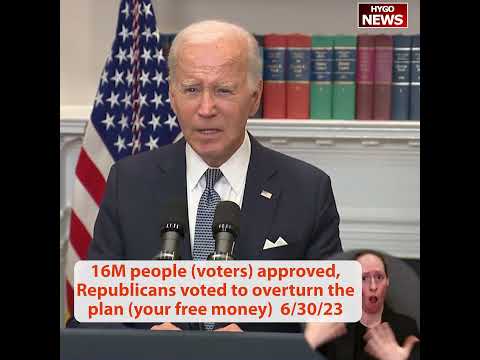
Biden Claims 16 Million Were Approved, Says Republicans “Snatched” Relief From Millions of Americans
On June 30, 2023, following the Supreme Court’s 6-3 ruling striking down his student loan forgiveness program, President Biden delivered remarks in which he portrayed 16 million approved borrowers as victims of Republican interference, claiming that the money “was literally about to go out the door” before Republican officials and “special interests” stepped in. Biden accused Republicans of “literally snatching from the hands of millions of Americans thousands of dollars in student debt relief that was about to change their lives,” framing the legal challenge as a partisan attack on working-class and middle-class families rather than addressing the constitutional basis of the Court’s decision.
”The Money Was Literally About to Go Out the Door”
Biden opened his remarks by emphasizing how close the program had come to distributing funds. He laid out the timeline in detail: “Last year I announced my student debt relief plan, a plan that was on the verge of providing more than 40 million Americans with real debt relief: up to $10,000 for many borrowers and up to $20,000 for those who had gotten a Pell Grant.”
He then stressed the operational readiness of the program: “This program was all set to begin. The website had been set up. The applications had been simplified so that it took less than five minutes to complete. Notices had been sent out to people about the relief they were eligible for. Sixteen million people — sixteen million people had already been approved. The money was literally about to go out the door.”
The emphasis on the 16 million approved applicants was a deliberate political choice. By highlighting the sheer number of people who had been told they would receive relief, Biden was building an emotional case against the Court’s decision. Each of those 16 million individuals represented a potential voter who could now be told that Republicans had taken away their promised relief.
However, the operational readiness of the program did not speak to its legality. The Supreme Court had not ruled on whether the application process was efficient or whether the website functioned properly. It had ruled that the President lacked the constitutional authority to cancel $400 billion in debt through executive action under the HEROES Act. The fact that 16 million people had been approved for an unlawful program was, if anything, an argument that the administration should have secured legal authority before creating expectations it could not fulfill.
Blaming Republicans and “Special Interests”
Biden then turned his fire on Republicans: “And then, Republican elected officials and special interests stepped in. They said no — ‘no’ — literally snatching from the hands of millions of Americans thousands of dollars in student debt relief that was about to change their lives.”
The language was emotionally charged and politically calculated. By describing the outcome as Republicans “snatching” relief from Americans’ hands, Biden cast the legal challenge as an act of cruelty rather than a legitimate constitutional exercise. The reference to “special interests” further implied that the lawsuit was motivated by corporate or wealthy donors rather than genuine concerns about the separation of powers.
Biden continued: “You know, these Republican officials just couldn’t bear the thought of providing relief for working-class and middle-class Americans. Republican state officials sued my administration, attempting to block relief, including for millions of their own constituents.”
The characterization omitted the legal substance of the Republican challenge entirely. The six state attorneys general who filed the lawsuit in Biden v. Nebraska argued that the program violated the separation of powers by using emergency legislation to justify an unprecedented blanket debt cancellation that Congress had never authorized. The Supreme Court agreed with this analysis in a 6-3 decision. Biden’s framing suggested that the only motivation for opposing the program was hostility toward working Americans, which did not engage with the constitutional arguments the Court had found persuasive.
”Republicans in Congress Voted to Overturn the Plan”
Biden also pointed to congressional opposition: “Republicans in Congress voted to overturn the plan. I think every one. I don’t think I had any Republican votes for this plan.”
This reference was to a congressional resolution under the Congressional Review Act that Republicans had passed in an effort to block the student loan program. Biden had vetoed that resolution, but its passage in Congress demonstrated the breadth of Republican opposition to the program.
Biden’s complaint that he had received no Republican votes was framed as evidence of partisan obstruction. However, it also inadvertently highlighted the administration’s strategic choice. If the President knew that Congress would not support his student loan plan, that was itself an indication that the program might not survive judicial review under the major questions doctrine, which holds that executive actions of vast economic and political significance require clear congressional authorization.
The lack of bipartisan support, rather than being evidence of Republican obstruction, was evidence that Congress had not authorized the program. This was precisely the conclusion the Supreme Court reached.
The Legal Reality Behind Biden’s Claims
The Supreme Court ruled 6-3 in Biden v. Nebraska that Biden had overstepped his authority. The administration had relied on the HEROES Act of 2003, which authorized the Secretary of Education to “waive or modify” student loan provisions during national emergencies. The Court found that using this statute to justify canceling over $400 billion in debt stretched the law far beyond its intended scope.
Six Republican state attorneys general challenged the program on separation of powers grounds. Separately, two borrowers who did not qualify brought their own challenge in Department of Education v. Brown. The 8th U.S. Circuit Court of Appeals had blocked the program in November 2022, and the Supreme Court declined to lift that block before issuing its final ruling.
Biden had announced the forgiveness in August 2022, offering up to $10,000 for borrowers earning $125,000 or less and up to $20,000 for Pell Grant recipients. The program was widely viewed as a midterm election strategy aimed at Gen Z and Millennial voters.
The 16 Million Number as Political Leverage
The repeated emphasis on 16 million approved applicants served a dual political purpose. First, it magnified the perceived harm of the ruling by putting a massive number on the people affected. Second, it created a ready-made campaign message: 16 million Americans had been promised relief by a Democratic President, and Republicans had taken it away.
What Biden did not mention was that those 16 million people had been approved for a program that the nation’s highest court determined was unlawful from its inception. The approvals were processed under a program that exceeded presidential authority, meaning the “hope” Biden had extended was built on a legal foundation that six justices found constitutionally unsound. The administration’s decision to process applications and issue approval notices before the legal challenges were resolved created the very false hope that reporters would later confront Biden about.
Key Takeaways
- Biden claimed that 16 million borrowers had already been approved and the “money was literally about to go out the door” when Republicans intervened through lawsuits and congressional opposition.
- Biden accused Republicans of “literally snatching from the hands of millions of Americans” student debt relief that “was about to change their lives.”
- He framed the legal challenge as partisan hostility toward working-class Americans rather than addressing the constitutional separation of powers arguments that the Supreme Court found persuasive.
- The Supreme Court ruled 6-3 in Biden v. Nebraska that the $400 billion forgiveness program exceeded presidential authority under the HEROES Act.
- Biden noted that no Republicans in Congress had voted for his plan, which critics argued demonstrated the lack of congressional authorization that the Court cited in striking it down.