 HYGO News
 Trump Makes 13-Year-Old Brain Cancer Survivor DJ Daniel an Honorary Secret Service Agent; Dems Sit Silent
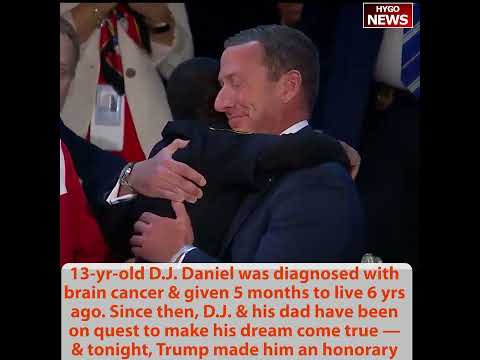
Trump Makes 13-Year-Old Brain Cancer Survivor DJ Daniel an Honorary Secret Service Agent; Dems Sit Silent
In one of the most emotionally powerful moments of his March 2025 joint address to Congress, President Trump introduced 13-year-old DJ Daniel, who had been diagnosed with brain cancer in 2018 and given five months to live — “that was more than six years ago.” Trump asked Secret Service Director Sean Curran to “officially make you an agent of the United States Secret Service,” producing an eruption of applause from the Republican side while many Democrats remained seated. Trump then pivoted to law and order, saying “our justice system has been turned upside down by radical left lunatics” who “weaponized law enforcement against political opponents, like me” and praised AG Bondi and FBI Director Patel for restoring “fair, equal, and impartial justice.”
DJ Daniel’s Story
Trump introduced DJ with the kind of personal storytelling that defined the most memorable moments of his addresses.
“Joining us in the gallery tonight is a young man who truly loves our police,” Trump said. “His name is DJ Daniel. He is 13 years old, and he has always dreamed of becoming a police officer.”
He described the diagnosis: “But in 2018, DJ was diagnosed with brain cancer. The doctors gave him five months at most to live.”
Then the defiance of the prognosis: “That was more than six years ago.”
The simple statement — that a boy given five months had lived for six years — captured the resilience that Trump wanted to honor. DJ had outlived his prognosis by more than fourteen times, and rather than retreating from life, he had spent those years pursuing his dream of law enforcement.
“Since that time, DJ and his dad have been on a quest to make his dream come true,” Trump said. “And DJ has been sworn in as an honorary law enforcement officer, actually a number of times. The police love him. The police departments love him."
"The Biggest Honor of Them All”
Trump then elevated DJ’s experience to a level that no previous honorary swearing-in could match.
“And tonight, DJ, we’re going to do you the biggest honor of them all,” Trump said. “I am asking our new Secret Service Director Sean Curran to officially make you an agent of the United States Secret Service.”
The chamber erupted. The reaction from the Republican side was immediate and sustained. DJ, visible in the gallery, was overwhelmed by the moment — a 13-year-old who had spent years fighting cancer was being inducted into the most elite protective force in the world by the President of the United States, before a joint session of Congress, on national television.
The choice of the Secret Service — rather than a local police department or the FBI — was deliberately elevated. The Secret Service was Trump’s own protective detail. Director Sean Curran was the agent who had been personally responsible for Trump’s safety. By making DJ an agent of his own protective force, Trump was connecting the boy’s story to his own — a president who had survived an assassination attempt honoring a boy who had survived cancer, both defying the odds.
Democrats Refuse to Applaud
The contrast in the chamber’s reaction became one of the defining images of the evening. While Republicans rose to their feet in sustained applause for a 13-year-old cancer survivor being honored by the President, many Democratic lawmakers remained seated and silent.
The optics were devastating for Democrats. Whatever their disagreements with Trump’s policies, refusing to stand for a child battling brain cancer was a choice that could not be justified on political grounds. The boy was not a policy. He was not a partisan figure. He was a 13-year-old who loved police officers and had been fighting cancer for six years.
Press Secretary Leavitt would later cite the moment as one of the most egregious examples of Democratic behavior during the address: “Democrats didn’t stand for an innocent and beautiful child who is surviving brain cancer.” The image of seated Democrats during DJ’s honoring became one of the most shared contrasts from the speech, used to illustrate the administration’s argument that Trump Derangement Syndrome had caused Democrats to lose their basic humanity.
”Bring Back Law and Order”
Trump transitioned from the emotional DJ moment to the policy substance of criminal justice reform.
“As we reclaim our sovereignty, we must also bring back law and order to our cities and towns,” Trump said.
He described the problem in terms that connected to the DJ story. “In recent years, our justice system has been turned upside down by radical left lunatics,” Trump said. “Many jurisdictions virtually ceased enforcing the law against dangerous repeat offenders, while weaponizing law enforcement against political opponents — like me.”
The juxtaposition was pointed: prosecutors had stopped enforcing laws against criminals while using the same legal system to pursue Trump. The two-tier justice system — leniency for offenders, persecution for political opponents — was the foundational grievance of the administration’s criminal justice reform agenda.
Trump described the corrective: “My administration has acted swiftly and decisively to restore fair, equal, and impartial justice under the constitutional rule of law — starting at the FBI and the DOJ.”
He acknowledged the officials leading the effort: “Pam, good luck. Kash, wherever you may be — good luck. Pam Bondi, good luck. So important. Gonna do a great job. Kash, thank you.”
The personal shout-outs to Bondi and Patel reinforced the human dimension of institutional reform. These were not abstract bureaucratic changes; they were real people with real mandates, personally tasked by the president to fix institutions that had been corrupted.
Supporting Police and Fire
Trump concluded the law enforcement segment with a tribute to the first responders who made public safety possible.
“We’re also once again giving our police officers the support, protection, and respect they so dearly deserve,” Trump said. “They have such a hard, dangerous job, but we’re going to make it less dangerous.”
He offered a realistic assessment of the challenge: “The problem is the bad guys don’t respect the law. But they’re starting to respect it, and they soon will respect it.”
Trump extended the tribute to firefighters. “This also includes our great fire departments throughout the country. Our firemen and women are unbelievable people and we’ll never forget them,” he said.
He added with characteristic humor: “And besides that, they voted for me in record numbers, so I have no choice.”
The laughter from the chamber at the self-deprecating joke provided a moment of levity after the emotional intensity of DJ’s ceremony and the serious policy substance of the law enforcement discussion. Trump’s ability to move seamlessly between tears, policy, and humor within a single segment was a distinctive feature of his oratorical style.
Key Takeaways
- Trump made 13-year-old DJ Daniel — diagnosed with brain cancer in 2018 and given five months to live — an honorary Secret Service agent, asking Director Sean Curran to conduct the ceremony.
- Many Democrats remained seated during DJ’s honoring, with Leavitt later calling their refusal to applaud a cancer-surviving child one of the evening’s most “disgraceful” moments.
- Trump said the justice system had been “turned upside down by radical left lunatics” who stopped enforcing laws against criminals while “weaponizing law enforcement against political opponents, like me.”
- He praised AG Bondi and FBI Director Patel for beginning to “restore fair, equal, and impartial justice under the constitutional rule of law.”
- Trump said police officers and firefighters were getting “the support, protection, and respect they so dearly deserve” and that criminals were “starting to respect the law.”