 HYGO News
Kennedy to Powell: 'The More We Help on the Fiscal Side, the Fewer People You Are Going to Have to Put Out of Work' (March 7, 2023)
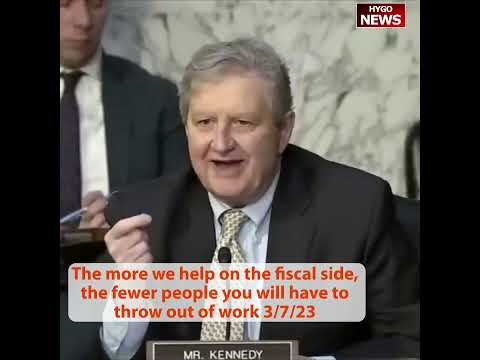
On March 7, 2023, Federal Reserve Chair Jerome Powell delivered the Fed’s semiannual monetary policy report to the Senate Banking Committee [1]. Consumer prices were 6.4 percent higher than a year earlier, and the unemployment rate was 3.4 percent [2][3]. To bring inflation back to its 2 percent goal, the Fed had raised its benchmark interest rate from near zero in March 2022 to a range of 4.5 to 4.75 percent by February 2023 [4][5]. Sen. John Kennedy, a Louisiana Republican, used his time to ask what that would cost in jobs, and whether Congress could make the cost smaller. This video shows the end of that exchange. All quotes are from the official hearing record, Senate Hearing 118-205 [1].
Key Moments
”When Congress spends money it stimulates the economy”
Kennedy began by thanking Powell and his team “for helping to save the economy during the pandemic meltdown” and said he was “generally supportive of the actions of the Fed right now.” “When Congress spends money it stimulates the economy, does it not?” he asked. Powell said it “would depend on whether that is funded by tax increases or not,” and that spending not paid for with taxes “would have a net, at the margin, stimulative effect.” Asked whether slower growth in federal spending and debt would make the Fed’s job easier, Powell said: “I do not think fiscal policy right now is a big factor driving inflation at this moment, but it is absolutely essential that we do slow the pace of growth,” before Kennedy cut him off.
”You are trying to raise the unemployment rate”
“You are raising interest rates to slow the economy, are you not?” Kennedy asked. “Yes, to cool the economy off,” Powell said. “So, in effect—and I am not being critical—when you are slowing the economy you are trying to put people out of work. That is your job, is it not?” “Not really,” Powell answered. “We are trying to restore price stability, not wages.” When Kennedy rephrased (“You are trying to raise the unemployment rate, are you not?”), Powell said: “No. We are trying to realign supply and demand, which can happen through a bunch of channels. Like, for example, you know, just job openings."
"Based on history”
Kennedy then turned to history. “The economists did a wonderful study. They looked at 10 disinflationary periods in America, going all the way back to the 1950s,” he said, and “in order to reduce inflation by 2 percent, unemployment have to go up 3.6 percent.” Powell replied: “I do not have the numbers in front of me, but yes, the standard has been that there have been recessions and downturns when the Fed has tried to reduce inflation.” With inflation at 6.4 percent and unemployment at 3.4 percent, Kennedy said, history implied that cutting inflation to 4.4 percent would push unemployment to 7 percent. “That is what the record would say,” Powell said. Getting inflation down to 2.2 percent, Kennedy went on, would mean “unemployment would have to go to 10.6 percent, would it not?” “Yeah, I do not think that kind of a number is at all in play here,” Powell said.
”It could work out that way”
“I think it is undeniable—it is undeniable that the only way we are going to get this sticky inflation down is to attack it on the monetary side, which [you are] doing, and on the fiscal side, which means Congress has got to reduce the rate of growth of spending and reduce the rate of growth of debt accumulation,” Kennedy said. “The more we help on the fiscal side, the fewer people you are going to have to put out of work. Is that not a fact?” When the committee’s chairman, Sen. Sherrod Brown, an Ohio Democrat, told him to answer, Powell said: “It could work out that way.”
Background: Two Goals and One Tool
Congress has assigned the Fed to conduct monetary policy “to support the goals of maximum employment and stable prices,” a pairing known as the dual mandate [6]. Raising interest rates slows borrowing and spending, which can bring inflation down but can also cost jobs, and in December 2022 the median projection of Fed officials was that unemployment would rise to 4.6 percent by the end of 2023 [7]. Senators pressed Powell on that tradeoff from both sides at the same hearing. Sen. Elizabeth Warren, a Massachusetts Democrat, said the Fed’s projection meant “about 2 million people who would lose their jobs.” Powell replied that inflation “is hurting the working people of this country badly, all of them, not just 2 million of them” [1]. Kennedy’s argument was that Congress could share the burden by spending less.
The Record
- “The current inflation rate is 6.4 percent and the current unemployment rate is 3.4 percent.” Those were the January 2023 figures from the Bureau of Labor Statistics [2][3].
- The history Kennedy cited. The most prominent study at the time, presented by five economists at the U.S. Monetary Policy Forum on February 24, 2023, found “no post-1950 precedent for a sizable central-bank-induced disinflation that does not entail substantial economic sacrifice or recession.” In the seven sizable U.S. disinflations it counted since 1950, the unemployment rate rose by 1.8 to 4.8 percentage points [9][10].
- Spending and inflation. Kennedy’s premise had support in the Federal Reserve System’s own research. A 2022 San Francisco Fed analysis estimated that pandemic-era fiscal support “may have contributed to about 3 percentage points of the rise in U.S. inflation through the end of 2021” [8].
- “It could work out that way.” Pressed by the committee’s chairman to answer, Powell did not dispute Kennedy’s bottom line [1].
What Happened Next
- Rates: The Fed raised its target range to 5.25 to 5.5 percent in July 2023, its last increase of the cycle, and began cutting in September 2024 with a half-point reduction [11][12].
- Inflation and jobs: By June 2023, inflation had fallen to 3.0 percent, with unemployment at 3.6 percent [13][14]. Unemployment ended 2023 at 3.7 percent [15] and rose to 4.3 percent in July 2024 [16].
- The fiscal side: On June 3, 2023, Biden signed the Fiscal Responsibility Act, which capped discretionary spending as part of a deal to raise the debt ceiling; the Congressional Budget Office estimated it would reduce projected deficits by $1.5 trillion over 10 years [17].
- The Fed’s leadership: Powell’s term as chair ended in May 2026. The Senate confirmed President Trump’s pick, Kevin Warsh, by 54 to 45, and Justice Clarence Thomas swore him in at the White House on May 22. Powell stayed on the Fed’s board as a governor [18][19].
Sources
- GovInfo: Senate Hearing 118-205, The Semiannual Monetary Policy Report to the Congress (March 7, 2023)
- Bureau of Labor Statistics: Consumer Price Index, January 2023 (February 14, 2023)
- Bureau of Labor Statistics: The Employment Situation, January 2023 (February 3, 2023)
- Federal Reserve: FOMC statement (March 16, 2022)
- Federal Reserve: FOMC statement (February 1, 2023)
- Federal Reserve: What economic goals does the Federal Reserve seek to achieve through its monetary policy?
- Federal Reserve: Summary of Economic Projections (December 14, 2022)
- Federal Reserve Bank of San Francisco: Why Is U.S. Inflation Higher than in Other Countries? Economic Letter 2022-07 (March 28, 2022)
- Centre for Economic Policy Research: Cecchetti, Feroli, Hooper, Mishkin and Schoenholtz, Managing Disinflations, Discussion Paper 18068 (2023)
- Federal Reserve: Governor Philip Jefferson, discussion of “Managing Disinflations” at the 2023 U.S. Monetary Policy Forum (February 24, 2023)
- Federal Reserve: FOMC statement (July 26, 2023)
- Federal Reserve: FOMC statement (September 18, 2024)
- Bureau of Labor Statistics: Consumer Price Index, June 2023 (July 12, 2023)
- Bureau of Labor Statistics: The Employment Situation, June 2023 (July 7, 2023)
- Bureau of Labor Statistics: The Employment Situation, December 2023 (January 5, 2024)
- Bureau of Labor Statistics: The Employment Situation, July 2024 (August 2, 2024)
- Congressional Budget Office: How the Fiscal Responsibility Act of 2023 Affects CBO’s Projections of Federal Debt (June 9, 2023)
- NPR: Senate confirms Kevin Warsh as next chair of the Federal Reserve (May 13, 2026)
- CBS News: Kevin Warsh sworn in as new Fed chair at White House, replacing Powell (May 22, 2026)