 HYGO News
Stefanik Grills Wray on Biden's 'Classified Stuff Downstairs' Tape: 'You're Either Aware or You're Not' (March 12, 2024)
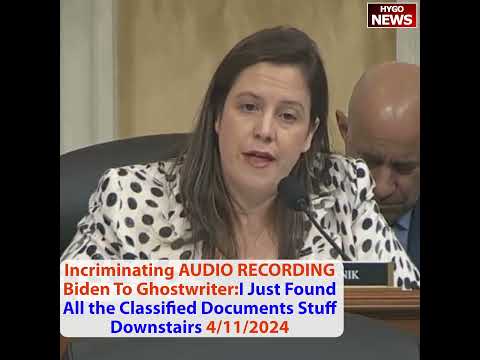
Rep. Elise Stefanik, R-N.Y., put FBI Director Christopher Wray on the spot over one of the most damaging lines in the Biden classified documents case. “Are you aware, and this is breaking news right now, are you aware that there is an audio recording of Joe Biden saying to his ghost writer, in February ‘I just found all the classified stuff downstairs’?” she asked at a House Intelligence Committee hearing. Wray would not say [1].
The video above shows the exchange at the committee’s Annual Threat Assessment hearing on March 12, 2024, the same day special counsel Robert Hur testified about his report to the House Judiciary Committee [1][3]. Quotes from the hearing are from Stefanik’s office’s release, checked against the video. More than two years later, in July 2026, the recordings Stefanik asked about were made public [5].
”You’re Either Aware or You’re Not”
Stefanik started with the Hur report itself. “Director Wray, have you read Robert Hur’s special counsel report?” “I have reviewed it,” Wray said. “Do you believe Joe Biden mishandled classified information?” “I’m not gonna discuss the report. That’s the Special Counsel’s report, and I’ll refer to him” [1].
Then she asked about the tape. “Again I would just, respectfully refer you to the Special Counsel,” Wray answered [1].
“No, I’m asking you: Are you aware as the director of the FBI? You’re either aware or you’re not,” Stefanik shot back. She repeated the question, this time pinning down the date: “Whether the audio exists of Joe Biden saying in February 2017, ‘I just found all the classified stuff downstairs,’ to his ghostwriter.” (In the video, she first gives the year as 2016.) [1]
“Again, I’m just gonna refer to the Special Counsel, and his testimony, and his report,” Wray said. “It sounds like you might be aware of it then,” Stefanik replied [1].
She went on to press Wray on whether the FBI had any counterintelligence investigation into either Biden or Donald Trump, and whether Congress had been notified as the law requires. “There is no investigation that I can confirm here, no,” Wray said. “I believe we have been in compliance with the law” [1].
What Hur Found
The line Stefanik quoted came straight from Hur’s report. “In a recorded conversation with his ghostwriter in February 2017, about a month after he left office, Mr. Biden said, while referencing his 2009 Thanksgiving memo, that he had ‘just found all the classified stuff downstairs,’” the report said. At the time, Biden was renting a home in Virginia, and his office, where he kept his papers, was downstairs [2].
Hur’s bottom line was a split verdict:
- The evidence: “Our investigation uncovered evidence that President Biden willfully retained and disclosed classified materials after his vice presidency when he was a private citizen” [2].
- The tape: “Evidence supports the inference” that Biden was referring to the same marked classified documents about the Afghanistan troop surge that FBI agents found in his Delaware garage in 2022. But Hur added that Biden “could have been referring to something other than the Afghanistan documents,” and noted his tone was “matter-of-fact” [2].
- The decision: “We conclude that no criminal charges are warranted in this matter,” the report said, finding “the evidence does not establish Mr. Biden’s guilt beyond a reasonable doubt” [2].
- The jury problem: At trial, Hur wrote, Biden would likely present himself “as a sympathetic, well-meaning, elderly man with a poor memory” [2].
Hur on the Hill the Same Day
While Stefanik questioned Wray, Hur was testifying before the Judiciary Committee. Republicans seized on the ghostwriter exchange there too. According to CBS News, Biden told Hur’s team he had not kept any documents he knew were classified and said he had no memory of the comments to the ghostwriter. Hur stood by his decision not to bring charges while making clear he did not “exonerate” the president [3].
The Fight Over the Tapes
The White House fought to keep the recordings from Congress. On May 16, 2024, Biden asserted executive privilege over the audio of Hur’s interviews with him and with his ghostwriter, Mark Zwonitzer. White House Counsel Edward Siskel wrote that the president “has decided to assert executive privilege over the recordings” because of his “longstanding commitment to protecting the integrity, effectiveness, and independence of the Department of Justice” [4]. The administration noted that the Justice Department had already turned over transcripts of both interviews [4].
House Republicans answered with contempt. On June 12, 2024, the House voted 216-207 to hold Attorney General Merrick Garland in contempt of Congress for withholding the recordings, with Rep. David Joyce of Ohio the only Republican voting no [6]. A Justice Department memo noted that “No U.S. Attorney has pursued criminal contempt charges against an Executive Branch official asserting the President’s claim of executive privilege” [6].
The Tapes Come Out
The first audio surfaced after Biden left office. On May 16, 2025, Axios published clips of Biden’s interview with Hur. In one, asked where he kept papers he was “actively working” on after leaving the vice presidency, Biden paused and said, “I don’t know,” CNN reported [7].
The ghostwriter tapes followed on Monday, July 27, 2026 [8]. The Oversight Project, an arm of the Heritage Foundation, released about three hours of audio and 117 pages of transcripts, with many redactions, after Biden lost his court fight to keep them private, the Associated Press reported [5]. Biden had sued to stop the Justice Department from releasing the material, then dropped the suit after a divided appeals court panel ruled 2-1 that there was a “substantial” public interest in disclosure [5].
What the tapes show, according to the AP and CNN:
- October 2016, still vice president: “They didn’t even know I had this,” Biden told Zwonitzer while discussing sensitive foreign policy notes [5].
- February 2017: “I just found all the classified stuff downstairs,” Biden said, before describing “a handwritten 40-page memorandum arguing against deploying additional troops to Iraq — I mean, to Afghanistan” [2][5].
- A warning to the writer: “Some of this may be classified, so be careful,” he said at one point [8].
- The memory question: “I should write the names down because I keep forgetting them,” he said while trying to recall an economic adviser’s name [8]. The AP noted he also “showed a command of many details” [5].
“The tapes have always belonged to the American People, the Oversight Project just delivered them to their rightful owner,” said Jeff Clark, the group’s vice president of litigation [5]. Biden’s spokesman, TJ Ducklo, called the release “just the latest example of this Administration weaponizing the DOJ for political retribution,” saying the conversations “were provided to the Department of Justice on the express condition they stay that way” [5].
By the Numbers
- February 2017: when Biden made the “classified stuff downstairs” remark, about a month after leaving office [2].
- 216-207: the House vote holding Garland in contempt over the recordings [6].
- 2-1: the appeals court ruling that sent the ghostwriter tapes toward release [5].
- About 3 hours and 117 pages: the audio and transcripts the Oversight Project released in July 2026 [5].
- 74 and 81: Biden’s age when the ghostwriter sessions began and when Hur’s report came out [5].
What Happened Next
Biden never faced charges. Months after this hearing, he ended his re-election campaign following a halting debate performance against Trump, the AP noted [5]. The Hur report’s “poor memory” line had already become a flashpoint in the debate over his fitness for office [5][7].
For more on how the White House handled the documents case, see Press Secretary Karine Jean-Pierre’s insistence that Biden “was surprised that the records were there” and her claim that “the search is clearly complete,” one of the statements on our Karine Jean-Pierre record page.
Sources
- Office of Rep. Elise Stefanik: ICYMI: Stefanik Questions FBI Director Chris Wray on If There Is An Ongoing Counterintelligence Investigation into President Trump or Biden and More (March 12, 2024)
- U.S. Department of Justice: Report on the Investigation Into Unauthorized Removal, Retention, and Disclosure of Classified Documents Discovered at Locations Including the Penn Biden Center and the Delaware Private Residence of President Joseph R. Biden, Jr. (Special Counsel Robert K. Hur, February 2024)
- CBS News: Robert Hur defends special counsel report at tense House hearing on Biden documents probe (March 12, 2024)
- CNN via ABC17 News: Biden asserts executive privilege over Hur audio files ahead of House contempt proceedings against Garland (May 16, 2024)
- Associated Press via FOX19: Joe Biden interviews with memoir ghostwriter reveal him discussing sensitive information (July 28, 2026)
- CBS News: House votes to hold Attorney General Merrick Garland in contempt for withholding Biden audio (June 12, 2024)
- CNN via KTVZ: Audio released of Biden interview with special counsel who described him as an ‘elderly man with a poor memory’ (May 16, 2025)
- CNN via News 5 Cleveland: Newly released Biden audio recordings include references to ‘classified’ material and struggles with memory (July 28, 2026)